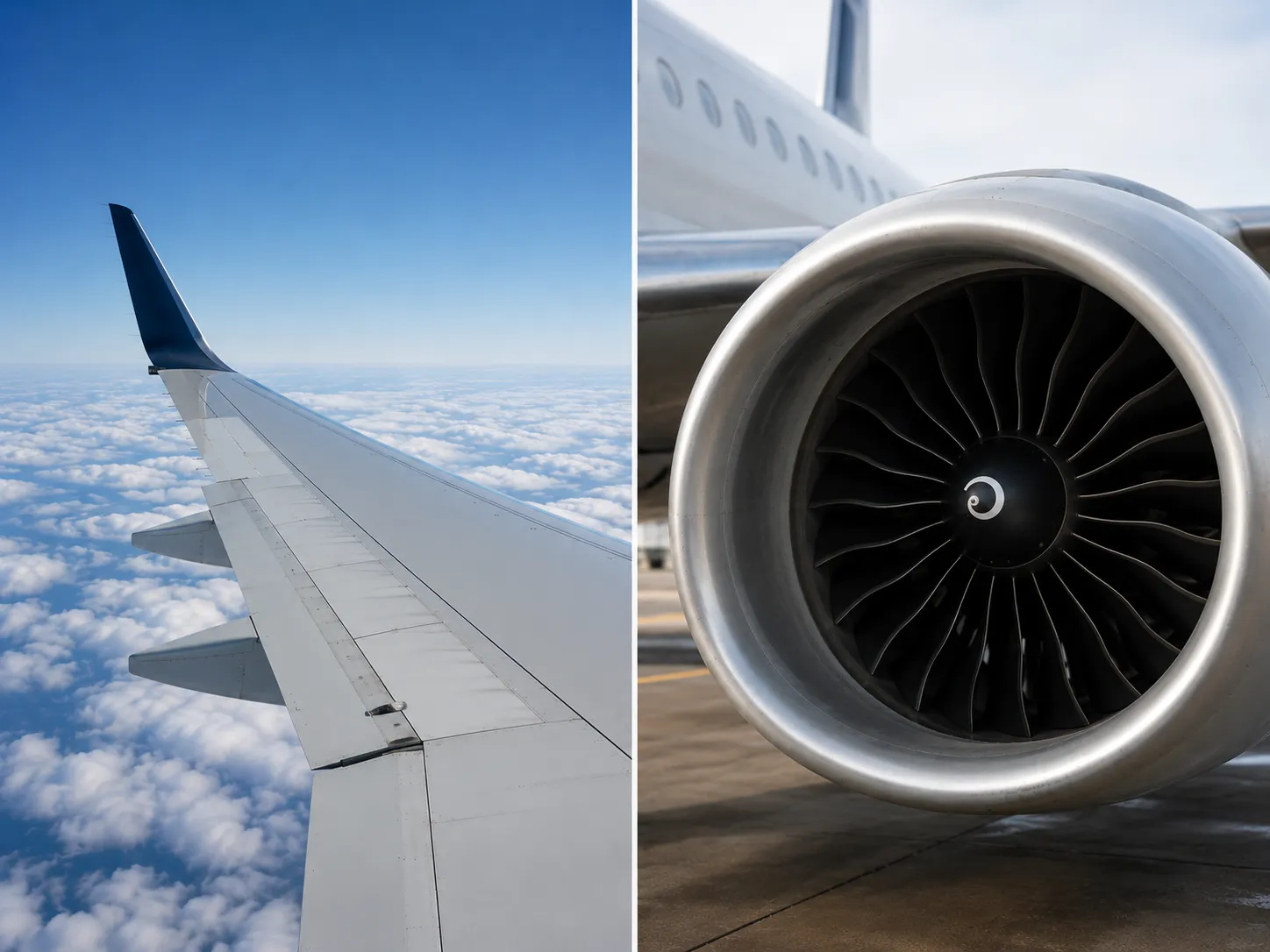
In aviation, the word stall can appear in different contexts. That often creates confusion because a wing stall and an engine compressor stall sound similar, but they are completely different phenomena.
A wing stall happens in the external aerodynamics of the aircraft. It involves airflow over the wing and the production of lift. A compressor stall happens inside a jet engine, specifically in the compressor, when airflow through the compressor stages becomes unstable.
So, despite the similar name, one event is related to aircraft lift, while the other is related to internal engine airflow.
What is a wing stall?
A wing stall occurs when the wing exceeds its critical angle of attack. Angle of attack is the angle between the wing chord line and the relative wind. As angle of attack increases, the wing can produce more lift up to a certain point. Beyond that point, airflow begins to separate from the upper surface of the wing, and lift decreases rapidly.
The FAA explains that when an aircraft reaches the angle of attack at which the lift coefficient reaches its maximum value, any further increase in angle of attack causes lift to begin decreasing rapidly. That point is known as the critical angle of attack or stalling angle of attack.
This is why it is important to understand that a wing stall is not caused simply by the airplane “flying too slowly.” Low airspeed can contribute to a stall because it often requires a higher angle of attack to maintain lift, but the direct aerodynamic cause is exceeding the critical angle of attack.
Why does airflow separate from the wing?
In normal flight, airflow tends to follow the shape of the wing. This organized flow helps create the pressure distribution and aerodynamic force we call lift.
When the angle of attack becomes too high, the air can no longer follow the upper surface of the wing properly. The flow separates and creates a more turbulent region. As that separation grows, the wing becomes less aerodynamically efficient and lift drops.
That is the core of a wing stall. It is not an engine failure, not a broken wing, and not simply a lack of speed. It is an aerodynamic condition in which airflow over the wing no longer remains properly attached.
A wing stall is directly related to angle of attack. Airspeed can influence the situation, but the determining factor is the wing exceeding its critical angle of attack.
How are pilots warned?
Modern aircraft include systems and features designed to alert the flight crew before a stall fully develops. Depending on the aircraft, these may include low-speed warnings, high angle-of-attack indications, flight deck alerts, and systems such as the stick shaker, which vibrates the control column to get the pilots’ attention.
The FAA describes stall warning as something that can occur when additional angle of attack, increased load factor, or reduced power brings the aircraft closer to stall conditions.
The purpose of these warnings is to help pilots recognize the condition early. Stall recovery training also emphasizes reducing angle of attack as a key part of recovery.
What is compressor stall?
A compressor stall is a different phenomenon. It does not happen on the wing. It happens inside the engine, particularly in the compressor stages.
In a turbofan engine, air enters through the inlet, passes through the fan, and is then compressed by compressor stages before reaching the combustion chamber. For the engine to operate properly, airflow through the compressor must remain relatively stable and organized.
A compressor stall occurs when airflow in one or more regions of the compressor becomes unstable. The FAA defines engine stall as a flow breakdown at one or more compressor airfoils, which can produce a wide range of pressure disturbances, from mild fluctuations to more significant reductions in engine pressure and flow.
In simple terms: in a wing stall, airflow separates from the wing; in a compressor stall, airflow becomes unstable inside the engine compressor.
Amazon Recommended Products
AVIATION PICKS




Are compressor stall and compressor surge the same thing?
They are related, but they are not exactly the same.
A compressor stall can be localized, affecting the airflow in certain stages or regions of the compressor. A compressor surge is a more severe system-level instability, often involving larger pressure oscillations and, in some cases, significant flow reversal.
NASA technical reports discuss stall and surge in axial compressors as phenomena related to compressor stability and the behavior of airflow through compressor stages.
In practical terms, compressor stall can be understood as a loss of airflow stability in the compressor, while compressor surge is a more severe instability of the compression system.
What can cause compressor stall?
A compressor stall can be associated with different conditions, including inlet airflow distortion, foreign object ingestion, bird ingestion, ice, blade damage, operation outside certain intended conditions, or engine-specific issues.
Each event must be evaluated individually. Not every bird ingestion causes a compressor stall. Not every engine noise means compressor stall. And not every compressor stall means a complete engine failure.
The key technical point is that a compressor is designed to operate within a stable range of pressure, rotational speed, and airflow. When operating conditions move beyond the compressor’s stability margin, airflow can break down.
What may be noticed during compressor stall?
Depending on severity, a compressor stall may be subtle or very noticeable. It can involve loud bangs, vibration, a temporary loss of thrust, increased exhaust gas temperature, or visible flames from the inlet or exhaust.
However, that should not automatically be interpreted as an explosion or engine destruction. In many cases, the engine structure remains intact, and the crew follows procedures defined by the manufacturer and the airline.
Visible flames during a compressor stall should not automatically be confused with a major engine fire. In some events, flames can be associated with transient airflow and combustion instability, not necessarily catastrophic failure.
The main difference between the two events
The fundamental difference is location and effect.
A wing stall happens at the wing and affects lift. It is related to angle of attack, airflow separation over the airfoil, and reduced aerodynamic efficiency.
A compressor stall happens inside the engine and affects airflow through the compressor. It is related to airflow stability inside the compressor stages.
One is an external aerodynamic condition affecting the aircraft’s lift. The other is an internal engine airflow condition affecting compressor operation.
Is there a direct relationship between them?
In general, no. A wing stall is not the same thing as a compressor stall, and a compressor stall does not mean the wing has stalled.
The confusion exists because both the wing and compressor blades use aerodynamic profiles. Compressor blades also act like small airfoils, helping guide and compress air through multiple stages. When airflow over those blades becomes unsuitable, flow separation can occur, just as it can occur over an external airfoil.
The similarity is the aerodynamic idea of separated or disrupted flow over an airfoil. The difference is the affected system: the wing in the case of aircraft stall, and the compressor in the case of engine compressor stall.
How does the flight crew respond?
The response depends on the aircraft type, engine type, phase of flight, and manufacturer procedures. In a wing stall, the priority is to recover aerodynamic control, typically by reducing angle of attack and following trained recovery procedures.
In a compressor stall, the flight crew follows engine-specific procedures for the condition presented. Those procedures may involve monitoring engine parameters and taking actions defined in the aircraft’s operating manuals.
In both cases, crews are trained to recognize the signs, interpret the indications, and respond according to standardized procedures.
A wing stall and an engine compressor stall are different phenomena, even though they share the same word.
A wing stall is related to loss of lift caused by airflow separation over the wing after the critical angle of attack is exceeded. A compressor stall occurs inside the engine, when airflow through the compressor becomes unstable.
Understanding this difference helps avoid misleading interpretations. One event involves the aircraft’s ability to generate lift. The other involves the engine’s internal airflow stability.
Both are known technical phenomena considered in aircraft design, warning systems, operating procedures, and flight crew training.
References
Federal Aviation Administration — Pilot’s Handbook of Aeronautical Knowledge, Chapter 5: Aerodynamics of Flight. FAA reference on angle of attack, lift, maximum lift coefficient, and critical angle of attack.
Federal Aviation Administration — Airplane Flying Handbook, Chapter 5. FAA reference on slow flight, stall warning, and the relationship between angle of attack, load factor, power, and stall conditions.
Federal Aviation Administration — Advisory Circular AC 33.65-1. FAA reference on engine surge and stall, including the definition of engine stall as flow breakdown at one or more compressor airfoils.
NASA Technical Reports Server — Compressor Surge. NASA/Glenn Research Center technical material on stall and surge in axial compressors.
NASA Technical Reports Server — Pre-Stall Behavior of a Transonic Axial Compressor Stage. Technical study on pre-stall behavior in a transonic axial compressor stage.