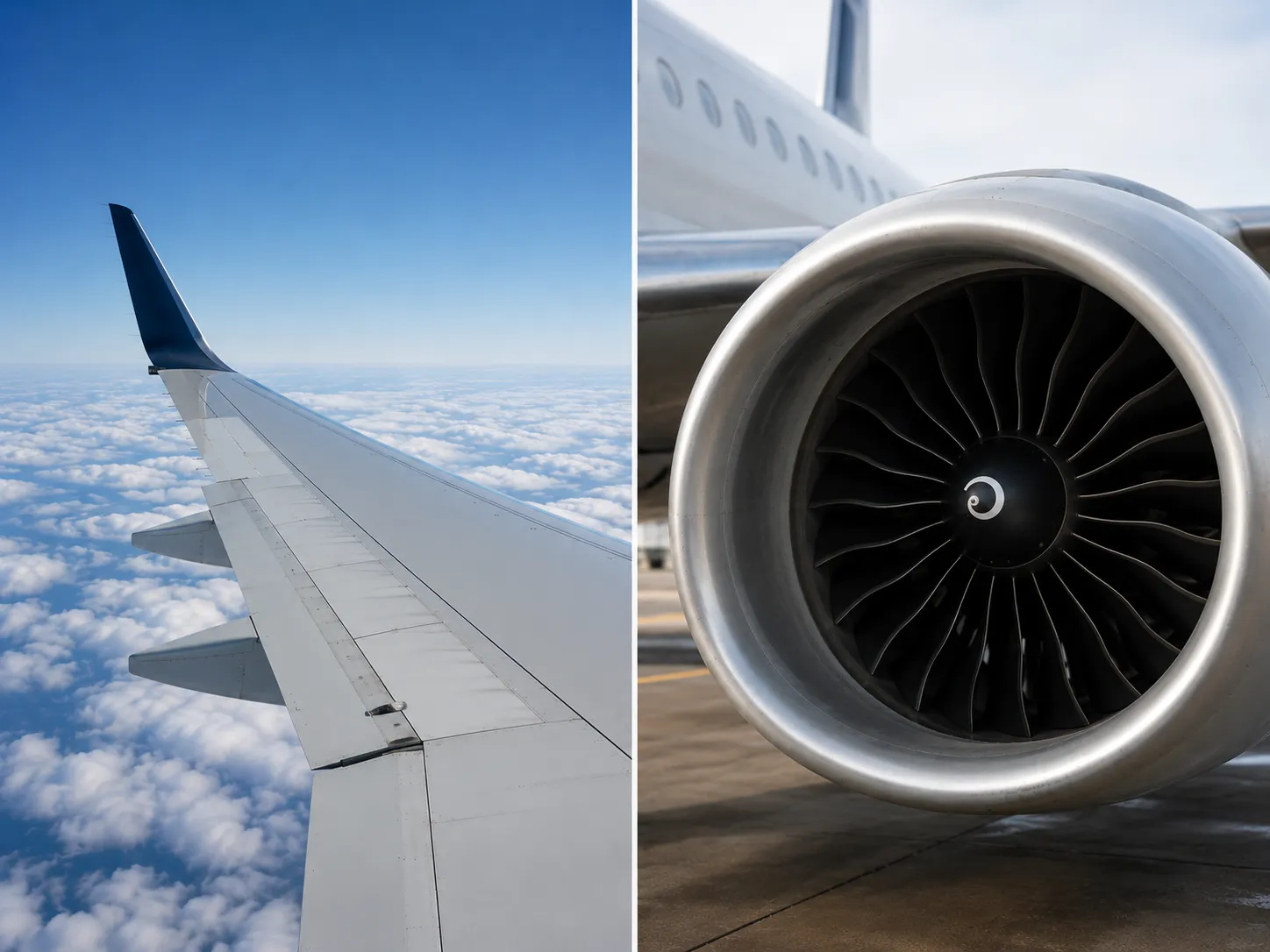
Thermodynamics is one of the most important foundations for understanding aircraft engines, air conditioning systems, pressurization, combustion, lubrication, compressed gases, and the thermal behavior of materials used in aircraft.
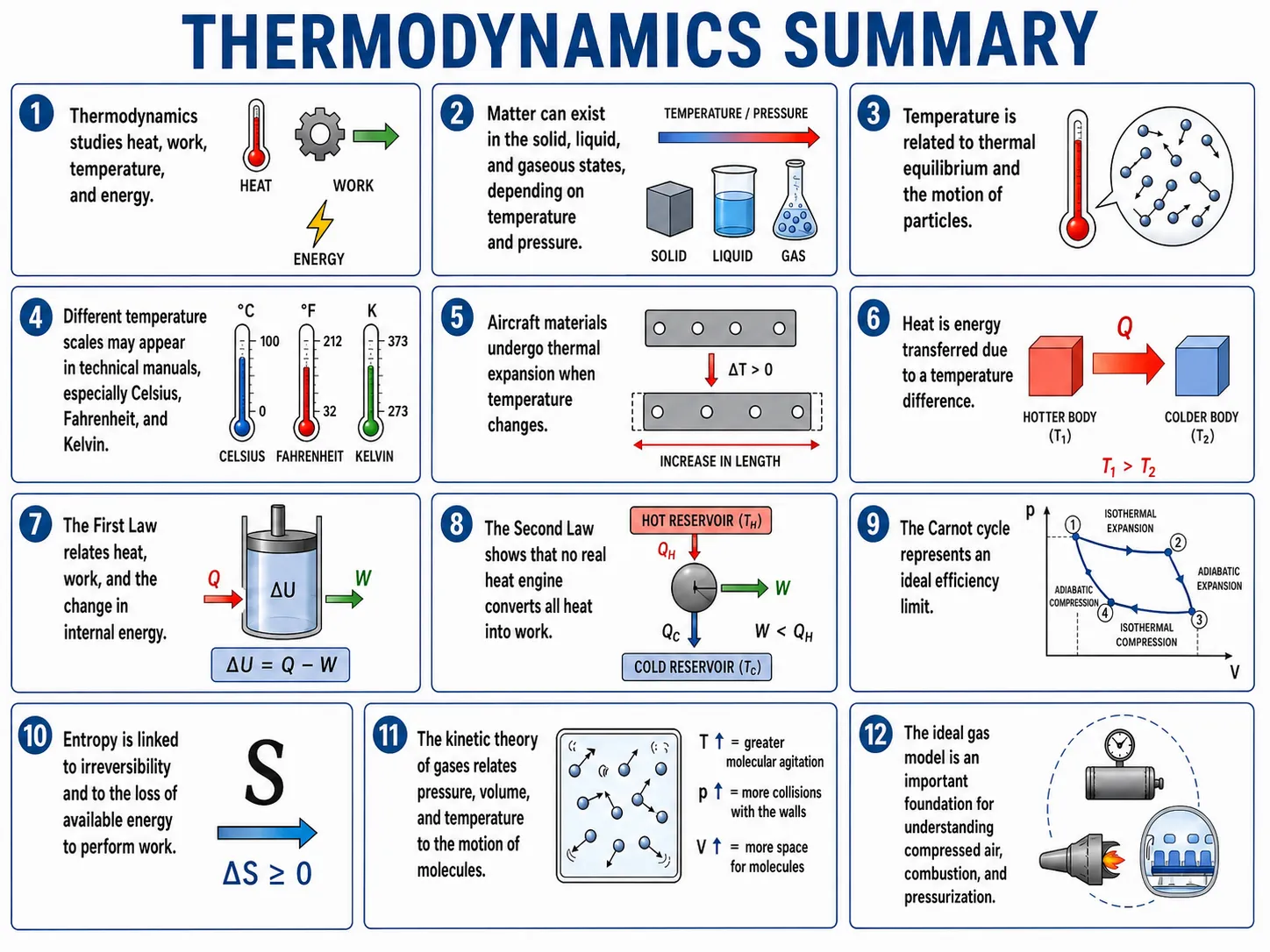
Thermodynamics is the branch of physics that studies the relationships between heat, work, temperature, and energy. It helps explain how thermal energy is transformed, how matter changes physical state, and why no real system can convert all the energy it receives into useful work.
In aviation, this subject is essential. Aircraft engines, air conditioning systems, cabin pressurization, lubrication, combustion, bleed air, temperature control, and even mechanical clearances are directly affected by thermodynamic phenomena.
For an aircraft mechanic, understanding thermodynamics is not just about memorizing formulas. It means understanding why temperature affects measurements, why materials expand, why engines heat up, why compressed gases behave differently under changing conditions, and why energy losses always exist in real systems.
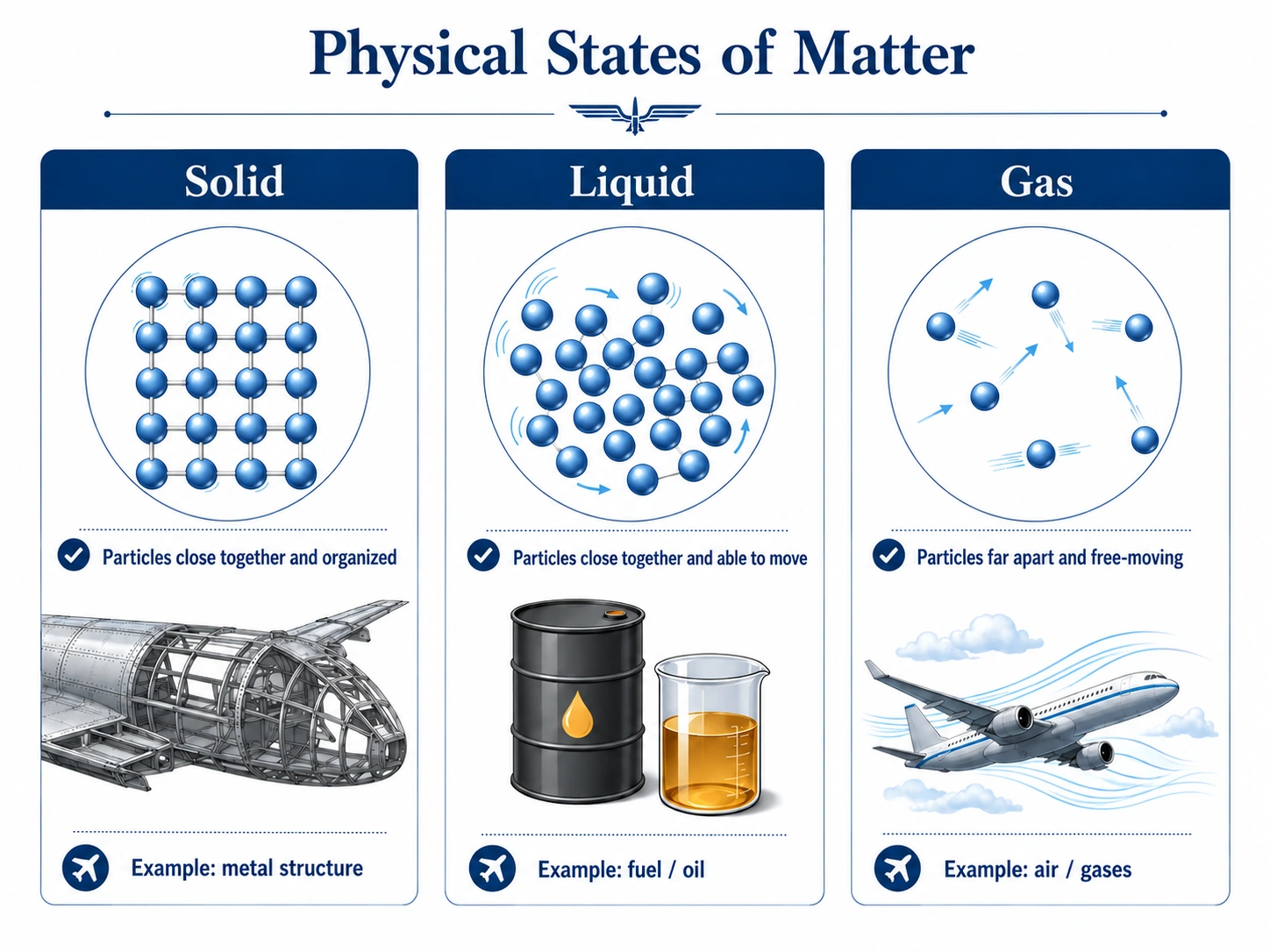
Matter is made of particles, such as atoms and molecules. The way these particles are arranged and how they move determines the physical state of matter. At a basic level, the three most important states are solid, liquid, and gas.
In a solid, particles remain close together and organized. They vibrate around relatively fixed positions, which gives a solid a definite shape and volume. A metallic component in an aircraft structure is a good example.
In a liquid, the particles are still close together, but they have more freedom to move. As a result, a liquid has a definite volume, but it takes the shape of its container. Hydraulic fluid, fuel, and engine oil are important aviation examples.
In a gas, the particles are much farther apart and move freely. A gas has no fixed shape or fixed volume; it expands to fill the available space. The air entering an engine, cabin pressurization air, and combustion gases are examples directly related to aircraft operation.
Temperature is a physical quantity associated with the thermal condition of a body or system. In simple terms, it tells us how hot or cold something is. However, human perception is subjective, so temperature must be measured in an objective way.
When two systems at different temperatures come into contact through a boundary that allows heat transfer, thermal energy moves from the hotter system to the colder one. This continues until both systems reach thermal equilibrium.
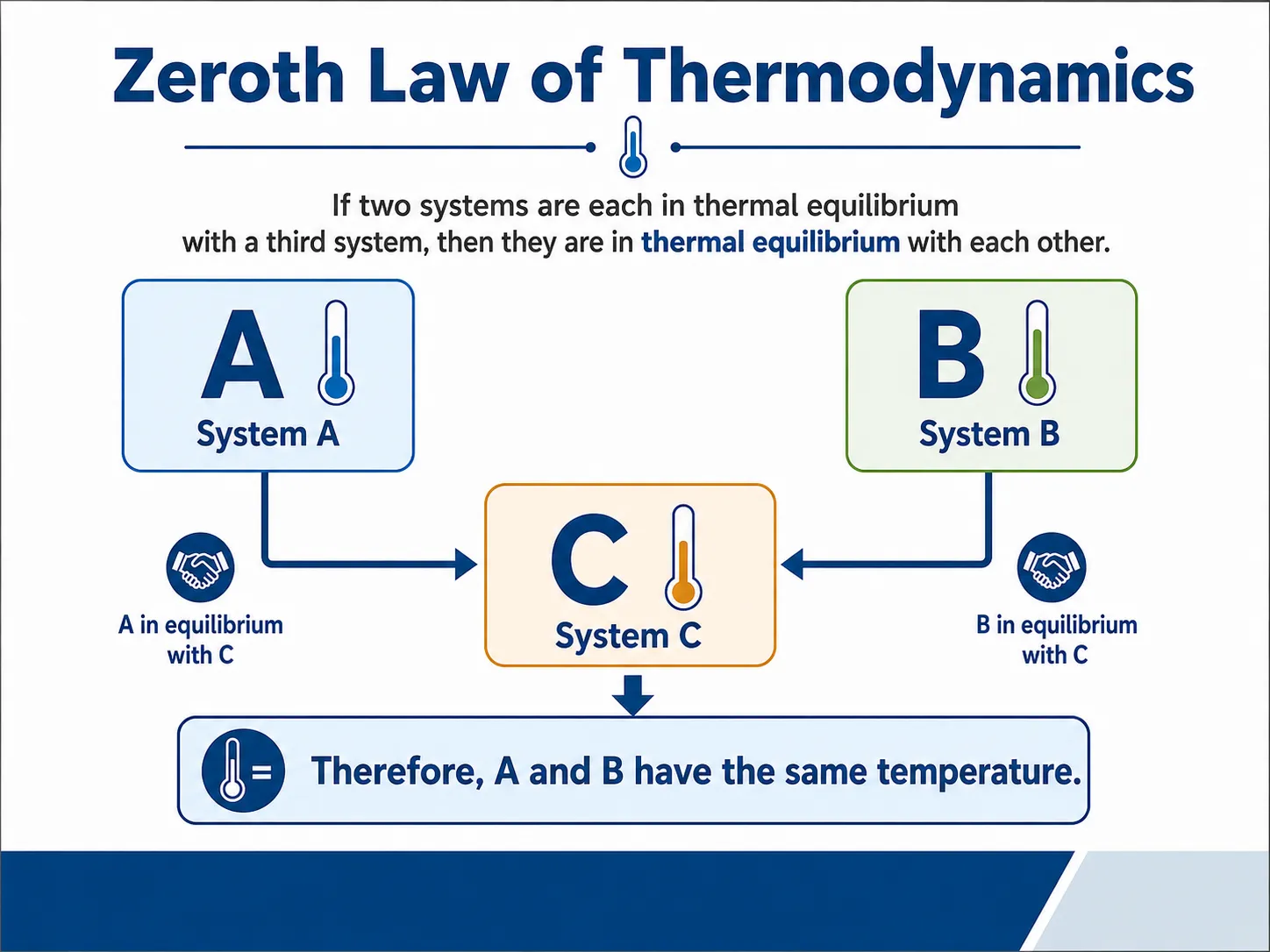
This idea is connected to the Zeroth Law of Thermodynamics. The law allows temperature to be defined more rigorously: if two systems are each in thermal equilibrium with a third system, then they are also in thermal equilibrium with each other.
Temperature measurements, inspections of heated components, and procedures performed within specific temperature ranges all depend on this concept. A component removed from operation may remain hot for some time before it exchanges heat with the surrounding air and reaches a new thermal condition.
Temperature scales were created to measure temperature in a consistent way. The most common ones are Celsius, Fahrenheit, and Kelvin. Each scale has its own reference points and may appear in different technical contexts.
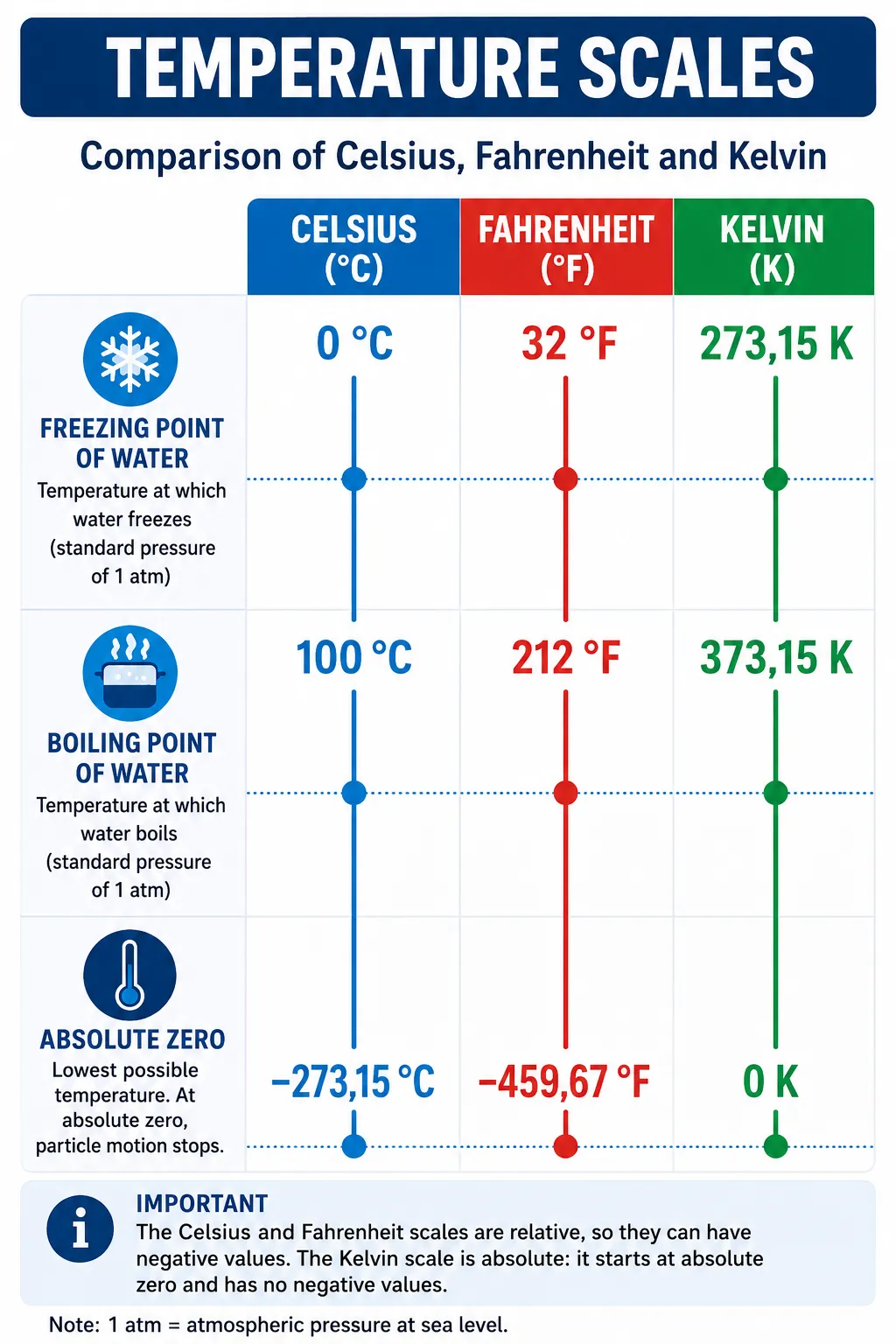
The Celsius scale is widely used in many countries and in general scientific applications. It uses the freezing point of water, near 0 °C, and the boiling point of water, near 100 °C, as reference points under standardized conditions.
The Fahrenheit scale is commonly used in the United States. Since many aircraft manuals, maintenance documents, and technical references are written for or by U.S.-based manufacturers and operators, aircraft mechanics may often encounter temperatures expressed in °F.
The Kelvin scale is known as an absolute temperature scale. It begins at absolute zero, a theoretical condition in which particle motion reaches its lowest possible level. In thermodynamics, Kelvin is especially important because many equations require absolute temperature.
This is the common relationship used to convert Celsius to Kelvin.
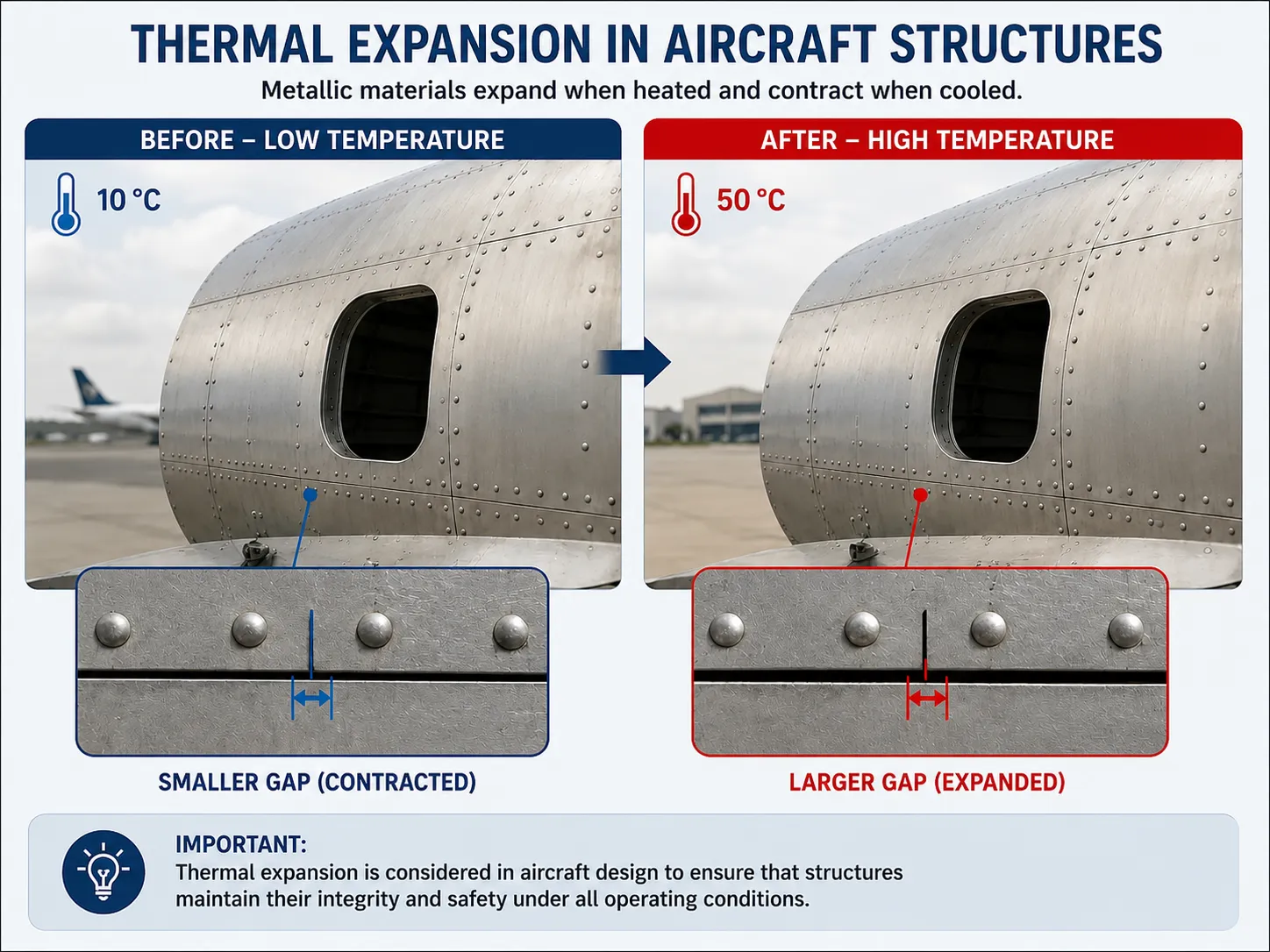
When the temperature of a material changes, its dimensions may also change. This phenomenon is called thermal expansion. In solids, expansion can occur in length, area, or volume. In fluids, the most important change is usually the change in volume.
In aircraft, this concept is very important because the structure and systems are exposed to wide temperature variations. An aircraft may be heated on the ground under direct sunlight and later operate at altitude, where the outside air temperature is much lower.
Metals, skins, fasteners, tubing, windows, sensors, fittings, and engine components can expand or contract. For that reason, maintenance procedures, measurements, and adjustments often have to follow temperature limits specified in approved technical documentation.
This simplified linear expansion equation shows that the change in length depends on the material, the original length, and the temperature change.
Heat is energy transferred between systems because of a temperature difference. This definition is important: heat is not simply something a body “contains.” It is energy in transit, moving from a hotter region to a colder one.
In the International System of Units, heat is measured in joules, the same unit used for energy. In some technical contexts, calories and Btu may also appear.
When a material receives heat, its temperature may increase. However, if the material is undergoing a phase change, such as melting or vaporization, the energy may be used to change its physical state without increasing its temperature during that transition.
Sensible heat is heat that causes a temperature change. Latent heat is heat involved in a phase change, such as ice melting or a liquid vaporizing, without a temperature change during that process.
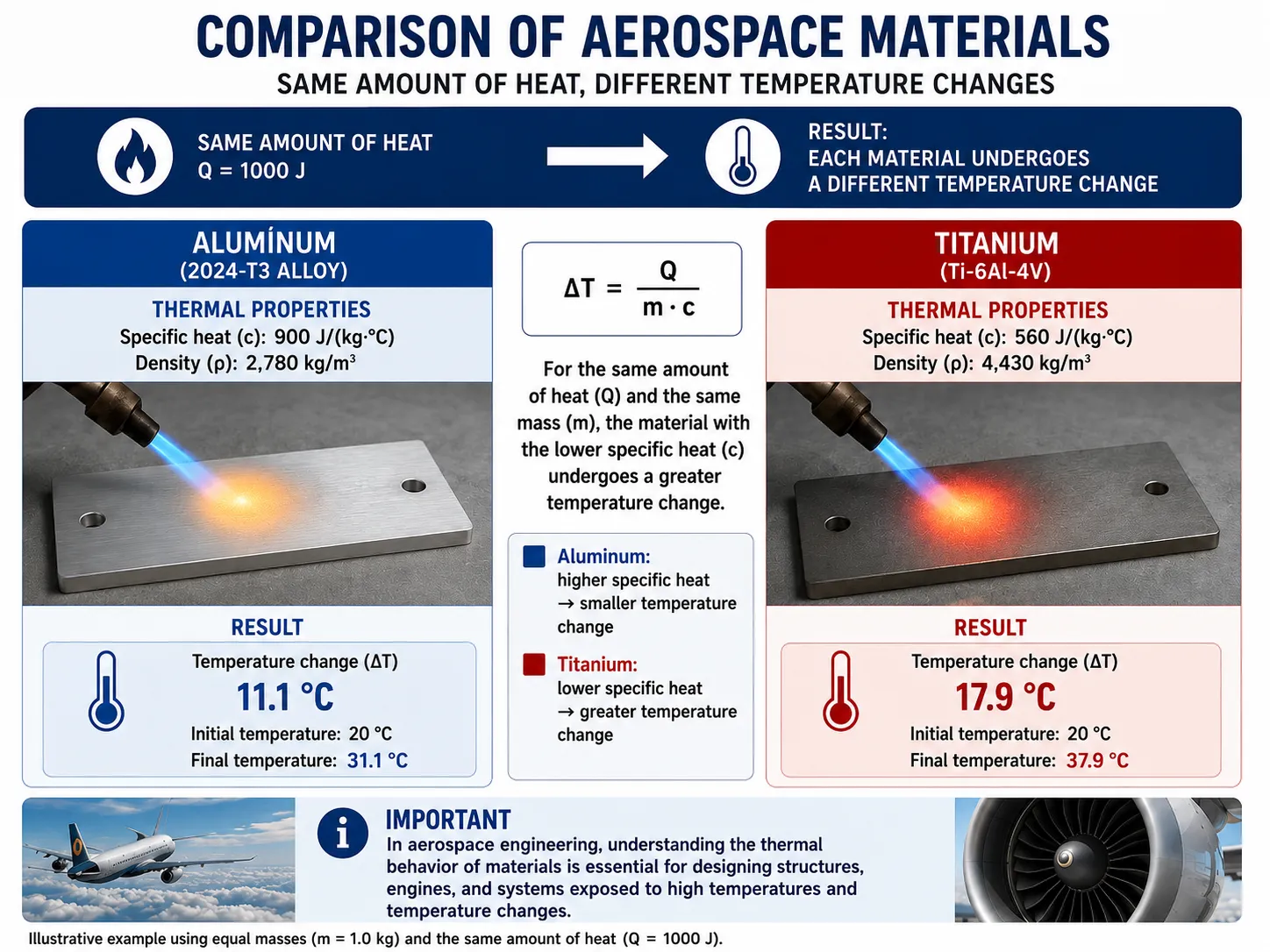
Different materials respond differently when they receive heat. Some heat up quickly, while others require more energy to achieve the same temperature increase. This difference is explained by heat capacity and specific heat.
Heat capacity indicates how much energy a body must receive to change its temperature. Specific heat, on the other hand, is a material property and represents the amount of energy required to raise the temperature of one unit of mass of that material.
In aviation, this helps explain why different materials heat up and cool down at different rates. Metals, fluids, rubber components, composite materials, and gases do not respond to heat in the same way.
The heat required depends on mass, the material’s specific heat, and the temperature change.
The First Law of Thermodynamics applies the conservation of energy to thermal systems. It shows that a system’s internal energy can change because of heat exchanged with the surroundings and work done on or by the system.
A simple example is a gas inside a cylinder with a movable piston. If the gas receives heat, its internal energy may increase. If an external force compresses the piston, work is done on the gas, which can also increase its internal energy.
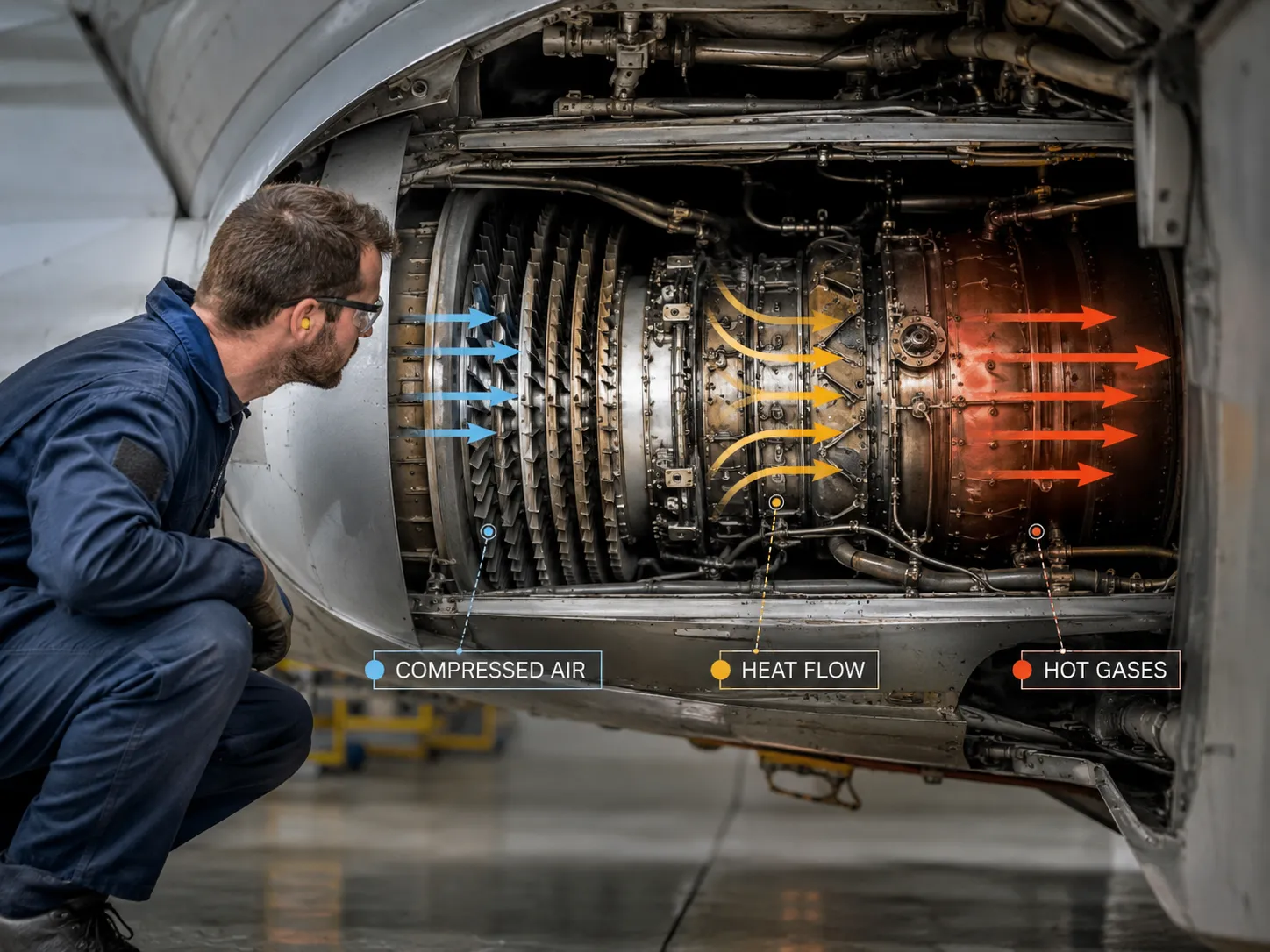
In real systems, heat and work are often closely connected. An aircraft engine converts the chemical energy in fuel into thermal energy and then into useful work and kinetic energy in the gas flow. However, part of that energy is always lost as heat rejected to the surroundings.
The change in internal energy depends on the heat added and the work done on the system, according to the sign convention used in the material being studied.
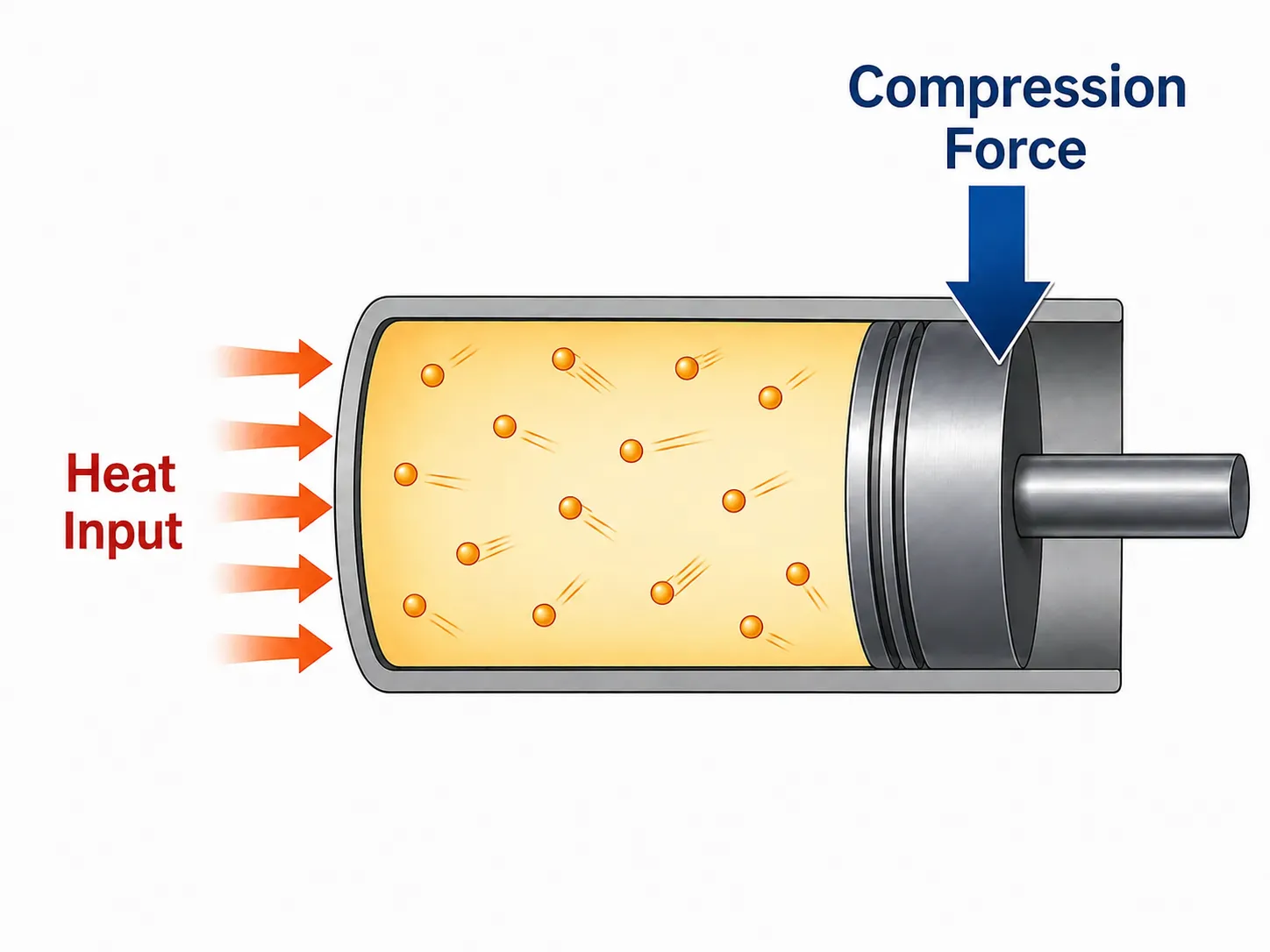
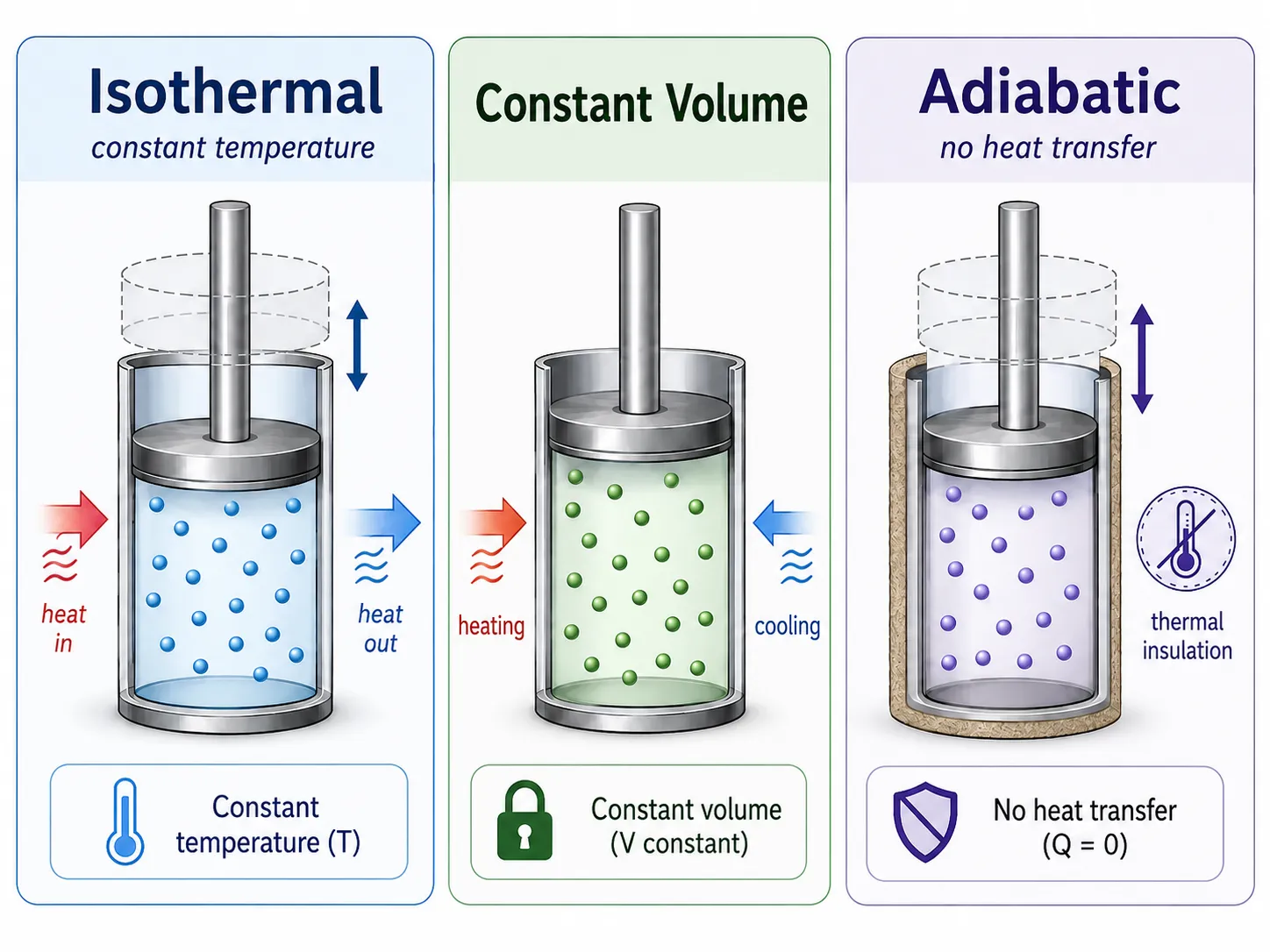
A thermodynamic process describes how a system changes from an initial state to a final state. Depending on the conditions, some properties may remain constant during the process.
In an isothermal process, temperature remains constant. For an ideal gas, this means internal energy does not change, and the energy involved appears through the relationship between heat and work.
In a constant-volume process, the system does not perform work through a change in volume. As a result, the heat added tends to appear as an increase in internal energy.
In an adiabatic process, there is no heat transfer with the surroundings. Even so, temperature and internal energy may change if work is done on or by the system.
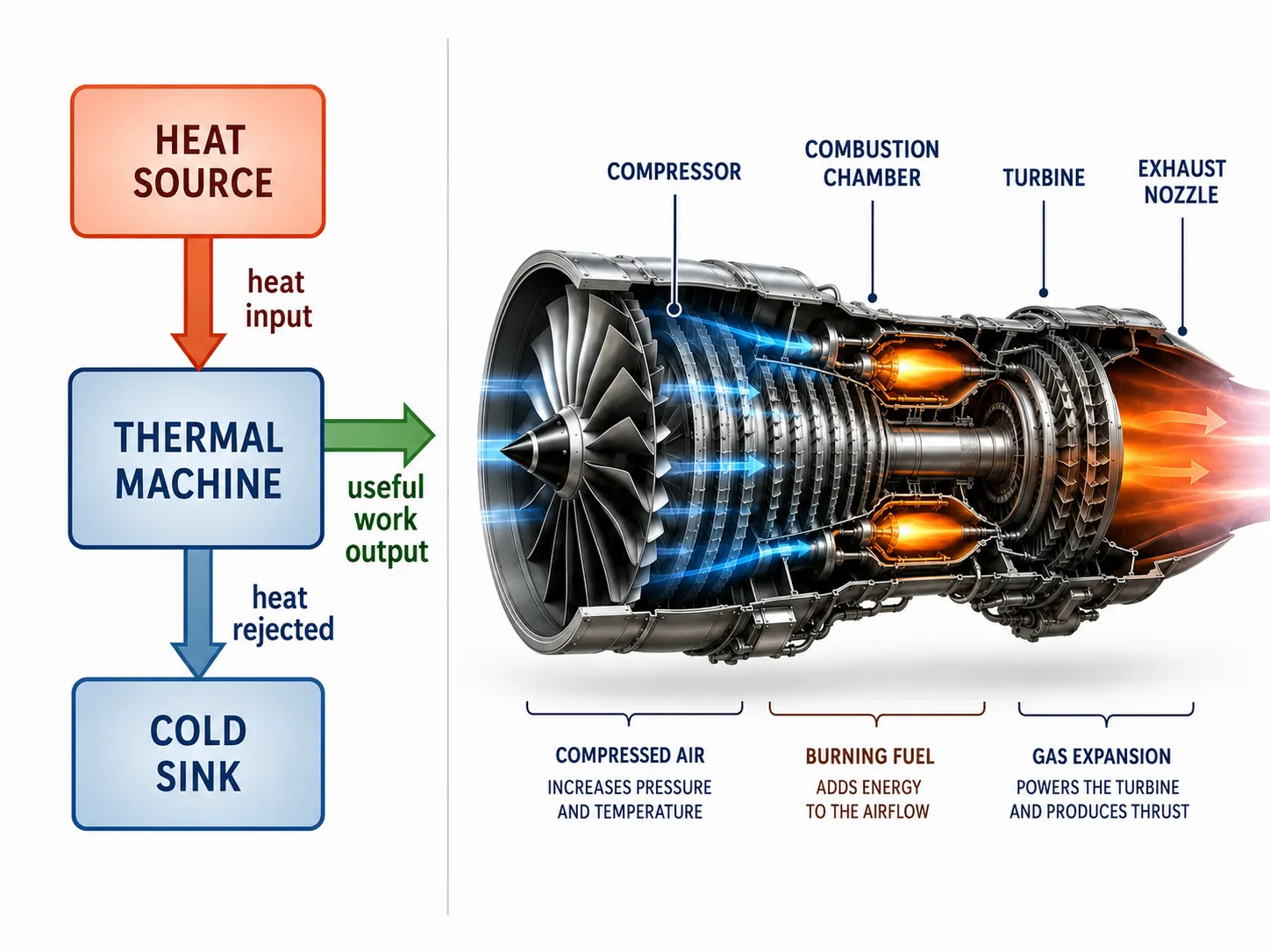
A heat engine is a system that converts part of the heat it receives into work. It operates between a hot reservoir, which supplies thermal energy, and a cold reservoir, which receives part of the rejected energy.
This concept is essential for understanding engines. In an aircraft engine, fuel releases energy during combustion. Part of that energy helps produce useful work or thrust, while another part is rejected as heat, exhaust gases, and internal losses.
No real heat engine can convert 100% of the heat it receives into work. Losses always occur. This fact is directly related to the Second Law of Thermodynamics.
The Second Law of Thermodynamics shows that thermal processes have a natural direction. Heat flows spontaneously from hotter regions to colder regions, and a heat engine can never convert all the heat it receives into work.
This means that some portion of the energy will always remain unavailable as useful work. In engines, this limitation appears as thermal losses, friction, component heating, exhaust gases, and other forms of energy not converted into useful power.
The efficiency of a heat engine indicates how much of the received energy is actually converted into work. Higher efficiency means better energy use, but real efficiency is always below an ideal theoretical limit.
This is a simple conceptual way to understand how effectively a heat engine uses the energy it receives.
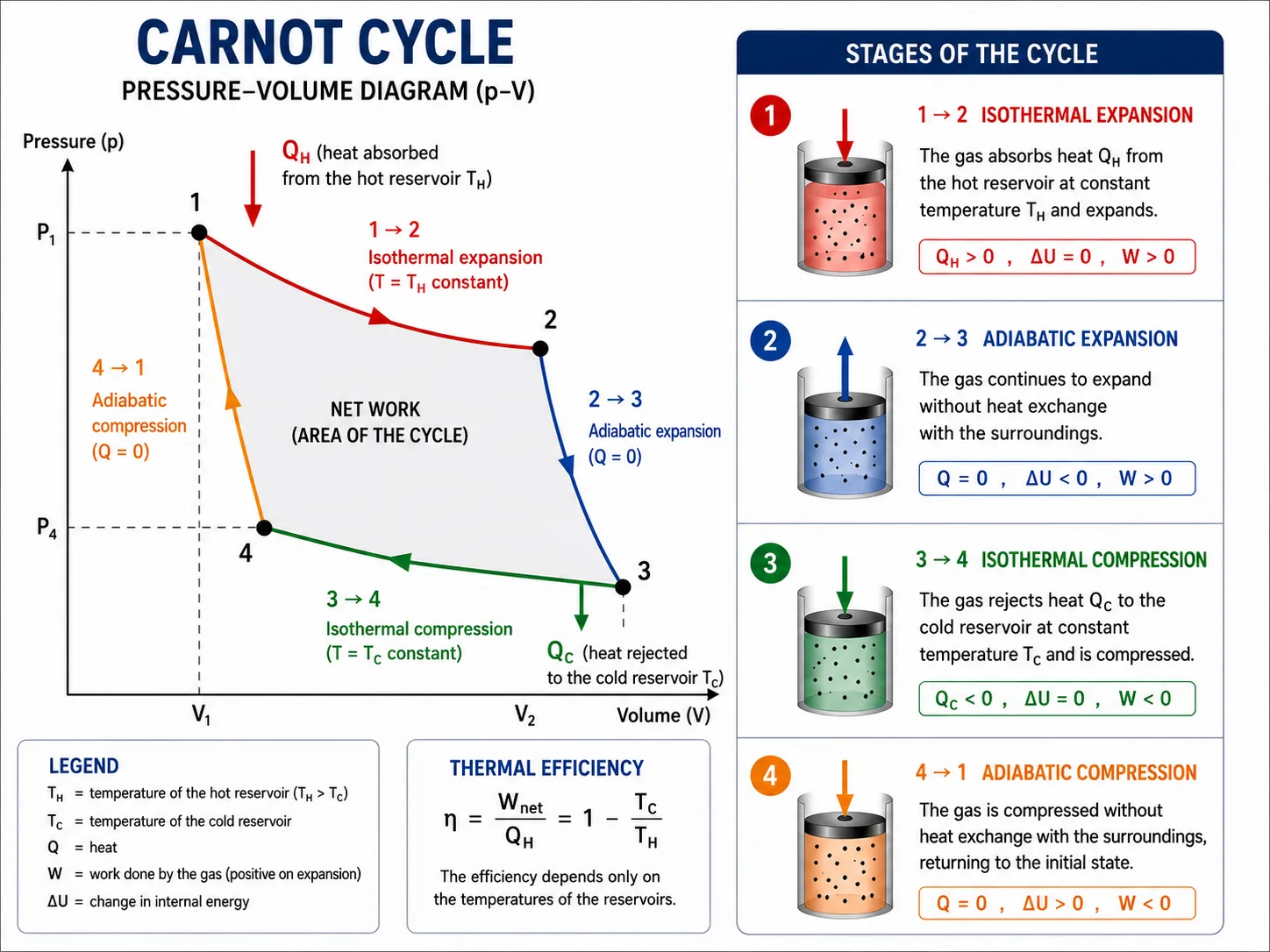
The Carnot Cycle is an ideal model of a reversible heat engine. It does not represent an actual machine exactly, but it serves as a theoretical reference for understanding the maximum possible efficiency between two temperatures.
The cycle consists of four reversible stages: two isothermal processes and two adiabatic processes. During one stage, the system receives heat from the hot reservoir; during another, it rejects heat to the cold reservoir; and over the full cycle, part of the energy is converted into work.
The importance of the Carnot Cycle is that no heat engine operating between two temperatures can have an efficiency greater than Carnot efficiency. For that reason, it is a theoretical limit, not a real-world performance promise.
Entropy is a quantity associated with the irreversibility of processes and with how energy becomes less available to do useful work. In simple terms, it helps explain why certain processes naturally occur in one direction but do not spontaneously return to their original state.
For example, when a hot body and a cold body come into contact, heat flows from the hot body to the cold body until both reach thermal equilibrium. After that, the total energy still exists, but the temperature difference that could have been used to produce work is gone.
In real systems, friction, mixing, heat losses, and dissipation cause total entropy to increase. This means that part of the energy becomes unavailable for producing useful work.
The Third Law is related to the behavior of systems near absolute zero. As absolute temperature approaches zero, thermal processes tend to cease, and entropy approaches an ideal minimum value.
The kinetic theory of gases explains gas behavior based on the motion of its molecules. Instead of looking only at pressure, volume, and temperature, it connects those macroscopic properties to the microscopic motion of particles.
In a gas, molecules are constantly moving and colliding with one another and with the walls of the container. These collisions are related to the pressure exerted by the gas. The greater the molecular agitation, the higher the temperature tends to be.
This idea is very important for understanding compressed gases, gas expansion, combustion, pressurization, air conditioning, and the behavior of air under different operating conditions.
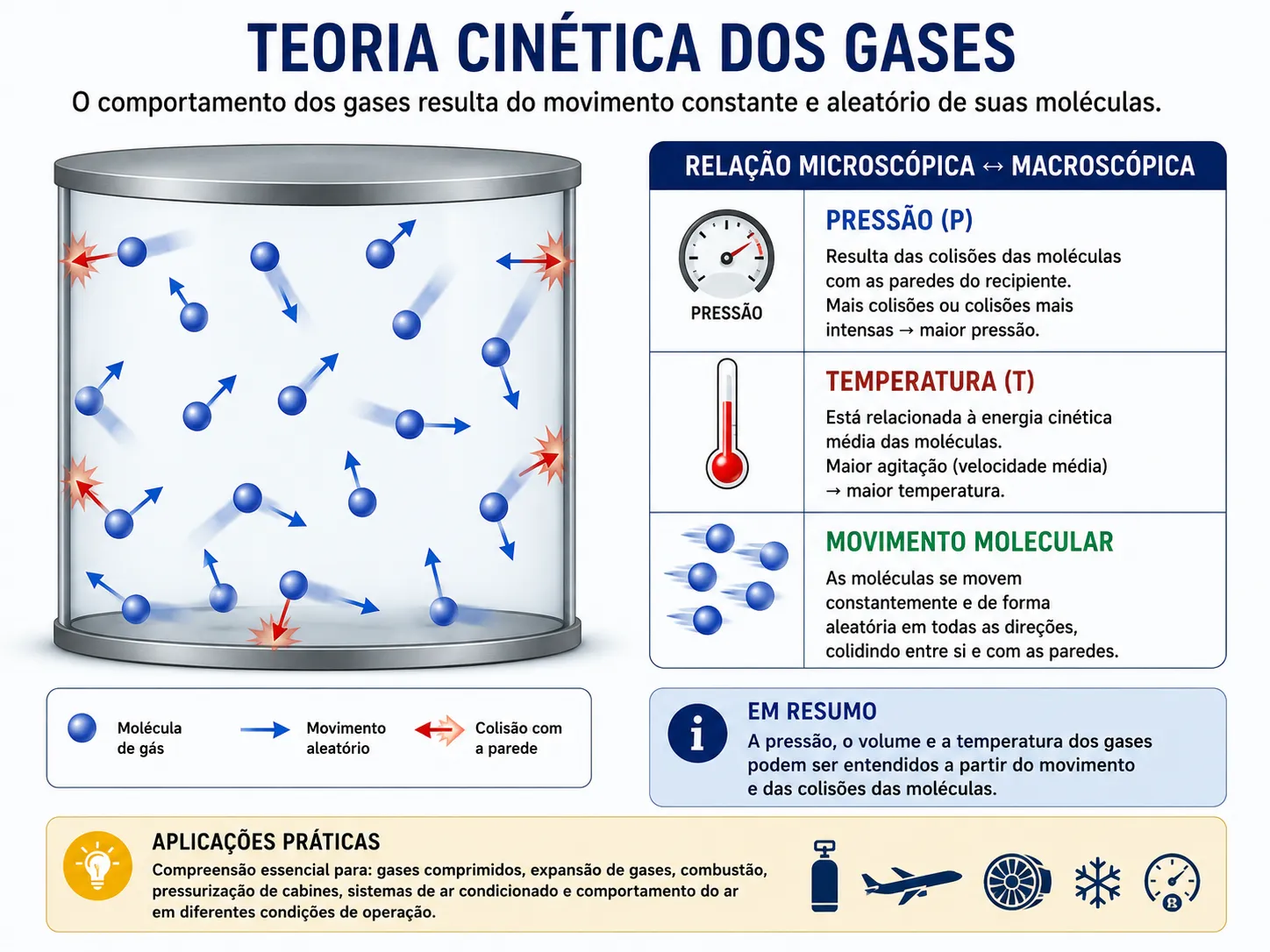
An ideal gas is a simplified model used to study real gases under approximate conditions. In this model, molecules are treated as very small particles that move randomly and collide ideally.
Although no real gas behaves perfectly as an ideal gas, the model is useful because it provides a simple way to relate pressure, volume, temperature, and amount of substance.
Ideal gas equation of state: pressure, volume, amount of substance, and absolute temperature are related.
In aviation, gas behavior appears in many areas: air intake, compression, combustion, exhaust gases, cabin pressurization, pneumatic systems, and altitude changes. For this reason, understanding the ideal gas model provides a foundation for more advanced topics.
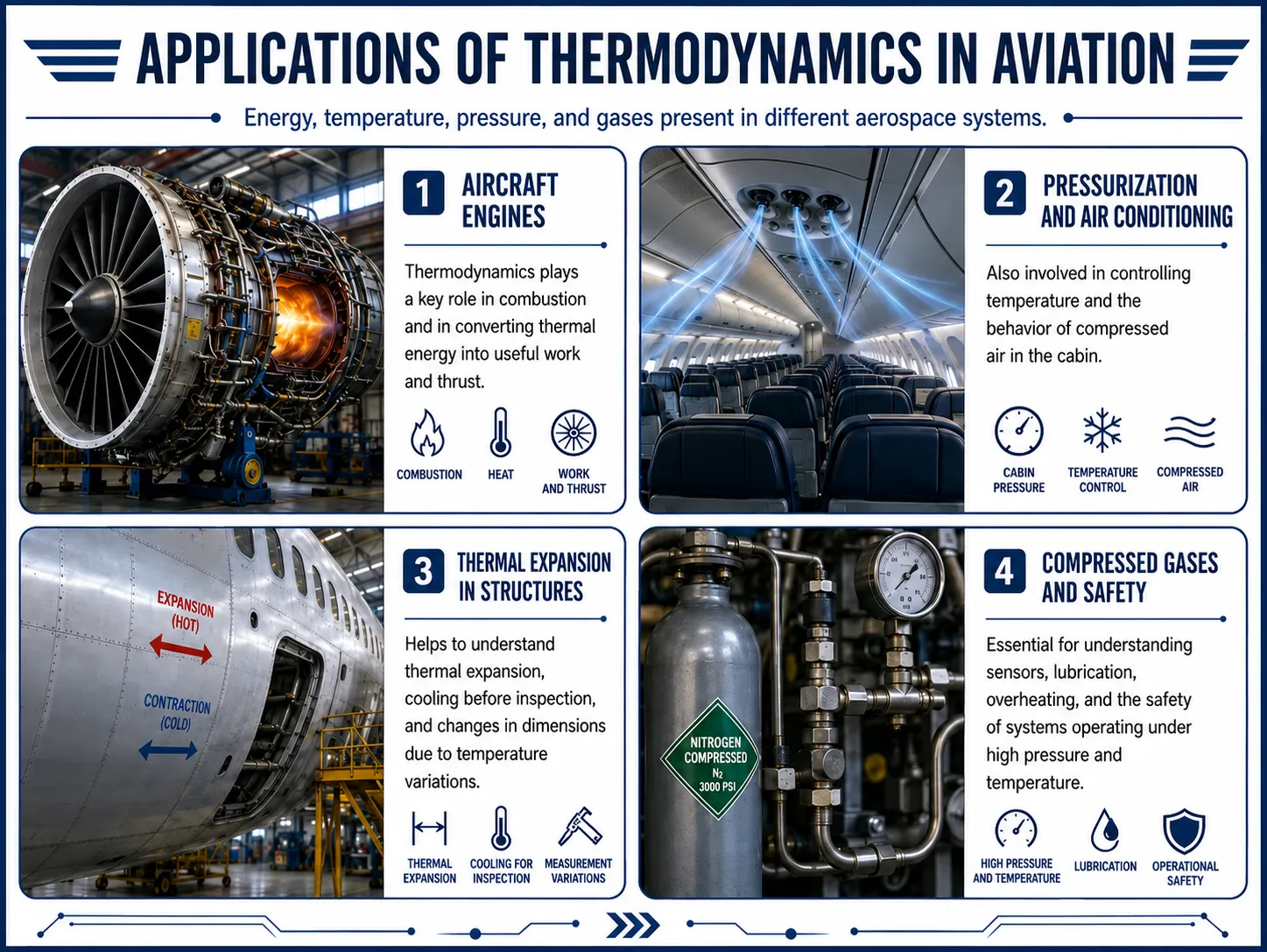
Thermodynamics is present in almost every system involving energy, temperature, pressure, gases, or fluids. In aircraft engines, it appears in combustion and in the conversion of thermal energy into work and thrust. In pressurization and air conditioning systems, it appears in temperature control and in the behavior of compressed air.
In maintenance, thermodynamics helps explain why certain procedures must be performed within temperature limits, why thermal clearances exist, why some components need to cool before inspection, and why measurements may vary depending on the thermal condition of the equipment.
It also helps explain the importance of proper lubrication, overheating control, engine performance, sensor operation, operating limits, and the safety of systems that work with compressed gases or high temperatures.
This content is educational and introductory. It was written to support understanding of physics fundamentals applied to aviation and aircraft maintenance. It does not replace official manuals, approved technical documentation, certified training, manufacturer procedures, or aviation authority regulations.