Bernoulli’s Principle is one of the most common explanations used when talking about lift on an aircraft wing. In many basic lessons, it is presented as the main reason airplanes can fly. In simple terms, Bernoulli’s Principle relates fluid speed and static pressure: under certain flow conditions, when fluid speed increases, static pressure tends to decrease.
In aviation, this idea helps explain part of what happens around a wing. But it should not be used by itself, and it should not be turned into an oversimplified explanation. The FAA’s Pilot’s Handbook of Aeronautical Knowledge describes lift generation as being based on important principles, including Newton’s laws of motion and Bernoulli’s principle of differential pressure.
What does Bernoulli help explain?
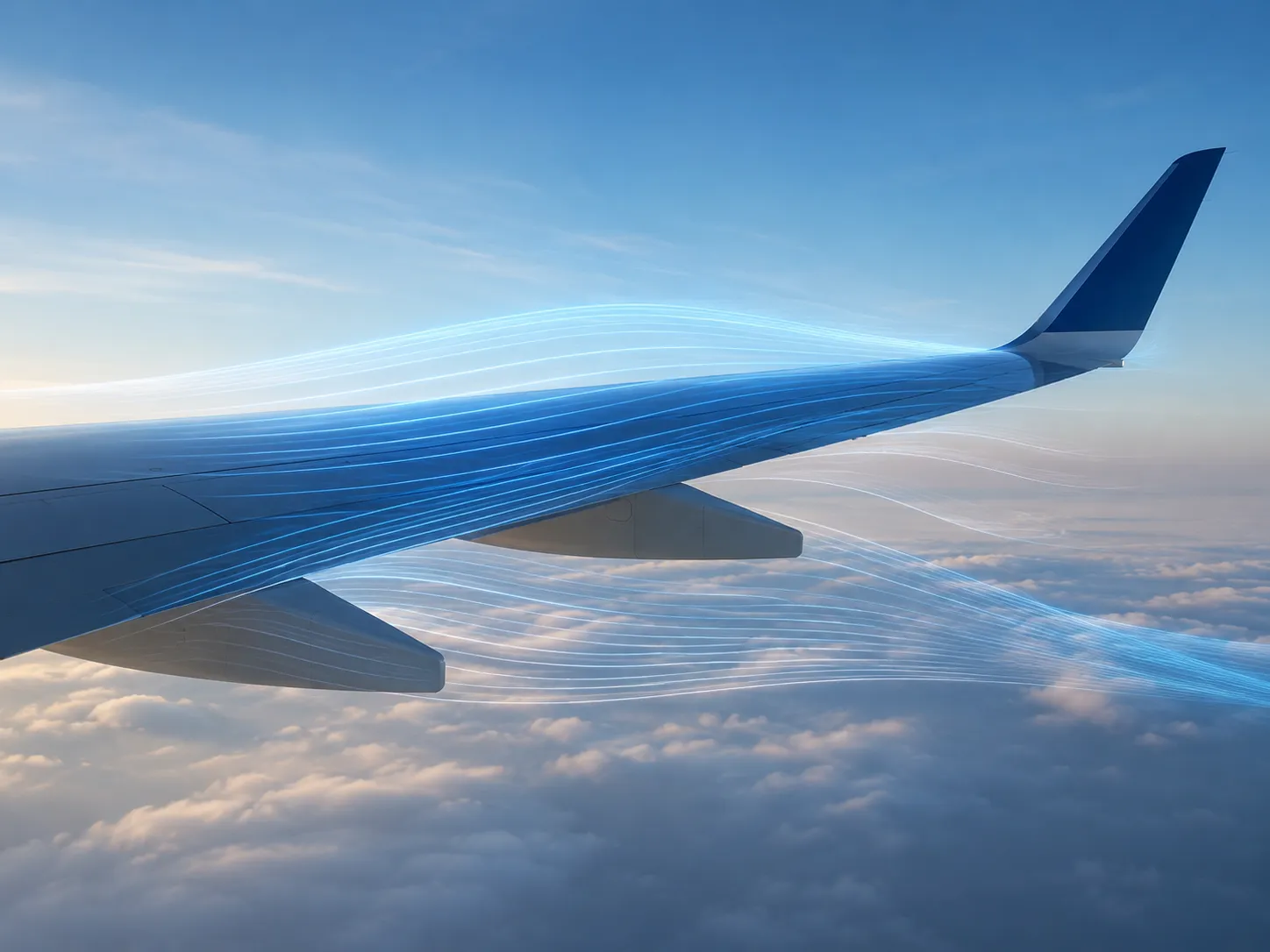
As a wing moves through the air, the airflow around it is not the same everywhere. In some regions, especially over the upper surface of the wing, the air may move faster. This acceleration of the airflow is associated with a decrease in static pressure in that region.
At the same time, pressure below the wing may be higher compared with the pressure above the wing. This pressure difference around the airfoil contributes to an upward aerodynamic force: lift.
So Bernoulli’s Principle is useful because it helps explain the relationship between airflow speed and pressure. It helps us understand why lower-pressure regions can develop around a wing and how those pressure differences contribute to lift.
A wing does not work by “magic”
Although Bernoulli is important, a wing does not generate lift simply because “the air over the top has a longer path to travel.” That explanation is common, but incomplete and often wrong.
One widely repeated mistake says that two air particles split at the leading edge, one moving over the top and the other moving under the wing, and that both particles “must” meet again at the trailing edge at the same time. This is known as the “equal transit time” theory. NASA Glenn Research Center explains that this is an incorrect lift theory: air particles traveling over the upper surface are not required to meet up with particles traveling under the wing at the same time.
The air over the top of the wing does not have to “meet back up” with the air moving below the wing. That explanation is an incorrect simplification of lift.
In reality, the air moving over the top of the wing can reach the trailing edge before the air moving below the wing. So the idea that lift happens because the air “has to meet back up at the trailing edge” is wrong.
Amazon Recommended Products
AVIATION PICKS




The wing also deflects air downward
Another essential point is that the wing changes the direction of the airflow. As the wing interacts with the air, it helps deflect some of that air downward. According to Newton’s third law, when the wing acts on the air by deflecting it downward, an aerodynamic reaction is associated with the lift force on the aircraft.
This does not eliminate Bernoulli. In fact, the pressure-based explanation and the momentum-change explanation are connected. They are different ways of looking at the same aerodynamic phenomenon. NASA notes that arguments about lift often happen because Bernoulli’s equation and Newton’s laws are applied incorrectly or oversimplified.
The role of angle of attack
Angle of attack is another key factor. It is the angle between the wing’s chord line and the relative wind. When the angle of attack changes, the airflow pattern around the wing also changes.
In general, increasing angle of attack increases lift up to a certain limit. But if the angle becomes too large, airflow can separate significantly from the upper surface of the wing, reducing lift and causing an aerodynamic stall. The FAA presents angle of attack as an essential concept for understanding lift, control, and stall behavior.
This shows that lift does not depend only on wing shape. It also depends on the aircraft’s attitude relative to the airflow, airspeed, air density, wing area, and other aerodynamic factors.
So, does Bernoulli explain flight?
The correct answer is: yes, but not by itself.
Bernoulli helps explain pressure differences around the wing. Those pressure differences are an important part of lift. But flight also involves downward airflow deflection, Newton’s laws, angle of attack, airfoil shape, airflow speed, and the full pressure distribution over the wing.
The mistake is turning Bernoulli into the only explanation. An airplane does not fly simply because the air over the top “moves faster to meet back up at the trailing edge.” That idea is incorrect. An airplane flies because a wing moving through the air, under the right conditions, produces a pressure distribution and changes the airflow in a way that results in lift.
Bernoulli’s Principle is an important part of explaining flight, but it should not be treated as the complete explanation. It helps explain how differences in airflow speed are related to pressure differences around a wing.
But lift is also connected to downward airflow deflection, aerodynamic reaction, angle of attack, and the overall behavior of the airflow around the airfoil. The most accurate way to understand flight is to combine Bernoulli, Newton, and real aerodynamic flow around the wing.
In short: Bernoulli helps explain flight, but flight does not depend on Bernoulli alone.
References
Federal Aviation Administration — Pilot’s Handbook of Aeronautical Knowledge, Chapter 4: Principles of Flight.
Federal Aviation Administration — Pilot’s Handbook of Aeronautical Knowledge, Chapter 5: Aerodynamics of Flight.
NASA Glenn Research Center — Bernoulli and Newton.
NASA Glenn Research Center — Incorrect Lift Theory.