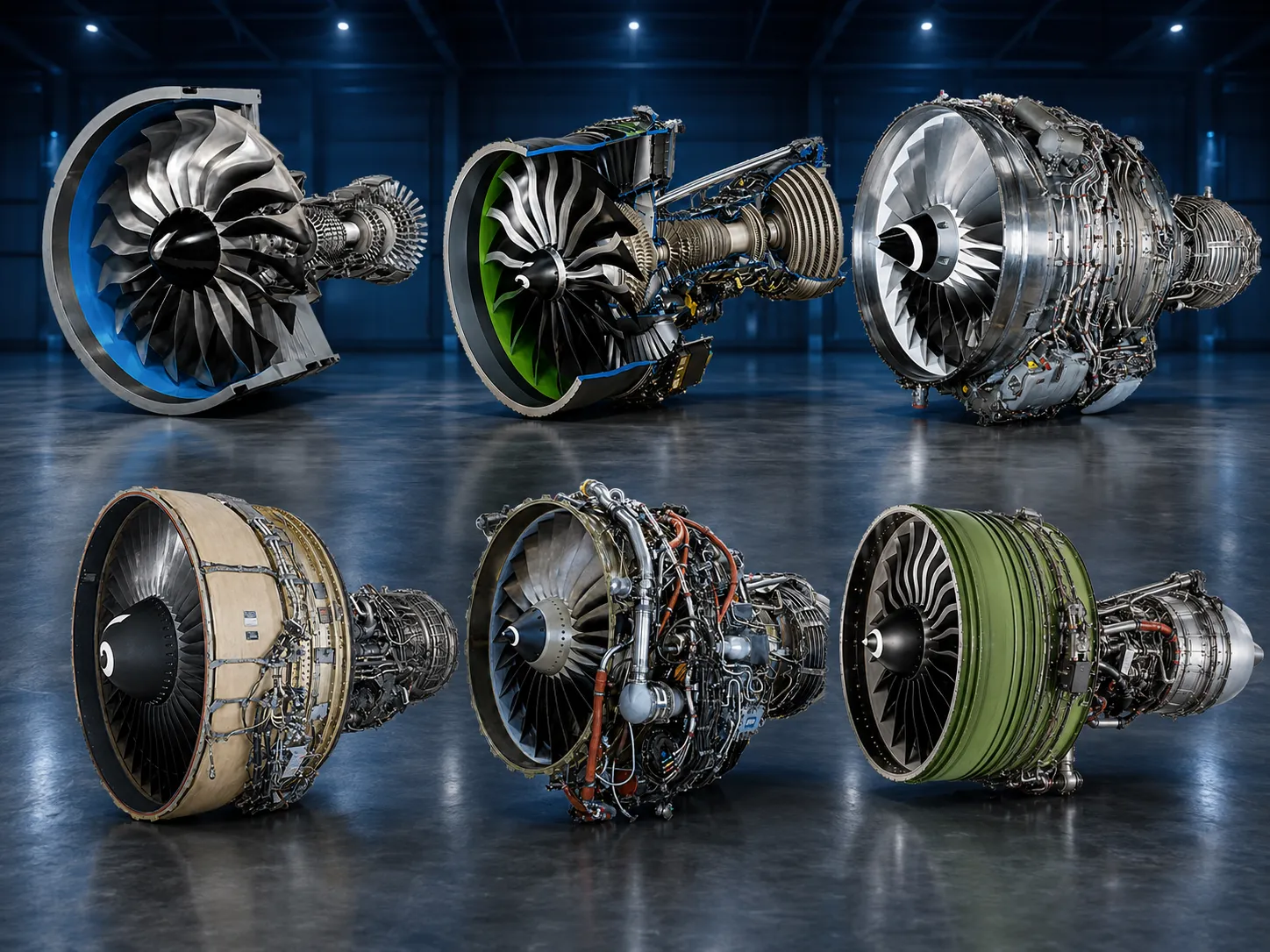
The GE90 Growth engine family, including the GE90-110B and GE90-115B versions, is recognized as one of the largest and most powerful turbofan engine families ever developed for commercial aviation. Designed for long-range Boeing 777 variants, this engine represents a major milestone in high-thrust propulsion engineering.
With a maximum thrust rating of 115,000 lbf, the GE90-115B powers high-capacity, long-range aircraft within the Boeing 777 family. Its application is closely associated with transoceanic and transpacific operations, where performance, reliability, and efficiency are essential.
The GE90 Growth program was developed to meet the demanding requirements of long-haul widebody aircraft, combining high thrust, a large fan diameter, a high bypass ratio, and advanced materials technology.
The GE90 is a two-spool turbofan engine positioned in the 115,000 lbf thrust class in its GE90-115B version. Its architecture was designed to meet the operational requirements of long-range Boeing 777 aircraft with high passenger and cargo capacity.
As a high-bypass turbofan, the GE90 uses a large front fan to move a significant mass of air. Part of this airflow enters the engine core, where it passes through compression, combustion, and expansion through the turbines. The remaining airflow passes through the bypass duct, contributing significantly to thrust generation.
In simple terms: the GE90-110B/-115B is a high-thrust turbofan developed for long-range Boeing 777 aircraft, combining a large fan, high bypass ratio, and advanced materials for intercontinental operations.
| Parameter | Value |
|---|---|
| Maximum thrust | 115,000 lbf |
| Bypass ratio | 9:1 |
| Overall pressure ratio | 42:1 |
| Installed length | 29.9 ft, approximately 9.11 m |
| Fan diameter | 10.5 ft, approximately 3.20 m |
| Dry weight | 18,260 lb, approximately 8,282 kg |
| Entry into service | 2004, with the GE90-115B version |
| Component | Stages | Function |
|---|---|---|
| Low-pressure compressor | 4 stages | Performs the initial compression of the airflow before it reaches the engine core. |
| High-pressure compressor | 9 stages | Completes the compression process before the combustor. |
| High-pressure turbine | 2 stages | Drives the high-pressure compressor. |
| Low-pressure turbine | 6 stages | Drives the fan and the low-pressure compressor. |
The GE90 introduced technologies that became major references in high-thrust commercial aircraft engines. These include composite fan blades, a high overall pressure ratio, advanced turbine components, and active clearance control systems.
| Technology | Description and benefit |
|---|---|
| Composite fan blades | Aerodynamically optimized fan blades with titanium leading edges for improved resistance to impact and erosion. |
| High overall pressure ratio | A 42:1 overall pressure ratio, contributing to more efficient thermodynamic work extraction. |
| Powder-metal turbine disks | Components designed for improved fatigue resistance and high-temperature operation. |
| Single-crystal turbine blades | Blades with no grain boundaries, improving creep resistance in high-temperature sections. |
| Active clearance control | A system that optimizes clearances between blade tips and casings to improve efficiency across different operating conditions. |
The GE90-110B is a GE90 Growth version used on the Boeing 777-200LR. This configuration provides high thrust for ultra-long-range missions while maintaining the basic architecture of the Growth family.
The GE90-115B is the highest-thrust version of the GE90 family. It powers the Boeing 777-300ER and Boeing 777-200F, two aircraft developed for long-haul operations and high-capacity missions.
| Feature | GE90-110B | GE90-115B |
|---|---|---|
| Maximum thrust | 110,000 lbf | 115,000 lbf |
| Main application | Boeing 777-200LR | Boeing 777-300ER and Boeing 777-200F |
| Architecture | Same basic Growth family architecture | Same basic Growth family architecture, with increased thrust |
The Boeing 777-200LR is an ultra-long-range passenger aircraft. It uses the GE90-110B and was developed to operate long intercontinental routes, connecting distant cities without intermediate stops.
The Boeing 777-300ER uses the GE90-115B. This aircraft became one of the most important members of the Boeing 777 family, combining high passenger capacity with the range required for long-haul international routes.
The Boeing 777-200F is the freighter version based on the 777-200LR airframe. It uses the GE90-115B and was developed for long-range cargo operations.
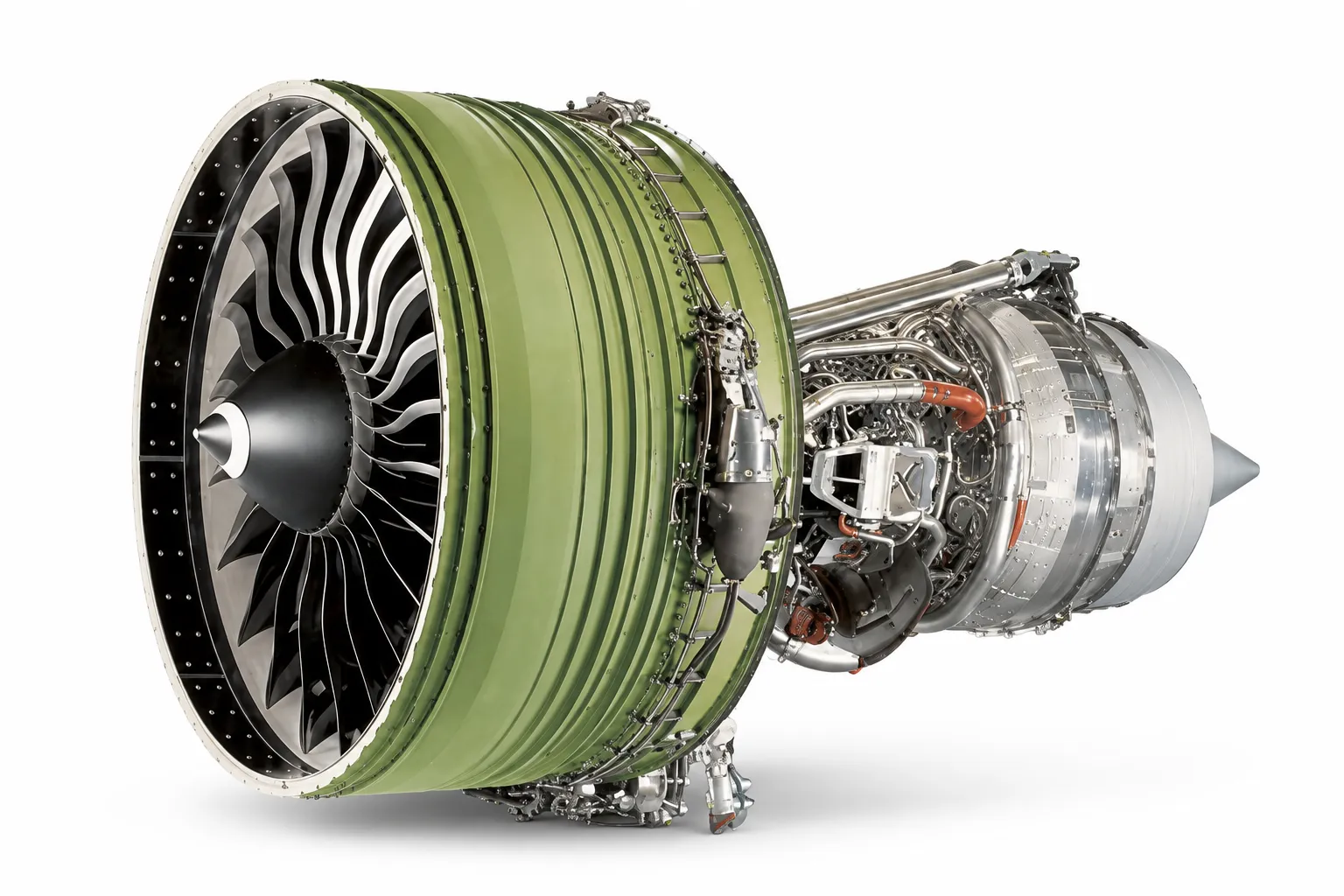
GE90 engine. Image used for educational purposes.
MTU Aero Engines supports the GE90 Growth program through maintenance, repair, and overhaul operations. MTU Maintenance Hannover, located in Germany, provides full MRO support for the GE90-110B and GE90-115B versions.
| Facility | Location | Start year | Work scope |
|---|---|---|---|
| MTU Maintenance | Hannover, Germany | 2010 | Full engine MRO. |
MTU Maintenance Hannover is positioned as a reference provider for GE90 Growth support. Working on an engine of this size requires specialized infrastructure, technical experience, and the capability to handle very large, highly complex components.
| Aspect | Details |
|---|---|
| MTU position | One of the first maintenance providers in the world licensed to repair and overhaul the GE90 Growth engine family. |
| Experience | More than a decade of operational experience. |
| Additional services | On-site maintenance activities. |
| Metric | Value |
|---|---|
| Shop visits through 2025 | More than 250. |
| Capability | Complete engine overhaul, or full engine MRO. |
| Differentiator | Licensed repair and overhaul capability for the GE90 Growth engine family. |
MTU’s role in the GE90 Growth program is focused on maintenance, repair, and overhaul. In this specific program, the company does not hold development or component manufacturing responsibility for the engine.
MTU Maintenance Hannover offers a broad service portfolio for the GE90-110B and GE90-115B. These services support Boeing 777 aircraft operating long international routes where engine reliability and availability are essential.
| Service | Details |
|---|---|
| On-site support | Maintenance performed at the customer’s facility. |
| Technical support | Specialized consulting for troubleshooting and problem solving. |
| Diagnostics | Performance analysis and condition monitoring. |
The GE90-115B became one of the most powerful commercial aircraft engines ever placed into service. Its use on the Boeing 777-300ER and Boeing 777-200F helped support long-haul operations with high passenger and cargo capacity.
| Metric | Value |
|---|---|
| Maximum thrust | 115,000 lbf. |
| Position | One of the most powerful commercial aircraft engines in the world. |
| Application | Long-range Boeing 777 aircraft. |
| Fleet | Hundreds of engines in operation. |
The GE90-115B entered service in 2004 and has accumulated more than two decades of operation on Boeing 777 aircraft. Its role in long-haul operations helped establish the Boeing 777-300ER as one of the most important widebody aircraft of its generation.
| Aspect | Details |
|---|---|
| Entry into service | 2004, with the GE90-115B version. |
| Time in operation | More than 20 years of service. |
| Fleet in operation | Boeing 777-200LR, Boeing 777-300ER, and Boeing 777-200F. |
The GE90-115B played an important role in expanding long-haul operations with twin-engine aircraft. Its high thrust, combined with the efficiency and reliability of the Boeing 777, helped make longer routes and higher-capacity operations more practical.
The GE9X is the technological successor to the GE90 in the Boeing 777 segment and was developed for the Boeing 777X family. Even with this transition, the GE90 will continue to require maintenance support for many years because of the existing Boeing 777-200LR, 777-300ER, and 777-200F fleet.
| Aspect | Details |
|---|---|
| Successor | GE9X, developed for the Boeing 777X. |
| GE90 status | Production in transition. |
| MRO demand | Expected to remain strong because of the existing fleet. |
The sustainability outlook for the GE90-equipped fleet is connected to the use of sustainable aviation fuel, commonly known as SAF, continued MRO support, and incremental updates that may contribute to operational efficiency.
With Boeing 777-200LR, 777-300ER, and 777-200F aircraft expected to remain in operation for decades, demand for GE90 MRO services will remain relevant. In this environment, MTU Maintenance Hannover is positioned as a reference provider for this iconic engine.
The GE90-110B/-115B represents one of the most significant high-thrust engine architectures in commercial aviation history. Its use on long-range Boeing 777 variants helped expand the possibilities of intercontinental twin-engine operations.
With its large fan diameter, high bypass ratio, high overall pressure ratio, and advanced materials, the GE90 Growth family became a reference for power, reliability, and technical maturity.
MTU Maintenance Hannover’s MRO support reinforces the importance of the maintenance ecosystem for large commercial aircraft engines. Even with the arrival of the GE9X for the new Boeing 777X generation, the GE90 will remain important as long as the current Boeing 777 fleet continues to operate.