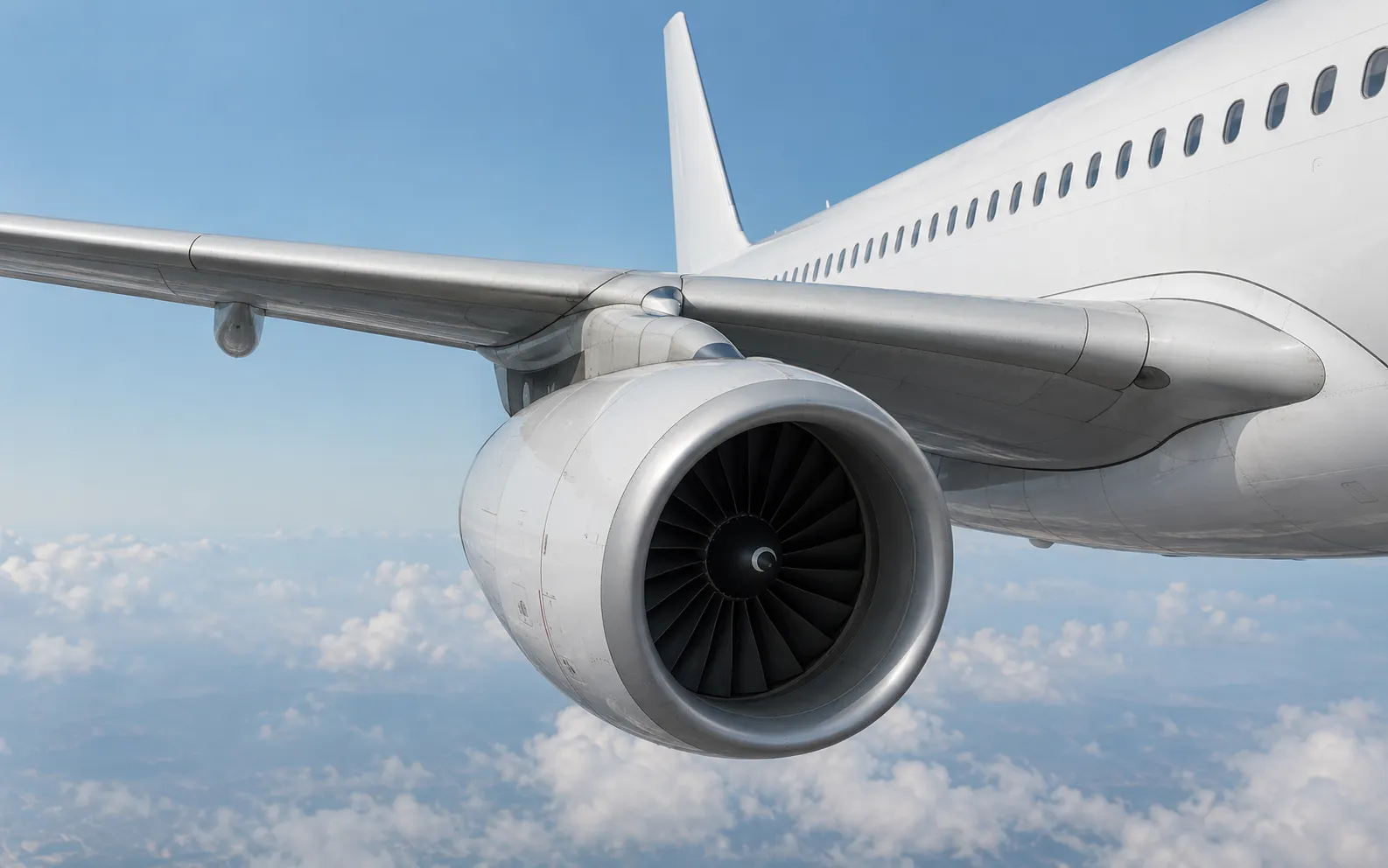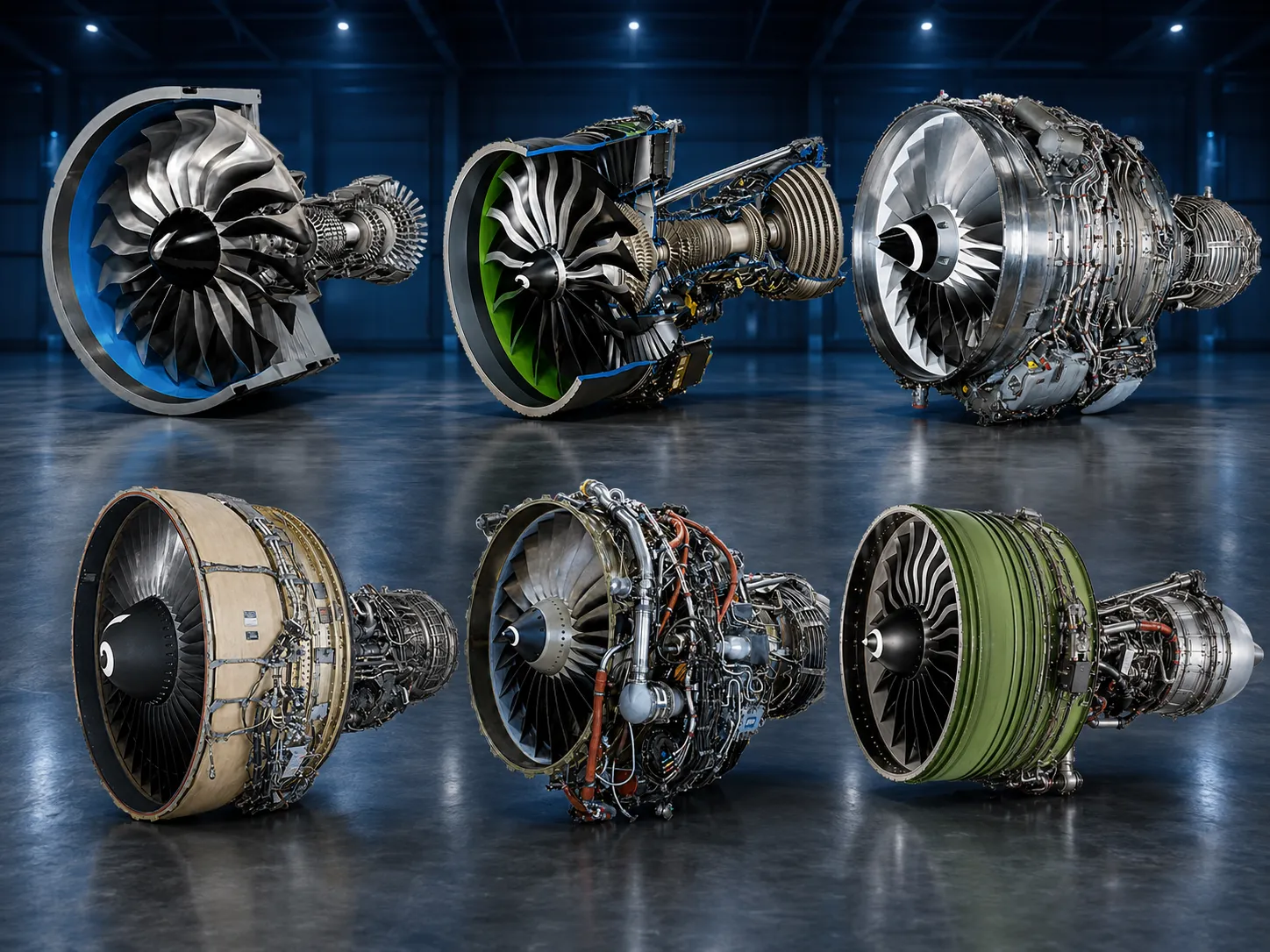
The IAE V2500 is a two-spool turbofan engine designed for narrowbody aircraft. It has powered several aircraft platforms, including the Airbus A319, A320, and A321 families.
The engine was developed by International Aero Engines, or IAE, a joint venture founded in 1983. The program brought together the technical experience of Pratt & Whitney, the Japanese Aero Engines Corporation, known as JAEC, and MTU Aero Engines.
The introduction of the V2500Select-One™ version in September 2008 marked an important evolution of the engine. This upgrade brought operational improvements over the V2500-A5 variant, including lower fuel burn and longer time on wing.
The V2500 is a two-spool turbofan engine positioned in the 22,000 to 33,000 lbf thrust class. This thrust range is mainly suited for single-aisle commercial aircraft operating short- and medium-haul routes.
As a turbofan engine, the V2500 uses a front fan to move a large mass of air. Part of this airflow enters the engine core, where it is compressed, mixed with fuel, burned, and expanded through the turbines. The remaining airflow passes around the core through the bypass duct, helping generate thrust more efficiently.
In simple terms: the V2500 is a medium-thrust turbofan designed for single-aisle commercial aircraft, combining efficiency, reliability, and a modular maintenance-friendly architecture.
| Parameter | Value |
|---|---|
| Maximum thrust | 33,000 lbf |
| Bypass ratio | 4.5:1 |
| Overall pressure ratio | 33.4:1 |
| Length | 10.5 ft, approximately 3.20 m |
| Fan diameter | 5.2 ft, approximately 1.58 m |
| Weight | 5,467 lb, approximately 2,480 kg |
| Entry into service | 1989 |
| Accumulated flight hours | More than 280 million |
The V2500 incorporates several technologies designed to improve performance, reliability, maintainability, and operating efficiency. These features helped establish the engine as one of the main powerplant options for A320ceo-family aircraft and other narrowbody platforms.
| Technology | Description and benefit |
|---|---|
| Snubberless fan | Fan blades without intermediate snubber supports, reducing aerodynamic losses and improving airflow efficiency. |
| Powder-metal turbine disks | Manufacturing process that improves resistance to fatigue and high operating temperatures. |
| Single-crystal turbine blades | A single-crystal structure eliminates grain boundaries, increasing resistance to creep and thermal fatigue. |
| Active clearance control | A system that dynamically adjusts clearances between blade tips and casings, improving efficiency across different operating conditions. |
| Modular design | A configuration that simplifies maintenance and reduces repair time by allowing complete modules to be replaced or serviced. |
| Digital engine control unit | Electronic management of engine operating parameters to help optimize performance. |
| On-condition maintenance | A maintenance strategy that allows the engine to remain in service until specific indicators show that intervention is required. |
The V2500-A5 is one of the main versions of the engine. It is used on the Airbus A319, A320, and A321 families, as well as the Boeing MD-90. This version has seen broad global commercial service.
The V2500Select-One™ is an upgraded version derived from the V2500-A5. Introduced in September 2008, it was designed to reduce operating costs and improve aircraft availability.
The V2500-E5 is a configuration used on the Embraer C-390 Millennium military transport aircraft. This version is adapted for mission-specific requirements, including military operations and cargo transport.
The V2500 is known for combining solid thermodynamic performance with operational reliability. Its 33.4:1 overall pressure ratio contributes to fuel efficiency, while its 4.5:1 bypass ratio provides effective propulsive efficiency for short- and medium-haul missions.
The engine’s aerodynamic design, including its snubberless fan blades and optimized airfoil profiles, contributes to efficiency across different phases of flight, from takeoff to cruise.
| Metric | V2500-A5 | V2500Select-One™ | Improvement |
|---|---|---|---|
| Fuel burn | Baseline | 1% lower | 1% reduction |
| Time on wing | Baseline | 20% longer | 20% increase |
| Operating cost | Baseline | Reduced | Improved life-cycle cost |
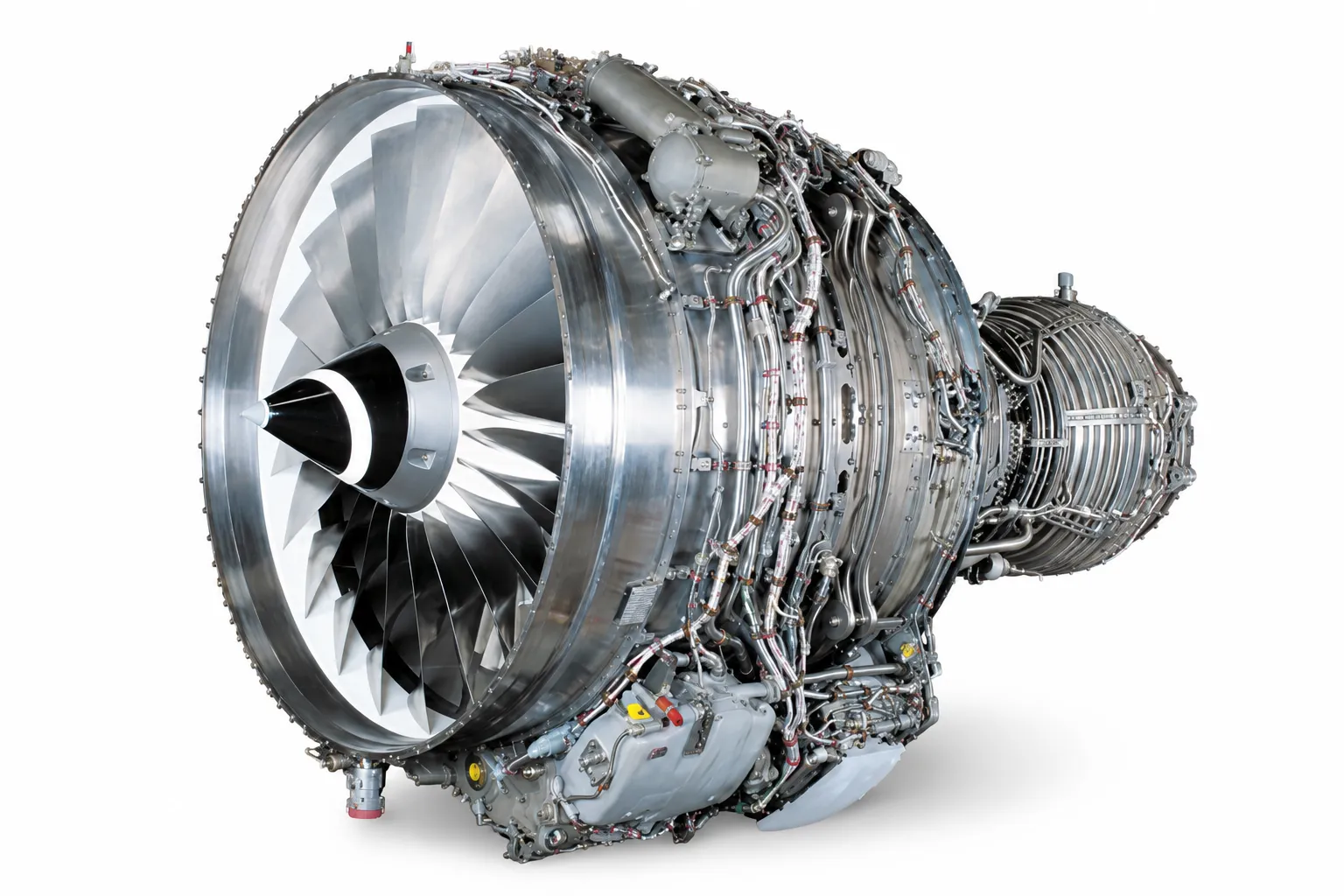
IAE V2500 engine. Image used for educational purposes.
MTU Aero Engines participates in the V2500 program with important technical and industrial responsibilities. The company is involved in low-pressure turbine components, casings, accessories, external components, engine testing, and the production of related parts.
| Parameter | Details |
|---|---|
| Program share | 16% |
| Responsible components | Low-pressure turbine, casings, accessories, and external components. |
| Additional activities | Engine testing and production of turbine and casing parts. |
MTU is involved in activities related to the V2500 low-pressure turbine. This module is essential because it extracts energy from the exhaust gas stream to drive the engine’s low-pressure system, including the fan.
The casing surrounds and supports internal engine components. It also helps manage secondary airflows used for cooling and sealing. In a turbofan engine, these structures must withstand mechanical loads, vibration, and thermal changes during operation.
Accessories and external components include auxiliary systems mounted on the outside of the engine. These systems may be related to fuel management, lubrication, control, and operational support.
MTU performs engine testing activities at its facilities, including development testing for new components, performance validation after repair or overhaul, and certification support for new configurations entering service.
Maintenance, repair, and overhaul of the V2500 are supported by a global MRO network. This network provides support for operators in different regions and helps maintain aircraft availability while reducing downtime.
| Model | Facility | Location | Start year | Work scope |
|---|---|---|---|---|
| V2500-A5 | MTU Maintenance | Hannover, Germany | 1997 | Full engine MRO |
| V2500-A5 | MTU Maintenance | Vancouver, Canada | 1997 | Full engine MRO |
| V2500-A5 | MTU Maintenance | Zhuhai, China | 1997 | Full engine MRO |
| V2500-A5 | On-site services | Global | — | Field maintenance activities |
| V2500-E5 | MTU Maintenance | Canada | 2018 | Full engine MRO |
| Metric | Value |
|---|---|
| Shop visits through 2025 | More than 7,400 |
| First year of V2500-A5 MRO | 1997 |
| First year of V2500-E5 MRO | 2018 |
| Capability | Complete engine overhaul, or full engine MRO. |
MTU offers a broad repair portfolio for V2500 variants, including low-pressure turbine components, casings, structural parts, blades, coatings, heat treatments, inspections, and performance testing.
In addition to shop-based overhaul, MTU provides field maintenance services, often referred to as on-site support. These activities help reduce aircraft downtime and allow technical support closer to the actual operation.
International Aero Engines was founded in 1983 as a joint venture focused on the commercialization and support of the V2500 engine. The program brings together companies with different technical and industrial responsibilities.
| Partner | Main responsibilities |
|---|---|
| Pratt & Whitney | Program leadership, compressors, combustor, and high-pressure turbine. |
| Japanese Aero Engines Corporation | High-pressure compressors and structural components. |
| MTU Aero Engines | Low-pressure turbine, casings, accessories, and part of the production workshare. |
| Aircraft | Engine variant | Note |
|---|---|---|
| Airbus A319 | V2500-A5 / V2500Select-One™ | Smaller member of the A320 family. |
| Airbus A320 | V2500-A5 / V2500Select-One™ | Main application with a large installed fleet. |
| Airbus A321 | V2500-A5 / V2500Select-One™ | Larger member of the A320 family. |
| Boeing MD-90 | V2500-A5 | Narrowbody commercial aircraft. |
| Aircraft | Engine variant | Note |
|---|---|---|
| Embraer C-390 Millennium | V2500-E5 | Tactical military transport aircraft equipped with a mission-optimized engine. |
The V2500’s long operating history has contributed to its technical maturity. Since entering service, the engine has accumulated more than 280 million flight hours and remains associated with a large global fleet.
The long service history of the V2500 has allowed operators and maintenance providers to refine maintenance intervals, develop optimized repair procedures, introduce incremental upgrades, and improve operational availability throughout the engine’s life cycle.
The V2500 is positioned in the 22,000 to 33,000 lbf thrust class, historically competing with engines in the same category used on previous-generation single-aisle aircraft.
The introduction of the V2500Select-One™ in 2008 delivered important benefits for operators with large fleets. Lower fuel burn and longer time on wing help reduce total ownership cost and increase aircraft availability.
With significant A320ceo fleets still equipped with V2500 engines, MRO operations remain highly relevant. Support includes specialized facilities, repair capabilities, and the development of new preventive maintenance solutions.
The future of the V2500 is mainly tied to fleet support, maintenance, and operational optimization. Compatibility with sustainable aviation fuel, or SAF, may help reduce emissions, while flight data analysis can support predictive maintenance strategies.
The IAE V2500 is one of the most important turbofan engines in the single-aisle commercial aircraft market. Its use on aircraft such as the Airbus A319, A320, A321, and Boeing MD-90, along with the V2500-E5 version for the Embraer C-390 Millennium, demonstrates the versatility of the design.
MTU Aero Engines’ participation in the program, especially in low-pressure turbine components, casings, accessories, testing, and maintenance support, reinforces the importance of industrial collaboration in aircraft engine programs.
With more than 280 million accumulated flight hours, a broad support network, and continued evolution through the V2500Select-One™ version, the V2500 remains a strong example of maturity, reliability, and technical support in the turbofan engine segment for single-aisle aircraft.