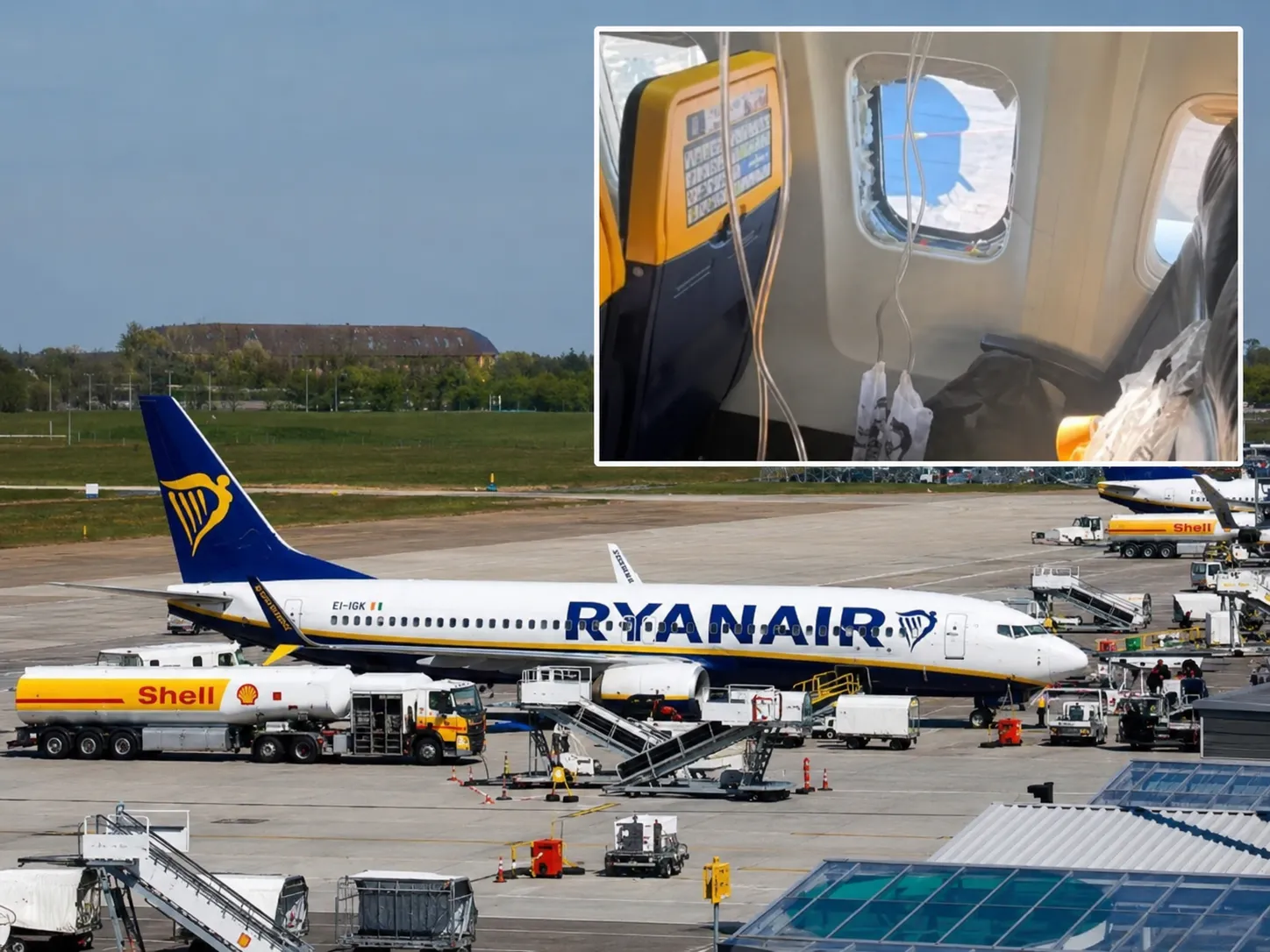
A serious incident involving Ryanair Flight FR1879 prompted an aviation safety investigation after a passenger window was broken during a flight from Thessaloniki, Greece, to Memmingen, Germany, on July 10, 2026.
The aircraft involved was a Boeing 737-800, variant 737-8AS, registration 9H-QEU, operated by Malta Air on behalf of Ryanair. Shortly after takeoff, the flight crew discontinued the flight and returned to Thessaloniki Airport.
- Flight: Ryanair FR1879
- Departure: Thessaloniki, Greece
- Destination: Memmingen, Germany
- Aircraft: Boeing 737-800
- Registration: 9H-QEU
- Operator: Malta Air on behalf of Ryanair
- Date: July 10, 2026
- Outcome: safe return and landing in Thessaloniki
What happened during the flight
About ten minutes after takeoff, while the aircraft was climbing, passengers reported hearing a loud noise. A passenger window was then broken, causing a rapid cabin decompression.
The oxygen masks deployed from the overhead compartments. Footage recorded inside the aircraft shows the opening in the side of the cabin, damage to the interior paneling around the window, and oxygen masks hanging above the seats.
According to preliminary reports published by the media, a 61-year-old Serbian passenger seated next to the window was partially forced through the opening. His head and shoulders were reportedly outside the aircraft before his wife and nearby passengers managed to hold him and pull him back into the cabin.
The passenger received medical assistance after landing and was taken to a hospital. Initial information indicated that his injuries were not life-threatening.
Important: the broken window, cabin decompression, and safe return are confirmed. The exact engine failure sequence and the source of the debris remain subject to the official technical investigation.
Amazon Recommended Products
AVIATION PICKS

Footage shows significant engine damage
Images released after the landing show significant damage near the front of one of the engines. Several fan blades appear to be missing or damaged, leading aviation observers and news organizations to consider the possibility of an uncontained engine failure.
Preliminary information indicates that debris released from the engine may have struck the side of the fuselage and broken the window. However, this sequence must still be confirmed through examination of the engine, recovered debris, maintenance records, and recorded aircraft data.
An uncontained failure occurs when an internal engine component breaks and fragments escape beyond the structure designed to contain them. Depending on their energy and trajectory, those fragments may strike the nacelle, wing, fuselage, or other aircraft systems.
In the case of Flight FR1879, the available footage is consistent with a serious engine failure, but the initiating cause has not yet been determined. Investigators typically examine material fatigue, previous damage, component defects, foreign object damage, and inspection history.
Why the broken window caused cabin decompression
At altitude, the cabin of a commercial aircraft is maintained at a higher pressure than the surrounding atmosphere. This pressure difference allows passengers and crew members to breathe under safe and manageable conditions.
When a significant opening develops in the fuselage or a passenger window, pressurized cabin air rapidly escapes into the lower-pressure atmosphere. Cabin pressure drops, and the passenger oxygen masks may deploy automatically.
Under these conditions, the flight crew uses supplemental oxygen, carries out the appropriate emergency procedures, and begins a descent to an altitude where the surrounding atmospheric pressure allows normal breathing without prolonged use of the masks.
The common expression “sucked out of the airplane” describes the visible effect of rapid decompression. Technically, pressurized air rushing out of the cabin creates a powerful flow toward the opening, pushing nearby people and objects in that direction.
Amazon Recommended Products
AVIATION PICKS
Safe return to Thessaloniki
Following the incident, the flight crew discontinued the flight to Germany and returned to Thessaloniki. The Boeing 737-800 landed safely, with emergency services waiting for the aircraft on the ground.
Ryanair said the passengers returned to the terminal and that a replacement aircraft was provided to continue the trip to Memmingen.
The safe return highlights the importance of flight crew training, emergency procedures, and the protective systems built into commercial aircraft. At the same time, the extent of the damage requires a detailed investigation.
What investigators are expected to examine
Investigators are expected to examine the fan blades, fan hub, containment case, nacelle, fuselage, damaged window, and any fragments that can be recovered.
They are also expected to review the engine’s maintenance history, inspection records, component hours and cycles, flight recorder data, and any evidence of fatigue or previous damage.
Because the incident occurred over North Macedonian airspace, authorities from North Macedonia are leading the investigation, with assistance from other agencies and representatives connected with the aircraft, engine, operator, and manufacturers.
The final cause has not yet been determined
Footage of the damaged engine and reports that engine debris struck the window are important pieces of preliminary evidence, but they do not replace the conclusions of a formal technical investigation.
At this stage, it is possible to confirm that there was a serious engine failure, a broken passenger window, rapid cabin decompression, an injured passenger, and a safe return to the departure airport.
The possibility of an uncontained engine failure is consistent with the available footage and preliminary information. The initiating cause and the complete sequence of events, however, must still be established by the investigating authorities.
References
- Reuters. “Ryanair passenger partially sucked out of window on flight from Greece.” Published July 10, 2026. View source .
- Aviation Safety Network. Accident record involving Boeing 737-8AS, registration 9H-QEU, on July 10, 2026. View source .
- The Guardian. “Ryanair passenger almost sucked out of shattered window during flight.” Published July 10, 2026. View source .