The TCAS — Traffic Alert and Collision Avoidance System is an airborne system designed to reduce the risk of midair collisions between aircraft. It operates independently of air traffic control and uses information received from nearby aircraft transponders to track surrounding traffic and evaluate potential conflicts.
TCAS does more than simply display nearby aircraft. It continuously evaluates how the separation between aircraft is changing. As the calculated level of risk increases, the traffic symbol changes and, in TCAS II, the system can progress from a basic traffic indication to a Traffic Advisory and then to a Resolution Advisory.
How does TCAS identify other aircraft?
TCAS uses interrogations and responses from nearby aircraft transponders to obtain the information required to track surrounding traffic.
Among the parameters evaluated by the system are:
- relative position of the traffic;
- distance between the aircraft;
- relative altitude;
- vertical trend;
- closure rate;
- predicted development of the encounter.
This means that simply being close to another aircraft does not automatically make it a threat. TCAS considers how the encounter is developing and how much time remains before separation could become critical.
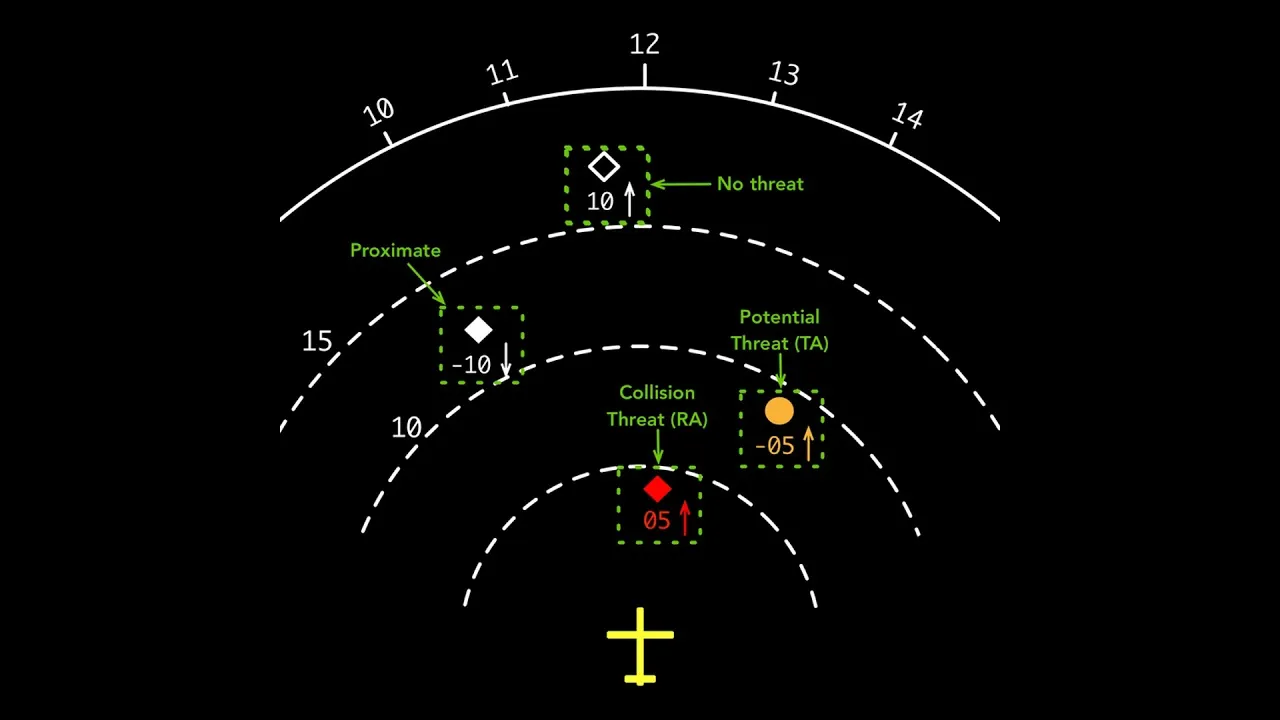
No Threat — Other Traffic
Traffic that is being tracked by TCAS but does not currently represent a significant threat is normally displayed as an open white diamond.
This category is known as Other Traffic.
The symbol allows the flight crew to remain aware of another aircraft's relative position even when no special action is required.
Amazon Recommended Products
AVIATION PICKS

Proximate Traffic
When another aircraft is nearby but does not yet meet the criteria required to trigger a Traffic Advisory, it may be displayed as a filled white diamond.
This classification is known as Proximate Traffic.
Its purpose is to improve flight crew situational awareness and make it easier to monitor aircraft operating nearby.
Potential Threat — Traffic Advisory (TA)
When TCAS determines that another aircraft may develop into a conflict, the traffic symbol normally changes to an amber circle.
TA — Traffic Advisory
The primary purpose of a TA is to draw the flight crew's attention to the traffic and help the pilots visually acquire the aircraft when possible.
A Traffic Advisory by itself should not be interpreted as a command to perform an evasive maneuver.
One of the associated aural alerts is:
“TRAFFIC, TRAFFIC”
Collision Threat — Resolution Advisory (RA)
When TCAS II determines that the encounter has reached a more critical level, the traffic may be displayed as a red square.
RA — Resolution Advisory
At this stage, TCAS II can provide vertical guidance intended to increase or maintain safe separation from the conflicting traffic.
A red square does not mean that a collision is inevitable. It means the system has identified a conflict serious enough to require resolution guidance.
Examples of TCAS Commands
Depending on the geometry of the conflict and the solution calculated by the system, TCAS II can issue different aural and visual commands.
CLIMB, CLIMB
The system is directing the flight crew to establish a climb in order to increase vertical separation from the conflicting traffic.
DESCEND, DESCEND
In this case, TCAS determines that a descending flight path provides the appropriate vertical separation solution.
CLIMB, CROSSING CLIMB
A crossing climb indicates that the resolution maneuver will require the aircraft to climb through the current altitude of the conflicting traffic before safe vertical separation is achieved.
DESCEND, CROSSING DESCEND
This is the equivalent condition in a descent: the resolution path crosses the altitude of the conflicting traffic while the aircraft descends.
INCREASE CLIMB
This command means that the aircraft is already climbing, but a greater rate of climb is required to achieve the necessary separation.
INCREASE DESCENT
The same principle applies in a descent: TCAS is commanding a greater rate of descent.
ADJUST VERTICAL SPEED
This command directs the flight crew to modify the aircraft's current vertical speed so that the flight path remains outside the vertical region considered unsuitable for resolving the conflict.
How do you read the numbers next to the traffic symbols?
The numbers displayed next to TCAS traffic symbols indicate the relative altitude of the other aircraft.
These values are normally displayed in hundreds of feet.
10 = approximately 1,000 feet above.
05 = approximately 500 feet above.
-10 = approximately 1,000 feet below.
A value without a minus sign indicates traffic above the own aircraft. A minus sign indicates traffic below.
Amazon Recommended Products
AVIATION PICKS

What do the arrows mean?
An arrow displayed next to the relative altitude indicates the traffic's vertical trend.
↑ = traffic climbing.
↓ = traffic descending.
For example, 05 ↑ indicates traffic approximately 500 feet above and climbing.
A display of -10 ↓ indicates traffic approximately 1,000 feet below and descending.
Why does TCAS use different colors and shapes?
The use of different shapes and colors allows the flight crew to recognize the level of concern associated with each traffic target quickly.
Open white diamond
Other Traffic — traffic being tracked by the system.
Filled white diamond
Proximate Traffic — nearby traffic.
Amber circle
TA — Traffic Advisory.
Red square
RA — Resolution Advisory.
This combination of symbols, colors, altitude information, and aural alerts reduces the amount of time required for the flight crew to interpret a potentially critical situation.
TCAS and Air Traffic Control
One of the fundamental characteristics of TCAS is that its collision avoidance logic operates independently of instructions issued by air traffic control.
This does not mean TCAS replaces air traffic control. It functions as an additional safety layer.
When two properly equipped TCAS II aircraft are involved in the same conflict, their systems can coordinate their Resolution Advisories.
For example, one aircraft may receive a climb advisory while the other receives a coordinated descent advisory.
TA and RA are not the same thing
Understanding the difference between these two indications is essential.
TA = awareness of conflicting traffic.
RA = resolution guidance.
A Traffic Advisory warns the flight crew about traffic that may represent a threat.
A Resolution Advisory goes one step further and provides vertical guidance intended to help resolve the conflict.
TCAS is an additional layer of safety
TCAS does not replace air traffic control, separation procedures, flight crew vigilance, or established operating procedures.
Its role is to provide an additional layer of protection when aircraft separation deteriorates and the system detects a potential collision threat.
The ability to detect nearby traffic, evaluate how an encounter is developing, and provide traffic alerts or resolution guidance has made TCAS one of the most important airborne collision avoidance systems used in modern aviation.
References
FEDERAL AVIATION ADMINISTRATION — FAA.
Advisory Circular AC 90-120 — Airborne Collision Avoidance Systems Operations.
Washington, DC: U.S. Department of Transportation, Federal Aviation Administration.
FAA — AC 90-120
FEDERAL AVIATION ADMINISTRATION — FAA.
Introduction to TCAS II Version 7.1.
Washington, DC: Federal Aviation Administration.
FAA — Introduction to TCAS II Version 7.1
FEDERAL AVIATION ADMINISTRATION — FAA.
Advisory Circular AC 20-151C — Airworthiness Approval of Traffic Alert and Collision Avoidance Systems (TCAS II), Versions 7.0 & 7.1 and Associated Mode S Transponders.
Washington, DC: Federal Aviation Administration.
FAA — AC 20-151C
FEDERAL AVIATION ADMINISTRATION — FAA.
Advisory Circular AC 120-55C — Air Carrier Operational Approval and Use of TCAS II.
Washington, DC: Federal Aviation Administration.
FAA — AC 120-55C
EUROCONTROL.
Airborne Collision Avoidance System (ACAS) Guide.
Brussels: EUROCONTROL.
EUROCONTROL — ACAS Guide
INTERNATIONAL CIVIL AVIATION ORGANIZATION — ICAO.
Traffic Collision Avoidance System (TCAS) — Safety Advisory.
Montreal: ICAO.
ICAO — TCAS Safety Advisory