Aircraft Navigation Lights
Aircraft navigation lights are among the most important visual references used to identify an airplane’s position and direction of travel, especially at night or in reduced visibility.
They are also known as position lights, because they help other pilots, air traffic controllers, and observers understand how an aircraft is oriented in space. The basic idea is simple: by looking at the colors and where they appear, you can tell whether an aircraft is coming toward you, moving away from you, or crossing from one side to the other.
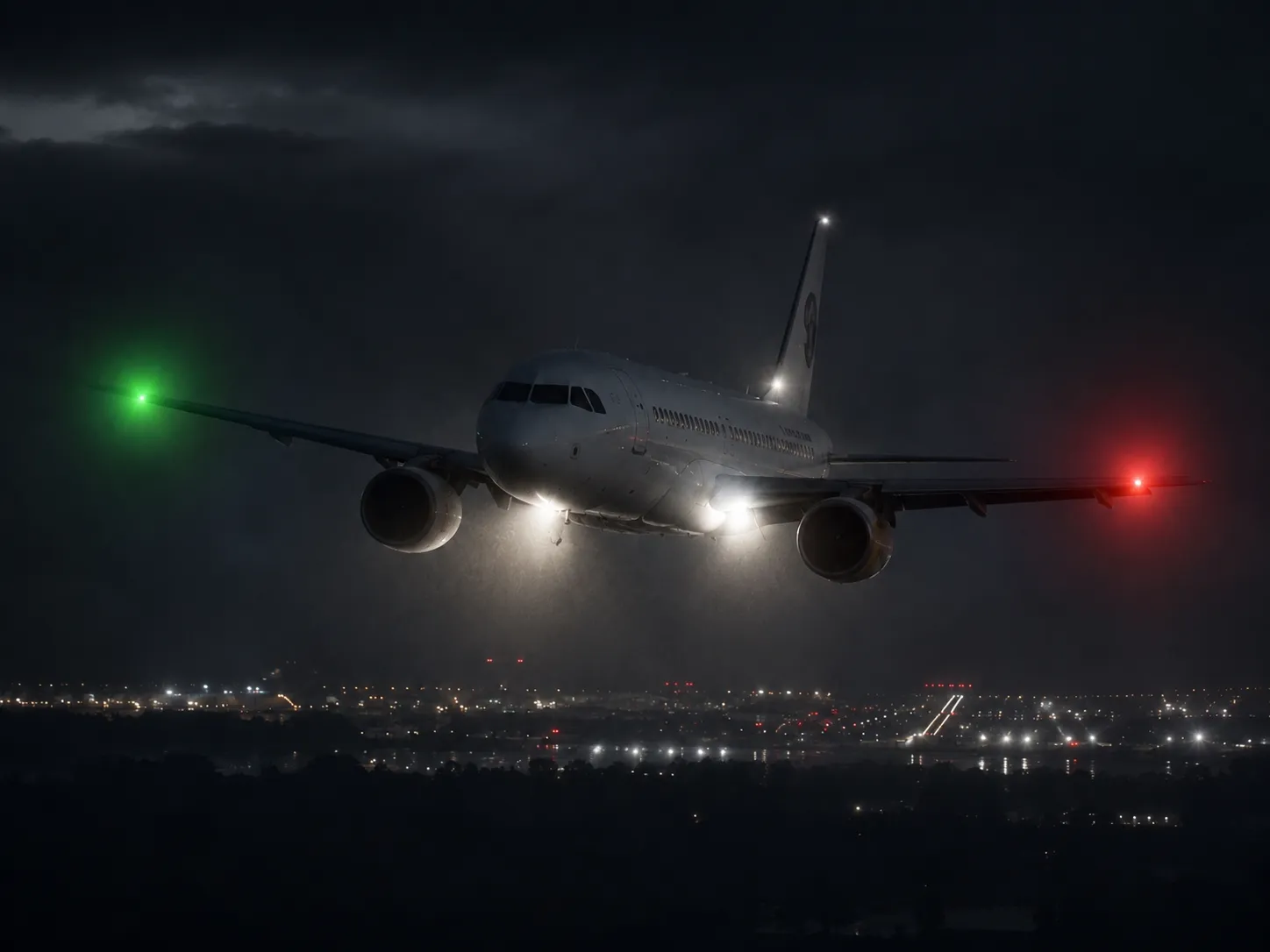
The basic system uses three main colors: red, green, and white. The red light is located on the aircraft’s left side. The green light is located on the aircraft’s right side. The white light faces rearward, usually from the tail area or rear-facing positions depending on the aircraft design.
For transport-category airplanes, U.S. regulation 14 CFR Part 25 states that the forward position lights must consist of one red and one green light, spaced laterally as far apart as practicable. With the airplane in its normal flying attitude, the red light must be on the left side and the green light on the right side. The rear position light must be white and mounted as far aft as practicable, either on the tail or on each wingtip, depending on the approved configuration.
This standardization matters because it allows pilots to quickly interpret another aircraft’s relative movement. If you see both the red and green lights at the same time, you are looking at the front side of the aircraft. In practical terms, that means the aircraft is coming toward you or is pointed roughly in your direction.
When an aircraft is moving away, the rear-facing white position light is the main reference. That white light helps indicate that you are seeing the back of the aircraft, not the front. This is why training diagrams often explain the concept in a very direct way: red and green visible together mean the aircraft is coming toward you; white rear lights indicate that the aircraft is moving away.
From a side view, the color pattern is also useful. If an aircraft is passing from left to right and you see the green navigation light, you are seeing the aircraft’s right side. If it is passing from right to left and you see the red navigation light, you are seeing the aircraft’s left side. This helps determine direction of travel even when the aircraft’s fuselage or tail is difficult to see clearly.
Amazon Recommended Products
AVIATION PICKS



Navigation lights are not headlights
It is important not to confuse navigation lights with other aircraft lights. Navigation lights are not headlights designed to light the way like a car. Their main purpose is to show position and orientation. Landing and taxi lights, on the other hand, are powerful white lights used to illuminate the runway environment or make the aircraft more visible during approach, landing, takeoff, and ground movement.
Aircraft also have anti-collision lights, such as beacons and strobes. These serve a different purpose: attracting attention to the aircraft. Under 14 CFR § 91.209, U.S. operating rules require position lights to be lighted from sunset to sunrise, and also address the use of anti-collision lights when the aircraft is equipped with an anti-collision light system.
In real nighttime operations near an airport, you may see several lights at the same time: red, green, white, strobes, beacons, landing lights, taxi lights, and sometimes logo lights, depending on the aircraft type and phase of operation. Even in that busy visual environment, navigation lights still have a specific purpose: they tell you how the aircraft is oriented.
That is why they are so important for situational awareness. By identifying the colors and their relative positions, an observer can quickly understand whether an aircraft is approaching, moving away, or crossing from one side to the other. For pilots, this visual interpretation supports traffic awareness and helps maintain separation during visual operations.
In short, navigation lights are a standardized visual code. Red on the left, green on the right, and white facing rearward. They are not meant to illuminate the sky. They are meant to communicate direction, position, and orientation. At night or in reduced visibility, that simple light pattern becomes an important part of flight safety.
References
Electronic Code of Federal Regulations — 14 CFR § 25.1385 — Position light system installation. Defines transport-category airplane position light installation, including red on the left, green on the right, and white rear position lights.
Electronic Code of Federal Regulations — 14 CFR § 91.209 — Aircraft lights. Establishes operating requirements for lighted position lights from sunset to sunrise and rules related to anti-collision light systems.
Federal Aviation Administration — Aeronautical Information Manual, 4-3-24, Use of Aircraft Lights. Provides FAA guidance on the use of position lights and anti-collision lights during surface and flight operations.
Federal Aviation Administration — Airplane Flying Handbook, Chapter 11. FAA training material that discusses visual interpretation of another aircraft’s lights during flight.
European aviation rules / SERA. European standardized rules state that, at night, aircraft in flight must display anti-collision lights and, except in specific cases, navigation/position lights.