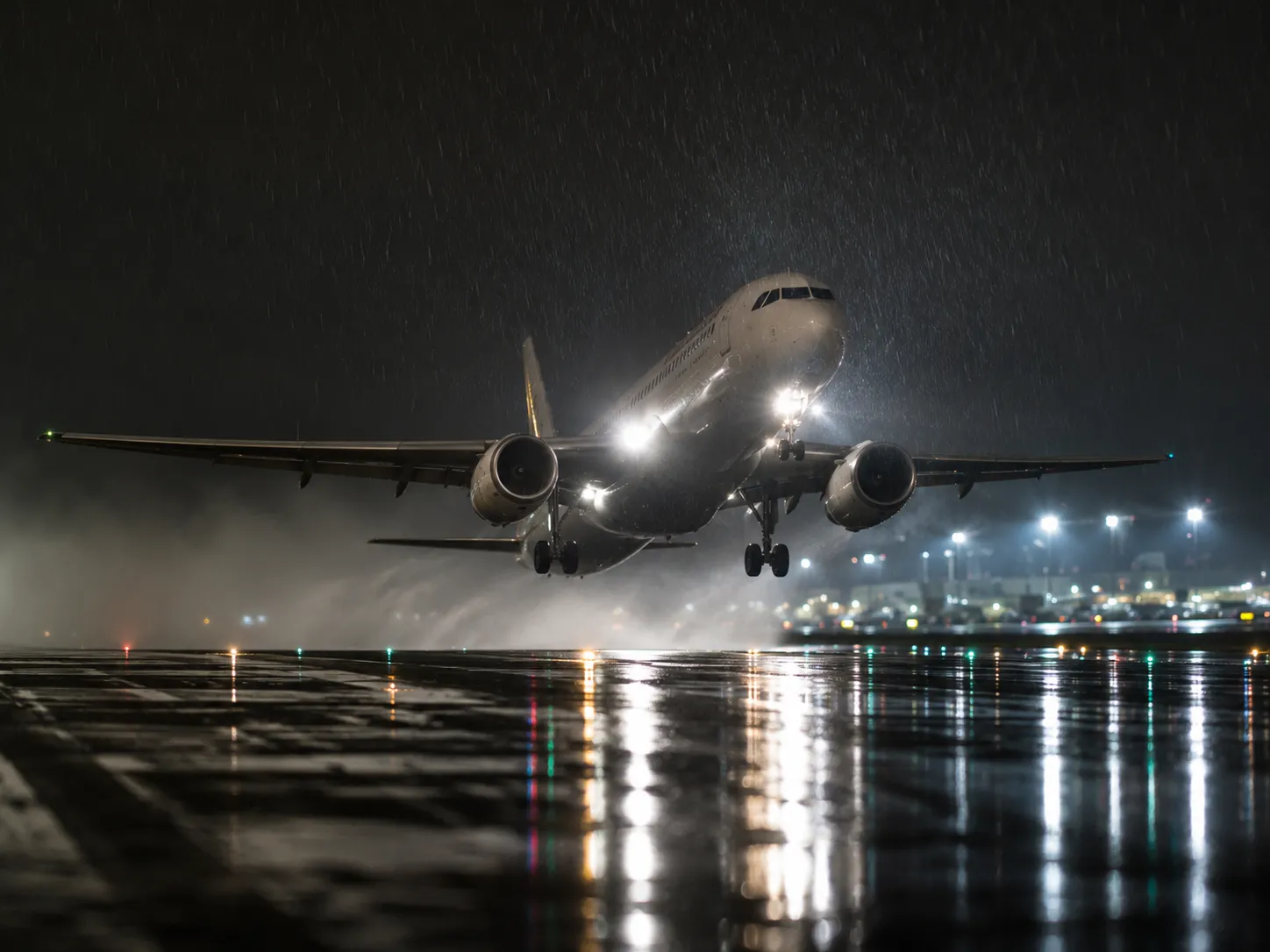
A nighttime takeoff in heavy rain may look like a dramatic display of engine power. In reality, it brings together several operational factors that the flight crew and dispatch team must evaluate before the aircraft enters the runway.
Rain by itself does not automatically prevent a jet from taking off. Commercial aircraft are designed to operate in adverse weather within the limits established by the manufacturer and the operator. The key question is how the precipitation is affecting visibility, runway condition, wind, braking capability, calculated performance, and the departure path.
At night, outside visual references are naturally reduced. Heavy rain can make the environment even more demanding by covering the windshield with water, reflecting airport lights, and reducing forward visibility. Safe operation therefore depends on planning, instrument flying, crew coordination, and strict compliance with operational limits.
What changes during a nighttime takeoff?
During daylight, pilots can use a broad range of visual cues, including the horizon, terrain, airport buildings, and the contrast between the runway and its surroundings. At night, many of those references disappear or are reduced to runway lighting and lights around the airport.
During the takeoff roll, centerline and edge lights help the pilots maintain alignment and position awareness. After rotation, the crew quickly transitions to a flight path controlled primarily through the flight instruments, flight director guidance, and published departure procedures.
Rain may add glare and reflections on the windshield and on the wet pavement. FAA guidance notes that nighttime environments and atmospheric conditions can create visual illusions. Although many of those illusions are discussed mainly in relation to approaches and landings, the underlying lesson still applies: the fewer reliable outside references there are, the more important disciplined instrument flying becomes.
During a nighttime takeoff in heavy rain, the crew does not rely on the appearance of the runway as its only reference. Aircraft control is supported by instruments, standard callouts, established procedures, and continuous cross-checking between the pilots.
Visibility, runway lighting, and RVR
In low-visibility operations, one important value may be RVR — Runway Visual Range. In practical terms, RVR describes the distance over which a pilot positioned on the runway centerline can see the runway surface markings or the lights outlining or identifying the runway.
RVR is not simply a subjective description of whether visibility looks “good” or “poor.” It is measured by equipment installed near the runway and may be reported at different points, such as touchdown, midpoint, and rollout. Its use depends on airport equipment, regulations, and the operator’s specific authorization.
Video recorded by a phone or camera may make a runway look almost invisible, but that alone does not prove that the operation was below minimums. Cameras handle light, contrast, rain, glare, and nighttime exposure differently from the human eye. Operational decisions are based on official weather reports and approved procedures.
A wet runway is not always a contaminated runway
An important technical distinction exists between a runway that is simply wet and one that is contaminated by standing water, snow, ice, slush, or another contaminant. That classification directly affects performance calculations.
A wet runway may still provide adequate drainage and braking conditions covered by the manufacturer’s performance data. Standing water, however, can increase tire drag and reduce the available friction between the tires and the pavement.
Certification and performance guidance consider the type, depth, and extent of the contaminant. It is not enough to know that rain is falling. The crew must know how the runway surface is actually being affected and what condition has been reported by the airport.
Why does standing water affect takeoff?
During the takeoff roll, the tires must displace water from the pavement. That process creates additional resistance to forward motion. As water depth and aircraft speed increase, the landing gear can produce substantial spray.
Water can also reduce braking effectiveness and directional control. This becomes especially important if the crew has to reject the takeoff before the critical decision speed established for that operation.
Amazon Recommended Products
AVIATION PICKS

Takeoff performance must also account for stopping
When people think about takeoff performance, they often focus only on the distance required to accelerate and lift off. The calculation must also consider the possibility of a rejected takeoff.
If a serious malfunction occurs during the takeoff roll, the crew may need to reject the takeoff, reduce thrust, deploy spoilers, apply wheel braking, and use thrust reversers when appropriate for the aircraft and procedure. On a wet or contaminated runway, the available deceleration may be lower than it would be on a dry surface.
Performance data must therefore address both acceleration and stopping capability. Relevant factors include aircraft weight, available runway length, temperature, pressure, wind, runway slope, flap setting, surface condition, and aircraft-specific characteristics.
Hydroplaning and tire friction
Hydroplaning occurs when a layer of water reduces effective contact between a tire and the pavement. Several forms of hydroplaning exist, and the phenomenon should not be reduced to one universal speed because tire pressure, water depth, pavement condition, speed, and other variables all matter.
From an operational standpoint, the most important effect is reduced friction. Less friction means lower braking effectiveness and less lateral force available for directional control.
This is one reason the actual runway condition must be included in the calculation. A long, dry runway does not present the same operating environment as a runway with standing water, crosswind, and reduced visibility.
Can jet engines operate in heavy rain?
Yes. Aircraft turbine engines are designed and certified to operate in rain. Certification requirements include demonstrations involving rain and hail ingestion to verify that the engine does not suffer unacceptable mechanical damage, dangerous power loss, or unstable operation within the conditions covered by the standard.
That does not mean every possible amount of water is irrelevant. There is a major difference between rainfall distributed through the air and concentrated spray thrown toward an engine inlet by the landing gear while the aircraft is moving through standing water.
FAA water-ingestion guidance explains that certificated turbine engines have demonstrated the ability to ingest simulated rainfall without operating problems. However, runway spray can form concentrated jets and waves, which is why aircraft design must prevent hazardous amounts of water from entering the engines, APU, or essential systems.
Rain entering a jet engine inlet is not automatically an abnormal condition. The technical concern involves precipitation intensity, standing water, landing-gear spray, and the operating limits established for the aircraft.
Heavy rain may point to a greater threat: convection
Not every area of heavy rain is directly associated with a severe thunderstorm over the airport. Even so, intense precipitation may be part of a convective environment involving cumulonimbus clouds, gusts, turbulence, hail, lightning, windshear, and microbursts.
These hazards receive special attention during takeoff because the aircraft is close to the ground, configured for climb, and has limited room for immediate maneuvering.
Windshear and microbursts
Windshear is a significant change in wind speed or direction over a relatively short distance. At low altitude, that change can rapidly affect indicated airspeed, angle of attack, climb performance, and flight path.
A microburst is a strong, localized downdraft that reaches the ground and spreads outward. An aircraft flying through one may first encounter increasing headwind, followed by a downdraft and then a tailwind. That sequence can produce a rapid loss of performance.
Airports equipped with systems such as LLWAS and TDWR can provide windshear and microburst alerts to air traffic controllers. Aircraft may also be equipped with predictive and reactive windshear warning systems. When a hazard is detected along the departure path, the safest decision may be to wait, change runways, or delay the departure.
Amazon Recommended Products
AVIATION PICKS


Weather radar helps, but it has limitations
Airborne weather radar does not “see clouds” in the same way a camera does. It primarily detects energy reflected by precipitation particles. Stronger returns generally indicate a higher concentration of water or wet ice, but correct interpretation requires training and proper system adjustment.
Very heavy precipitation can cause attenuation. In that situation, a storm cell absorbs or reflects a large part of the transmitted radar energy, reducing the radar’s ability to display weather behind it. A dark area beyond an intense return may therefore be a radar shadow rather than a genuinely clear region.
For that reason, crews combine several sources of information: airborne radar, airport weather data, air traffic control reports, windshear alerts, pilot reports, and observation of how cells are developing and moving.
Takeoff performance calculations
Before entering the runway, the crew must have performance data that matches the actual conditions. Depending on the operator, that data may come from an electronic flight bag application, an approved performance system, dispatch, or aircraft manual tables.
Typical inputs include:
- actual or planned takeoff weight;
- available runway length;
- temperature and atmospheric pressure;
- airport elevation;
- headwind, tailwind, or crosswind;
- runway slope;
- dry, wet, or contaminated surface condition;
- flap and high-lift system configuration;
- available thrust and possible reduced-thrust settings;
- operating speeds such as V1, VR, and V2;
- obstacles and required climb-path performance.
In some situations, a wet or contaminated runway may reduce the allowable takeoff weight, require a different thrust setting, or make another runway necessary. It is not technically correct to say that every takeoff in rain automatically uses maximum thrust. The selected thrust depends on approved calculations, manufacturer limitations, and company procedures.
Crosswind and directional control
Heavy rain may be accompanied by gusts and crosswinds. During the takeoff roll, a crosswind requires control inputs to keep the aircraft aligned with the runway centerline. Reduced tire friction may narrow the available margin, especially when standing water is present.
Crosswind limits are not identical for every aircraft and may vary with runway condition, crew qualification, operator policy, and contaminant type. There is therefore no single universal wind value that determines whether a takeoff can proceed.
Why can this type of takeoff still be safe?
A nighttime takeoff in heavy rain can be conducted safely when all relevant conditions remain within approved limits. Safety depends on far more than manual flying skill. It is built through several layers:
- aircraft and engine certification;
- current weather information;
- runway-condition inspection and reporting;
- takeoff performance calculations;
- low-visibility and windshear training;
- standard operating procedures;
- aircraft-system monitoring;
- the option to delay or cancel the takeoff when necessary.
Rain is therefore never evaluated in isolation. The decision depends on the combined effects of visibility, runway condition, wind, nearby thunderstorms, available alerts, and aircraft performance capability.
A nighttime takeoff in heavy rain is visually impressive, but its real complexity lies in the details that do not appear in the video. Before the jet accelerates, the crew has already reviewed visibility, runway condition, wind, weather radar information, windshear risk, and performance data.
Jet engines are certified to operate in rain, but standing water can increase drag, generate concentrated spray, and reduce braking effectiveness. At the same time, darkness reduces outside references and increases reliance on instruments and procedures.
The result is an operation built around planning and calculated margins. Whenever any factor exceeds the approved limits, the correct decision is not to force the departure, but to wait for safer conditions.
Technical references
- Federal Aviation Administration — AC 25-31, Takeoff Performance Data for Operations on Contaminated Runways.
FAA — AC 25-31 - Federal Aviation Administration — AC 20-124, Water Ingestion Testing for Turbine Powered Airplanes.
FAA — AC 20-124 - Electronic Code of Federal Regulations — 14 CFR § 33.78, Rain and Hail Ingestion.
eCFR — 14 CFR 33.78 - European Union Aviation Safety Agency — CS-25.1591, Take-off Performance Information for Operations on Slippery Wet and Contaminated Runways.
EASA — CS-25 - Federal Aviation Administration — Aviation Weather Handbook, FAA-H-8083-28A.
FAA Aviation Weather Handbook - Federal Aviation Administration — Aeronautical Information Manual, Safety of Flight.
FAA AIM — Safety of Flight - Federal Aviation Administration — Pilot/Controller Glossary, Runway Visual Range.
FAA Pilot/Controller Glossary - Federal Aviation Administration — Air Traffic Control, Windshear and Microburst Alert Systems.
FAA AIM — Air Traffic Control - Federal Aviation Administration — AC 00-24C, Thunderstorms.
FAA — AC 00-24C - Federal Aviation Administration — Chapter 13: Night Operations.
FAA — Night Operations