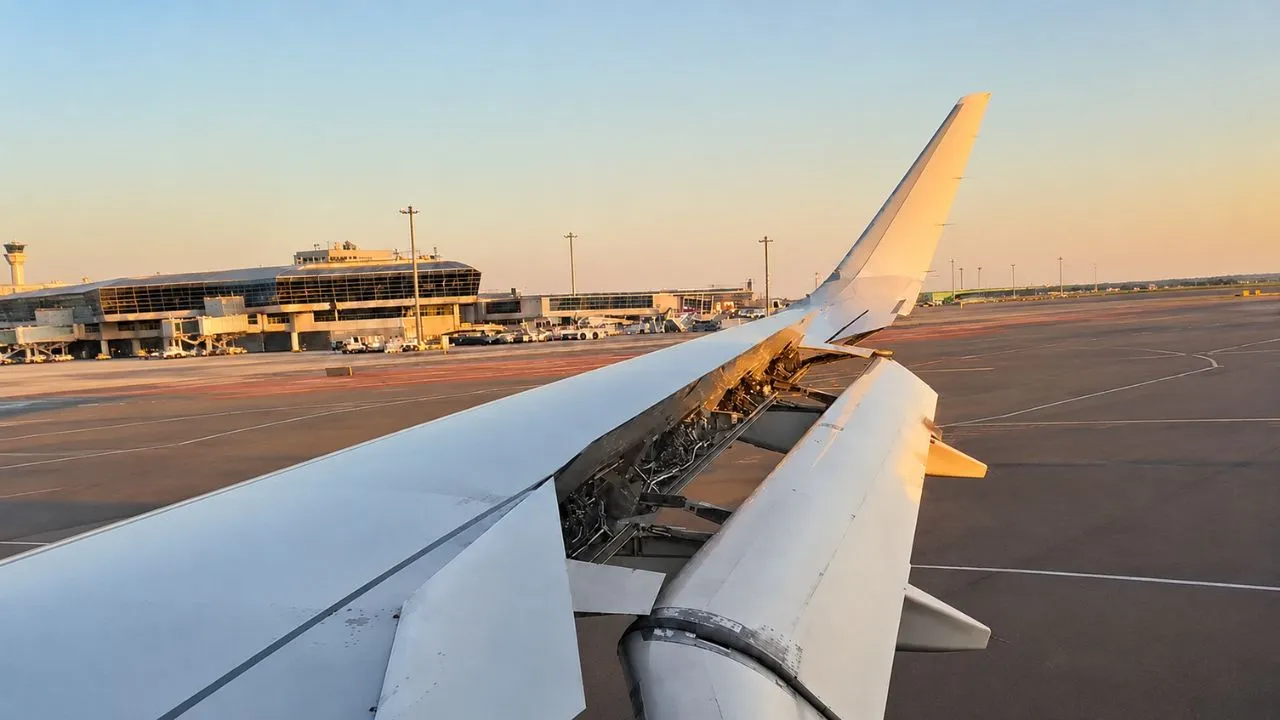
Watch the video and observe the movement of the spoilers and flaps after landing:
When observing an airplane wing immediately after landing, several things may draw your attention at the same time: panels rising from the upper surface, movable components changing position, internal mechanisms becoming visible, and the wingtip standing out in the frame.
To someone looking through a passenger window or watching a video of this moment, it may appear that several parts of the wing are moving simultaneously. In fact, that is exactly what is happening.
After touchdown, the aircraft’s primary objective is no longer to remain airborne. It must now reduce speed safely and efficiently. This is when the spoilers, wheel brakes, thrust reversers, and other deceleration systems come into action.
What changes on the wing after touchdown?
During flight, the wing is configured to generate lift. Even during the landing approach, when the flaps are already extended, its primary function is still to support the aircraft at a relatively low airspeed.
Once the wheels contact the runway, that requirement changes. The aircraft must now reduce lift, increase deceleration, and transfer more of its weight onto the landing gear.
After touchdown, the systems help the aircraft:
- rapidly reduce lift;
- increase aerodynamic drag;
- transfer more weight onto the landing gear;
- improve wheel-braking effectiveness;
- prepare for runway exit and taxi.
Why do the spoilers rise?
Spoilers are movable panels installed on the upper surface of the wing. After landing, they may rise rapidly to disrupt the airflow and reduce the wing’s ability to generate lift.
Reducing lift
Even after the wheels touch the runway, the wing may continue producing a significant amount of lift.
When the spoilers rise, they disturb part of the airflow over the wing. This rapidly reduces lift and transfers a greater portion of the aircraft’s weight onto the landing gear.
Increasing aerodynamic drag
Spoiler deployment also increases resistance to the aircraft’s forward motion. This additional aerodynamic drag assists with deceleration, especially during the first moments of the landing roll, when the aircraft is still traveling at a relatively high speed.
Improving wheel-braking effectiveness
The wheel brakes depend on adequate tire contact with the runway. If the wing continues supporting a large portion of the aircraft’s weight, the load acting on the wheels remains lower.
By reducing lift, the spoilers cause the aircraft to settle more firmly onto the landing gear. This improves tire traction and allows the wheel brakes to operate more effectively.
Amazon Recommended Products
AVIATION PICKS

Do the spoilers always deploy automatically?
On many commercial aircraft, the spoilers used after landing can be armed in advance by the flight crew.
When specific conditions are confirmed, such as ground contact and the correct control configuration, the system allows the automatic deployment of the ground spoilers.
The exact operating logic varies according to the manufacturer, aircraft model, and system design. Although the general principle is similar, the deployment criteria are not identical on every aircraft.
What happens to the flaps after landing?
Flaps are movable surfaces normally installed along the trailing edge of the wing. During approach, they are extended to increase lift at lower speeds and allow the aircraft to land at a reduced airspeed.
In many configurations, extending the flaps also increases aerodynamic drag.
After touchdown, the flaps normally remain extended during the initial portion of the landing roll. They are later retracted according to the flight crew’s procedures.
Flap retraction generally begins when:
- the aircraft has reduced its speed sufficiently;
- the initial landing-roll phase has ended;
- the after-landing procedures have begun;
- the aircraft is leaving the runway or beginning to taxi.
The exact timing varies depending on the aircraft type, airline procedures, and operating conditions.
What is the difference between spoilers and flaps?
Although spoilers and flaps are both movable surfaces installed on the wings, they perform different functions.
Spoilers
- are installed on the upper surface of the wing;
- reduce lift;
- increase drag;
- assist with deceleration;
- improve wheel-braking effectiveness after landing.
Flaps
- are normally installed along the trailing edge of the wing;
- increase lift at lower airspeeds;
- assist during approach and landing;
- may also increase aerodynamic drag;
- are retracted after landing according to operating procedures.
In simplified terms, the flaps help the aircraft fly and land at lower speeds, while the spoilers help remove lift and slow the aircraft after touchdown.
What are flap track fairings?
The elongated structures visible beneath the rear portion of the wing are known as flap track fairings.
On many aircraft, the flaps move rearward and downward when extended. This movement requires tracks, guides, linkages, actuators, and other mechanical components.
The fairings help to:
- cover portions of these mechanisms;
- protect internal components;
- reduce aerodynamic resistance;
- improve airflow beneath the wing.
They are therefore not merely decorative features. They are part of the structural and aerodynamic assembly associated with flap operation.
Amazon Recommended Products
AVIATION PICKS
What is the purpose of winglets?
Winglets are aerodynamic surfaces installed at the outer ends of the wings. Depending on the design, they may be curved, angled upward, or divided into upper and lower sections.
Their primary purpose is to reduce some of the aerodynamic effects associated with wingtip vortices and induced drag.
In general, winglets can help:
- improve aerodynamic efficiency;
- reduce fuel consumption under certain operating conditions;
- optimize overall wing performance;
- reduce a portion of the induced drag.
In the video, the winglets are visible at the wingtips, but they are not directly responsible for the aircraft’s deceleration after landing.
What happens inside the wing during these movements?
The movements visible from the outside are the result of the coordinated operation of several internal components.
These may include:
- actuators;
- linkages;
- tracks and guides;
- position sensors;
- hydraulic or electromechanical systems;
- computers and control units;
- commands initiated by the flight crew.
What appears to be a simple wing surface moving is actually the visible result of integrated mechanical, hydraulic, electrical, and electronic systems.
How are the spoilers, landing gear, and brakes connected?
Before touchdown, most of the aircraft’s weight is supported aerodynamically by the wings.
Immediately after the wheels contact the runway, the wing may still be producing lift. This means that the aircraft’s full weight is not yet acting on the landing gear.
When the spoilers rise:
- lift decreases;
- more weight is transferred onto the landing gear;
- tire contact with the runway increases;
- the wheel brakes become more effective;
- the aircraft decelerates more efficiently.
For this reason, spoilers used after touchdown may also be described as lift-dump or lift-reduction devices.
Does aerodynamic drag also help slow the aircraft?
Yes. In addition to the wheel brakes and thrust reversers, aerodynamic drag also contributes to reducing the aircraft’s speed.
When the spoilers rise, they increase the resistance of the airflow against the aircraft’s forward motion. This effect is particularly useful immediately after touchdown, when the aircraft is still moving at a relatively high speed.
What are we seeing on this wing?
In this type of scene, it is usually possible to observe:
- spoilers raised to reduce lift and increase drag;
- flaps still extended or beginning to retract;
- fairings covering the flap tracks and mechanisms;
- winglets installed at the wingtips;
- the transition from the landing configuration to the taxi configuration.
Within a few seconds, the wing changes from a configuration designed to support the aircraft at a low airspeed to one that assists with deceleration and stabilization on the ground.
After landing, the spoilers rise to rapidly reduce lift, increase aerodynamic drag, and transfer more of the aircraft’s weight onto the landing gear, improving wheel-braking effectiveness. After the initial deceleration, the spoilers and flaps are retracted according to operating procedures. The video also shows the flap track fairings and the winglets at the wingtips.
Reference sources
- Federal Aviation Administration — Airplane Flying Handbook.
- Federal Aviation Administration — Pilot’s Handbook of Aeronautical Knowledge.
- NASA — Beginner’s Guide to Aerodynamics.
- Airbus — technical materials on flight controls and high-lift systems.
- Boeing — technical and training materials on flight-control systems.
- SKYbrary — references on spoilers, flaps, and landing operations.