
Aerodynamics is one of the most important foundations for understanding how an aircraft flies. For an aircraft maintenance technician, it is not necessary to master all of the advanced mathematical aspects of aerodynamics, but it is essential to understand the relationship between the air, the atmosphere, the aircraft, and the forces acting on it during flight.
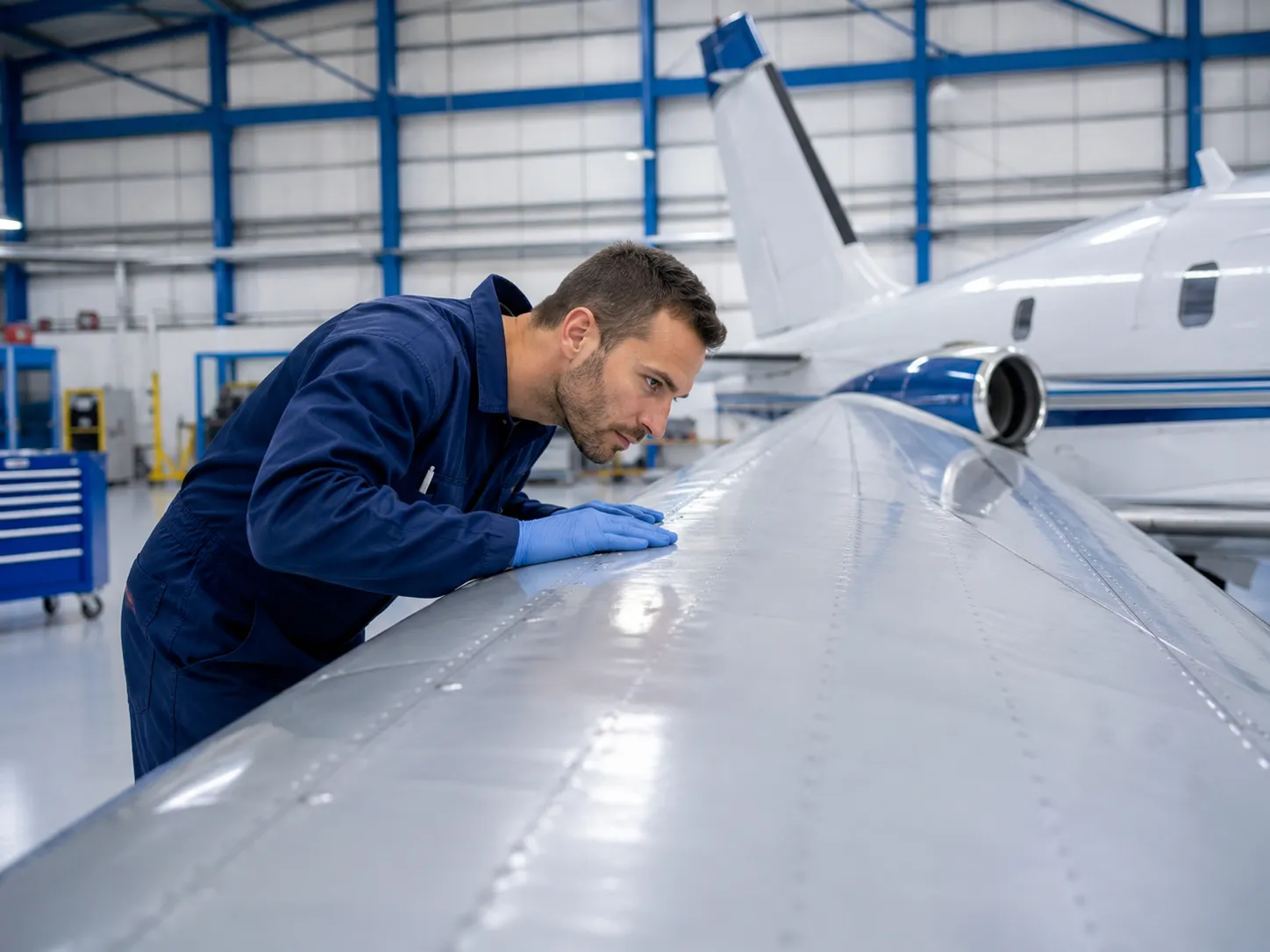
This knowledge is important because many maintenance decisions directly affect aircraft safety. A misaligned surface, an improperly repaired panel, uneven paint, deformation on a wing, or damage to a flight control surface can change the airflow and reduce aerodynamic performance.
For this reason, the technician needs to understand why the aircraft is designed with specific control systems, why external surfaces must remain smooth and regular, and how the air influences the behavior of an airplane or helicopter during flight.
The word aerodynamics comes from two Greek terms: aer, meaning air, and dyne, meaning force. Therefore, aerodynamics can be understood as the study of the forces produced by air when an object moves through it.
In aviation, that object is the aircraft. As it moves, air flows around its wings, fuselage, stabilizers, engines, propellers, and flight control surfaces. This movement of air generates forces that can either support or resist flight.
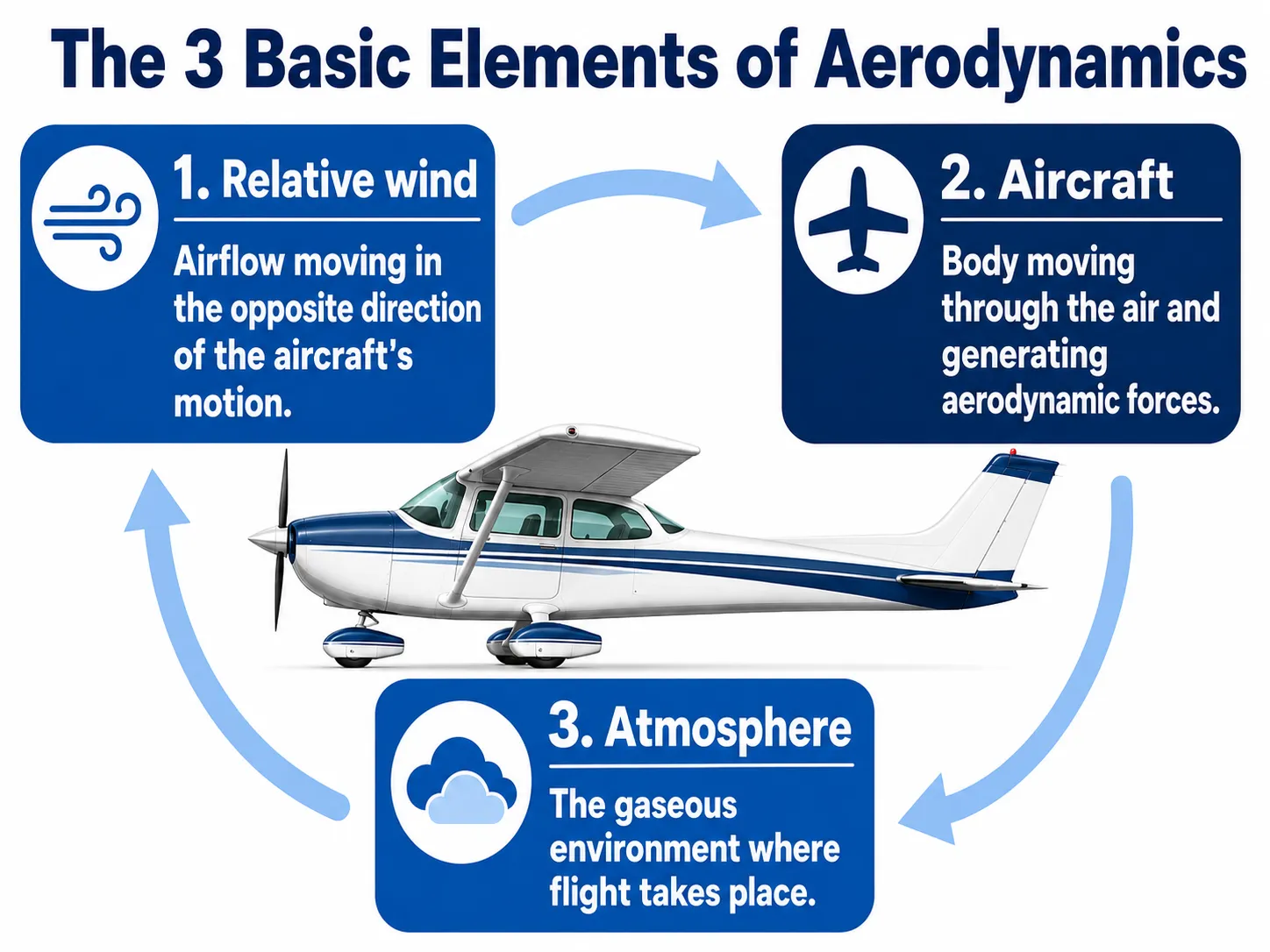
In practical terms, aerodynamics involves three main elements: the aircraft, the relative wind, and the atmosphere. The aircraft is the body moving through the air. The relative wind is the airflow passing around it. The atmosphere is the environment where all of this takes place.
Before studying the forces of flight, it is necessary to understand the environment in which the aircraft operates: the atmosphere.
An aircraft flies through the air. Because of this, the properties of the air directly influence control, lift, drag, engine performance, and the distance required for takeoff and landing.
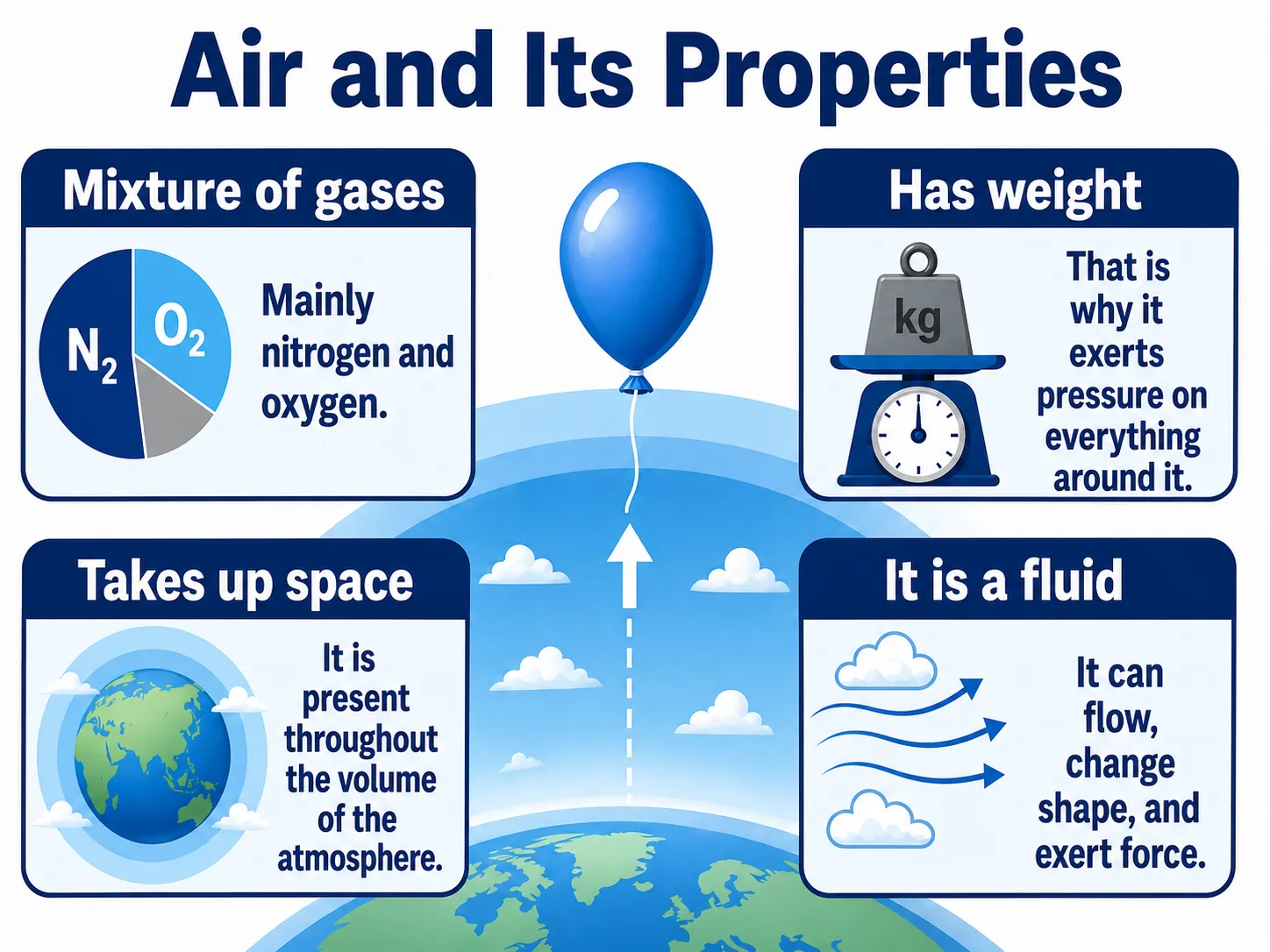
Air is a mixture of gases, made up mainly of nitrogen and oxygen. Although it may seem invisible and light, air has mass and therefore weight. It occupies space, can be compressed, and behaves like a fluid. This means it can flow, change shape, and exert pressure on objects.
A simple example helps explain this: a helium balloon rises because helium is lighter than the air around it. This shows that air has weight and affects objects within the atmosphere.
Atmospheric pressure is the force exerted by the weight of the air over a given area.
A useful comparison is diving. The deeper a person dives, the greater the water pressure on the body, because there is a taller column of water above them. Something similar happens with air. The closer we are to sea level, the greater the amount of air above us, and therefore the greater the atmospheric pressure.
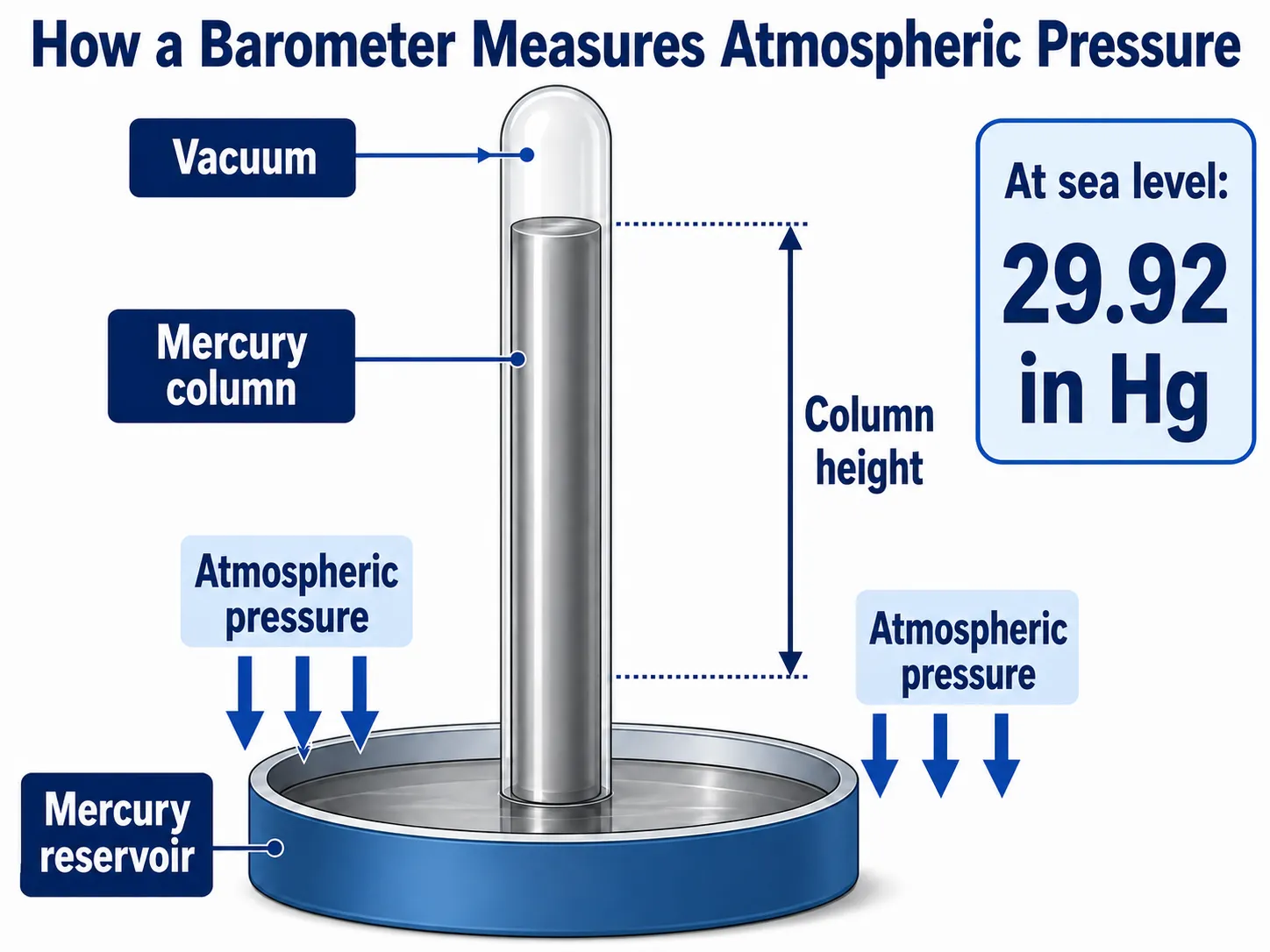
At sea level, standard atmospheric pressure is approximately 14.7 pounds per square inch, or 29.92 inches of mercury. This measurement is used because air pressure can be represented by the height of a column of mercury in a barometer.
In a mercury barometer, air pressure acts on the mercury in an open container and balances the mercury column inside a tube. When atmospheric pressure increases, the column rises. When pressure decreases, the column drops.
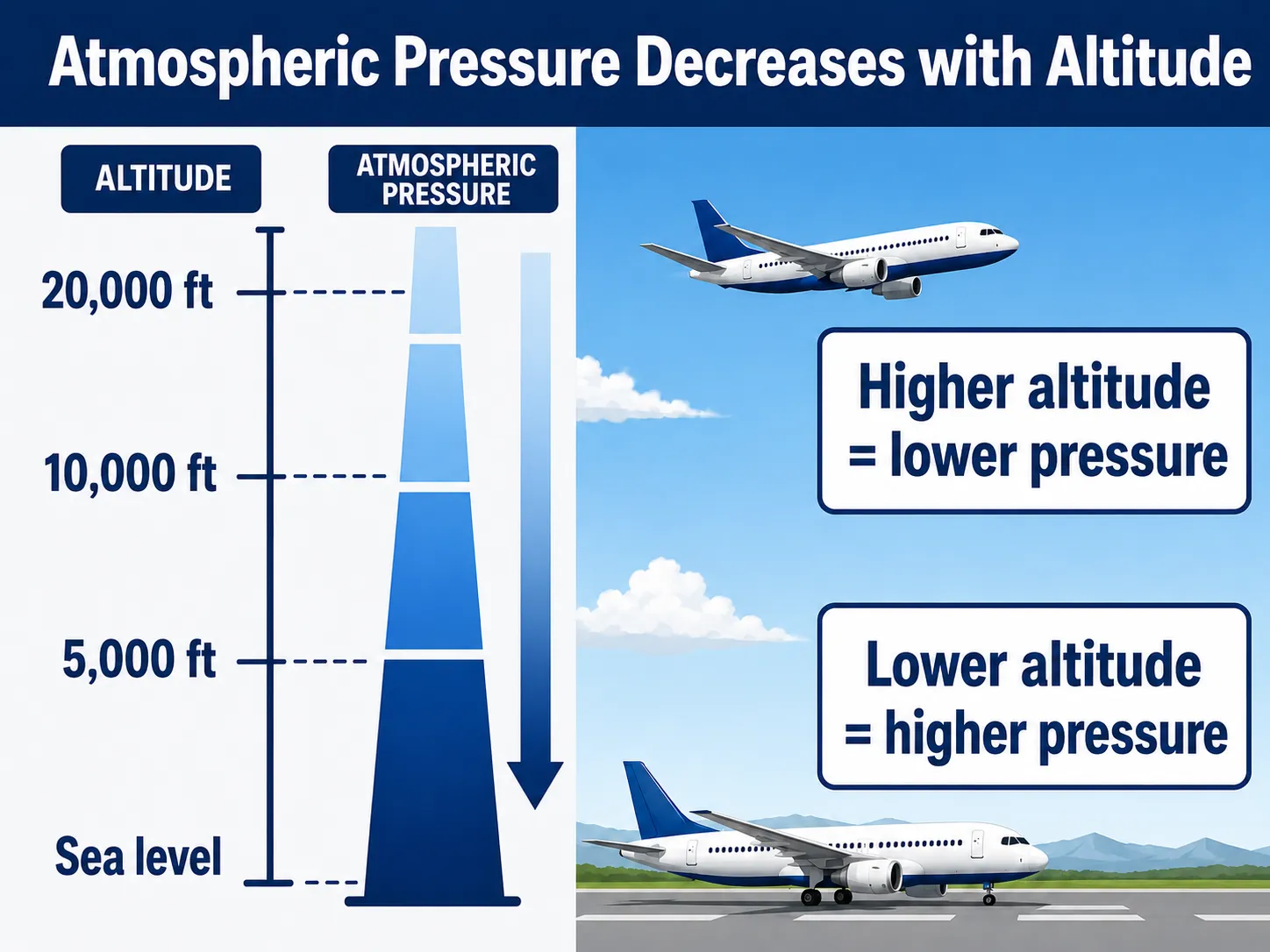
For aviation, the most important point is to understand that atmospheric pressure decreases with altitude. The higher the aircraft flies, the lower the pressure of the surrounding air.
This variation affects instruments, engine performance, lift, pressurization, and the overall behavior of the aircraft.
Density is the amount of mass contained in a given volume. In the case of air, density indicates how much air exists within a certain space.
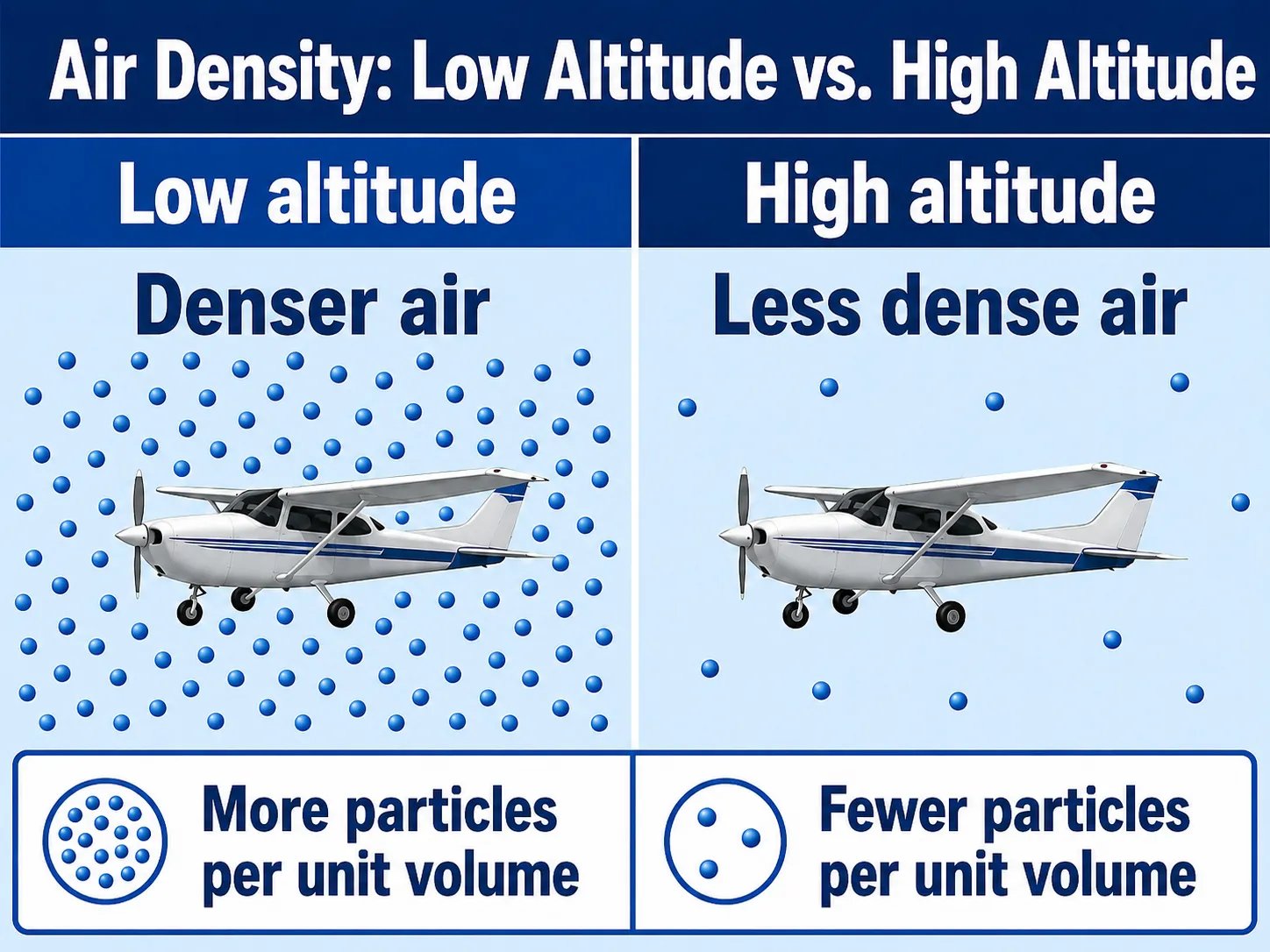
Since air is made up of gases, it can be compressed. When air is under higher pressure, its molecules are closer together. This makes the air denser. When pressure is lower, the molecules are farther apart, and the air becomes less dense.
Air density follows two important rules:
For this reason, the air at high altitudes is less dense than the air near sea level. In the same way, warm air is less dense than cold air.
This difference directly affects aircraft performance. In less dense air, there is less resistance to forward motion, but there are also fewer air particles passing over the wings, propellers, and engines. This can reduce lift, decrease propeller efficiency, and affect engine performance.
Under certain conditions, an aircraft may require a longer runway for takeoff, especially at high-elevation airports, on hot days, or in situations where the air is less dense. This happens because the wing needs enough airflow to generate adequate lift.
Humidity is the amount of water vapor present in the air. The higher the temperature, the greater the air’s ability to absorb water vapor.
An important point is that humid air is less dense than dry air when pressure and temperature are the same. This may seem strange at first, but it happens because water vapor molecules are lighter than the main molecules found in dry air.
In practice, on humid days, air density decreases. With lower density, the aircraft may have reduced aerodynamic performance and may require more distance for takeoff.
Therefore, temperature, altitude, and humidity are factors that must be considered when analyzing aircraft performance.
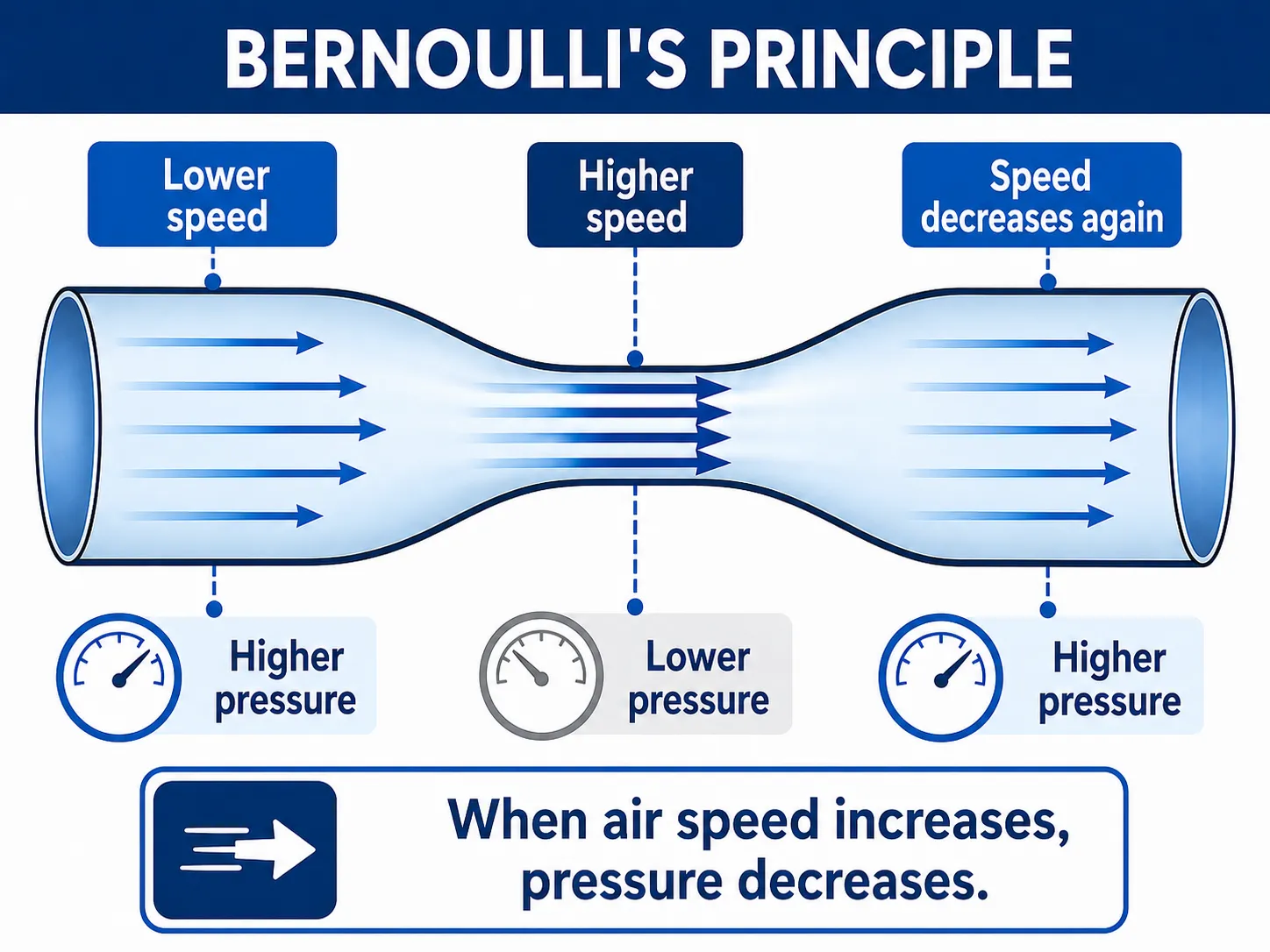
Bernoulli’s principle helps explain an important part of the lift produced by a wing.
In simple terms, this principle states that when a moving fluid increases in speed, its pressure decreases. Since air is considered a fluid, this behavior also applies to the airflow around a wing.
Imagine a tube with a narrower section. When air passes through that narrow area, it accelerates. As it accelerates, its pressure decreases. Something similar happens when air flows over the curved upper surface of a wing.
The upper surface of a wing usually has more curvature. When air passes over that region, it tends to accelerate. As the speed of the air over the wing increases, the pressure in that area decreases.
At the same time, on the lower surface of the wing, the pressure remains higher. This difference between lower pressure above the wing and higher pressure below it helps push the wing upward.
This upward force is called lift.
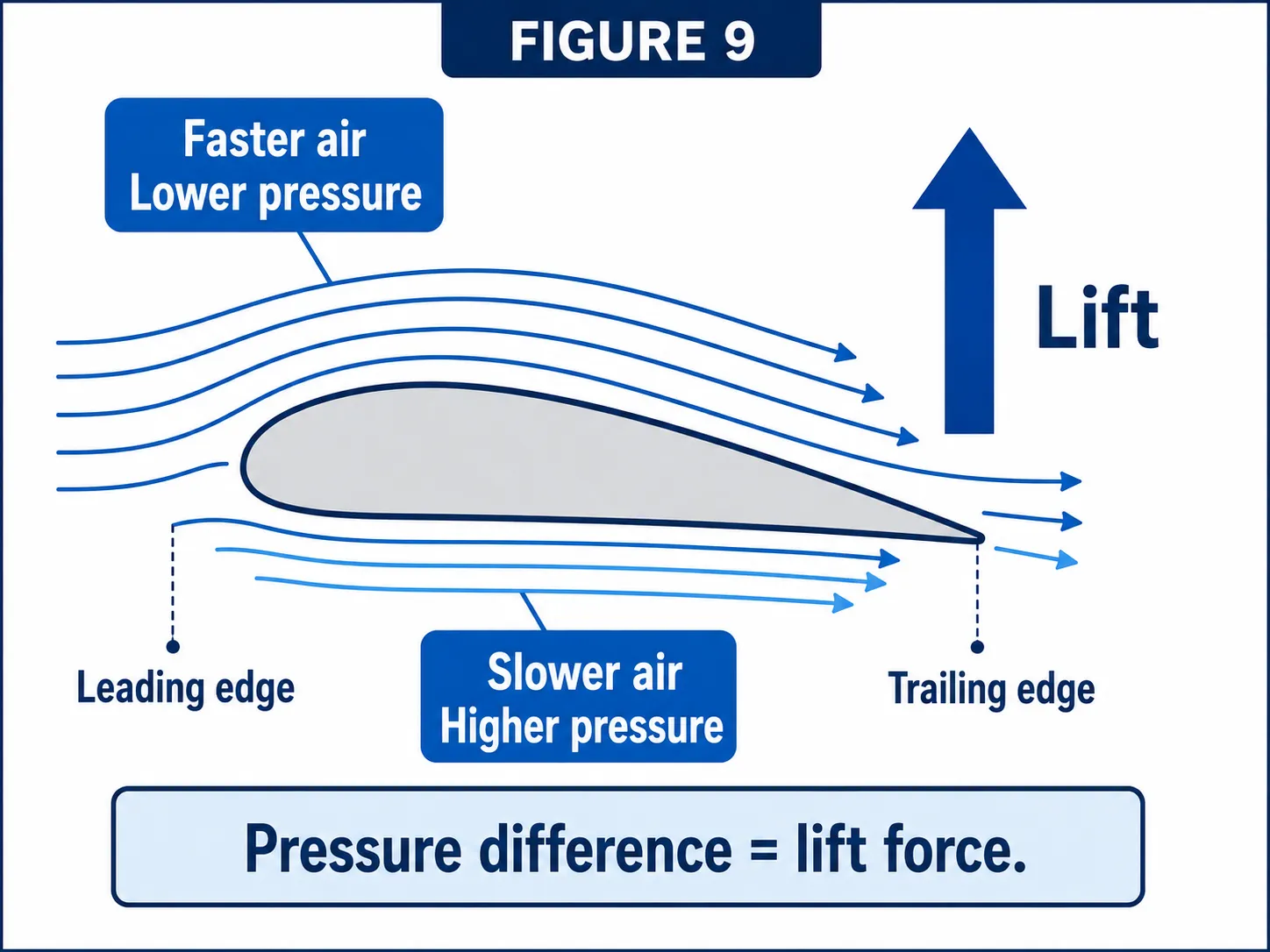
Although Bernoulli’s principle explains an important part of lift, it does not act alone. Lift is also related to the downward deflection of air, the wing’s angle of attack, and Newton’s laws of motion.
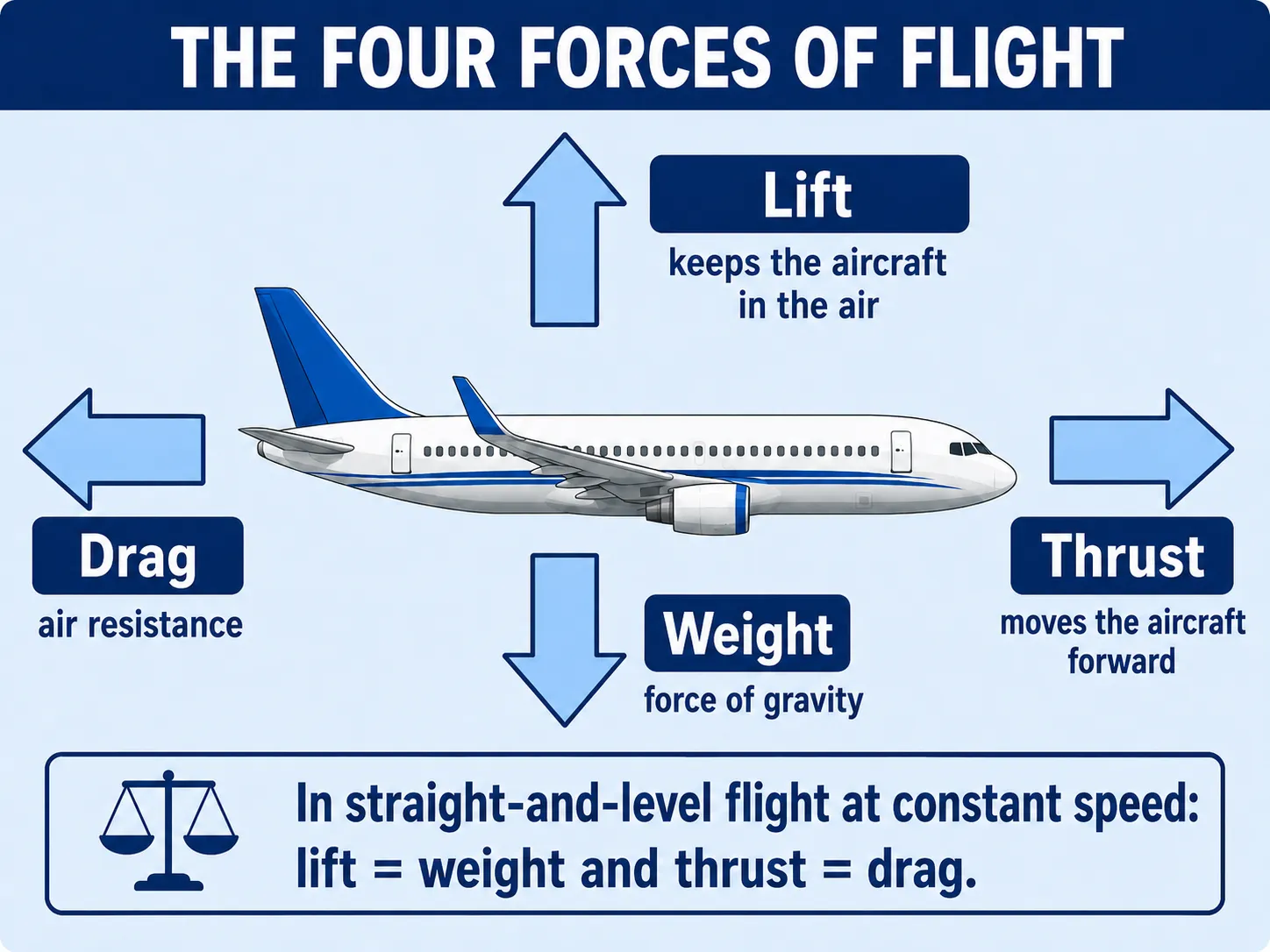
During flight, an aircraft is affected by four main forces: weight, lift, thrust, and drag.
Weight is the force of gravity pulling the aircraft downward.
Lift is the aerodynamic force that acts upward and allows the aircraft to remain in the air.
Thrust is the force that moves the aircraft forward. It can be produced by propellers, jet engines, or other propulsion systems.
Drag is the resistance of the air against the aircraft’s motion. It acts like an aerodynamic brake.
For an aircraft to maintain straight-and-level flight at a constant speed, these forces must be in balance. Lift must balance weight, and thrust must balance drag.
Motion is the change in position of a body in relation to a reference point.
A person seated inside an aircraft in flight may be stationary in relation to the cabin, but moving in relation to the ground and the outside air. This shows that motion always depends on the reference point being used.
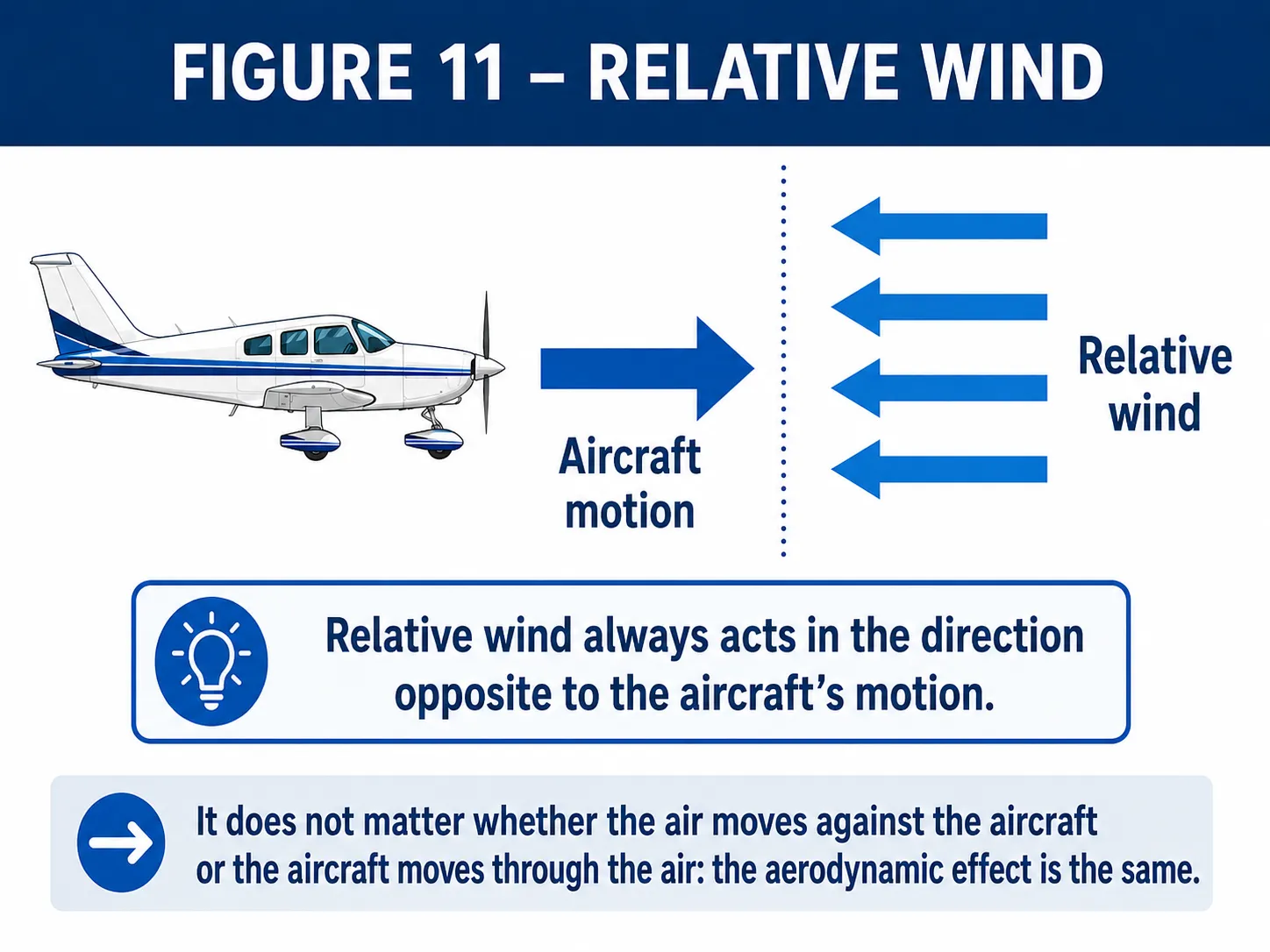
In aerodynamics, the most important factor is the relative motion between the aircraft and the air. It does not matter whether the aircraft moves through the air or the air moves against the aircraft. The aerodynamic effect is the same.
The airflow around the aircraft, caused by the aircraft’s movement, the movement of the air, or both at the same time, is called the relative wind.
Relative wind is essential for understanding lift, drag, angle of attack, and the operation of flight control surfaces.
In everyday language, we often use speed and velocity as if they meant the same thing. Technically, however, there is a difference between speed and velocity.
Speed only indicates how far an object travels in a given amount of time. Velocity also includes the direction of that movement.
For example, saying that an aircraft is flying at 260 miles per hour describes its speed. But saying that it is flying at 260 miles per hour toward the southwest describes its velocity, because it includes both magnitude and direction.
Acceleration is the change in velocity over time. When an aircraft increases its speed, positive acceleration occurs. When it reduces speed, deceleration occurs.
These concepts are important because any change in aircraft speed, direction, or attitude involves forces acting on the aircraft.
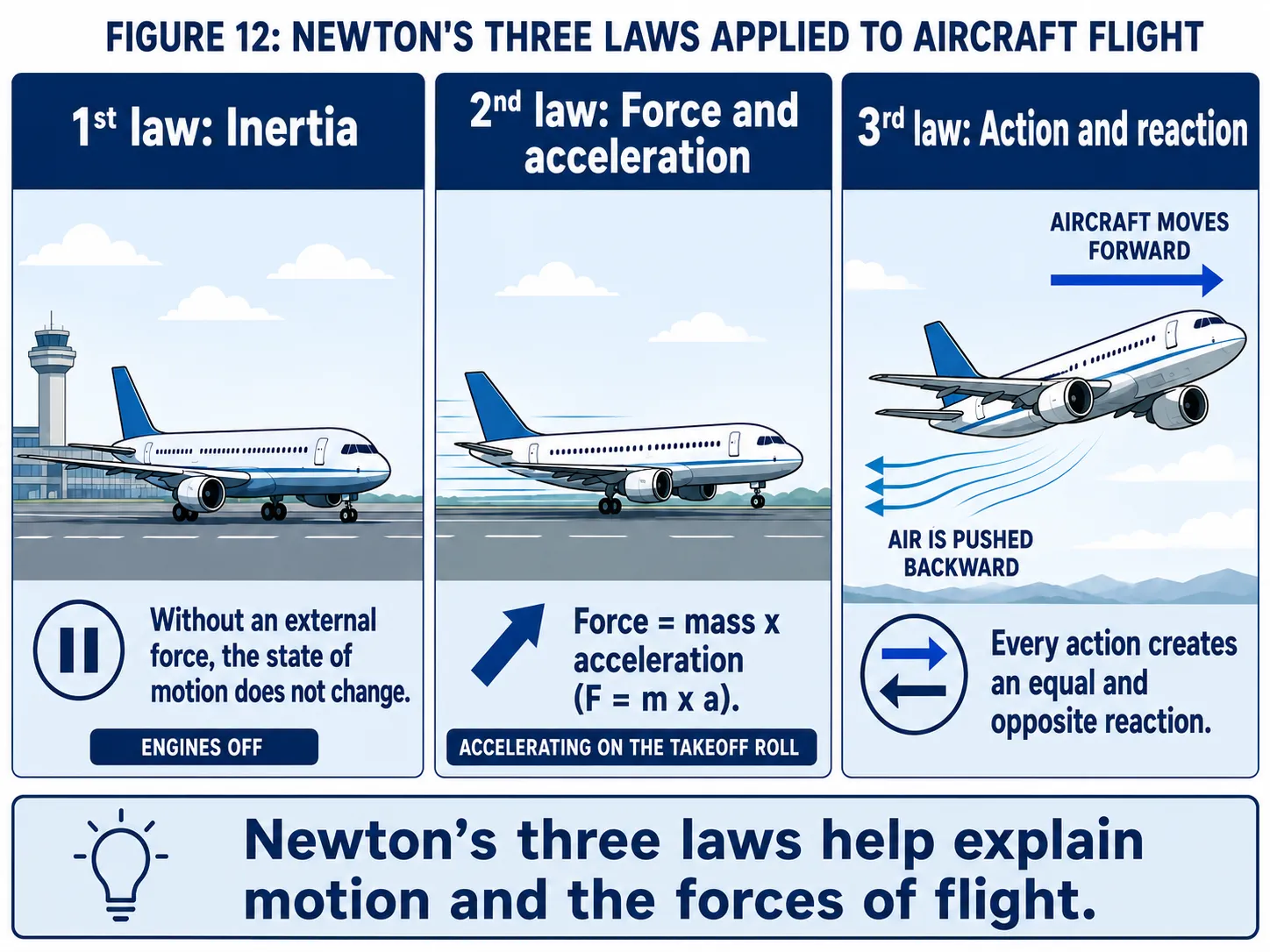
Newton’s laws of motion help explain how forces act on an aircraft.
The first law is the law of inertia. It states that a body at rest tends to remain at rest, and a body in motion tends to continue moving in a straight line at constant speed unless an external force acts on it.
When an aircraft is parked on the ground, it remains stationary until engine thrust overcomes inertia and starts moving it forward. During straight-and-level flight, the aircraft tends to continue moving unless a force changes its speed, direction, or attitude.
Newton’s second law relates force, mass, and acceleration. It can be represented by the formula:
Force = Mass × Acceleration
This means that to change the motion of a body, a force must be applied. The greater the mass of the aircraft, the greater the force required to produce a given acceleration.
In flight, this law appears in many situations: acceleration during takeoff, deceleration during landing, changes of direction during turns, corrections for crosswind, and changes in aircraft attitude.
Newton’s third law is the law of action and reaction. For every action, there is an equal and opposite reaction.
A simple example is a swimmer: the swimmer pushes water backward, and as a reaction, the body moves forward. In aviation, propulsion also follows this principle. A propeller or engine pushes air backward, and the aircraft receives a reaction that moves it forward.
Lift can also be analyzed through this principle. The wing deflects part of the air downward and, as a reaction, receives an upward force.
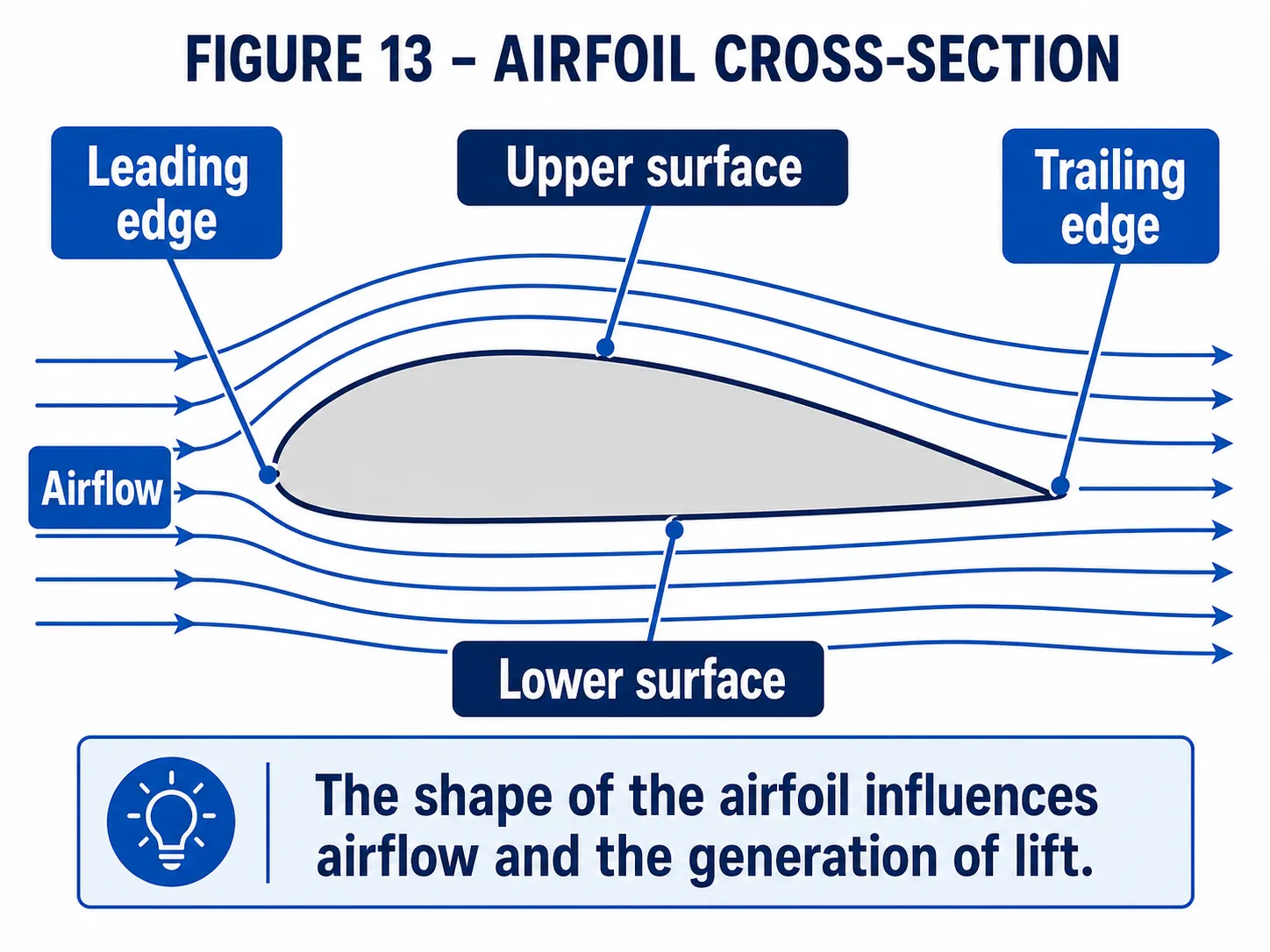
An airfoil is a surface designed to produce a useful reaction when it moves through the air.
The wing is the best-known example of an airfoil, but it is not the only one. Propeller blades, the horizontal stabilizer, the vertical stabilizer, and some flight control surfaces can also function as airfoils.
The purpose of an airfoil is to convert the relative motion of air into a useful force. In the case of a wing, the main force is lift. In the case of a propeller, the airfoil shape of the blades helps produce thrust.
On a conventional wing, the upper surface usually has more curvature than the lower surface. This difference in shape influences airflow and contributes to the generation of lift.
When air passes over the upper surface of the wing, it tends to move at a higher speed. As a result, pressure in that region decreases. On the lower surface, the pressure is relatively higher. The pressure difference between the two surfaces helps push the wing upward.
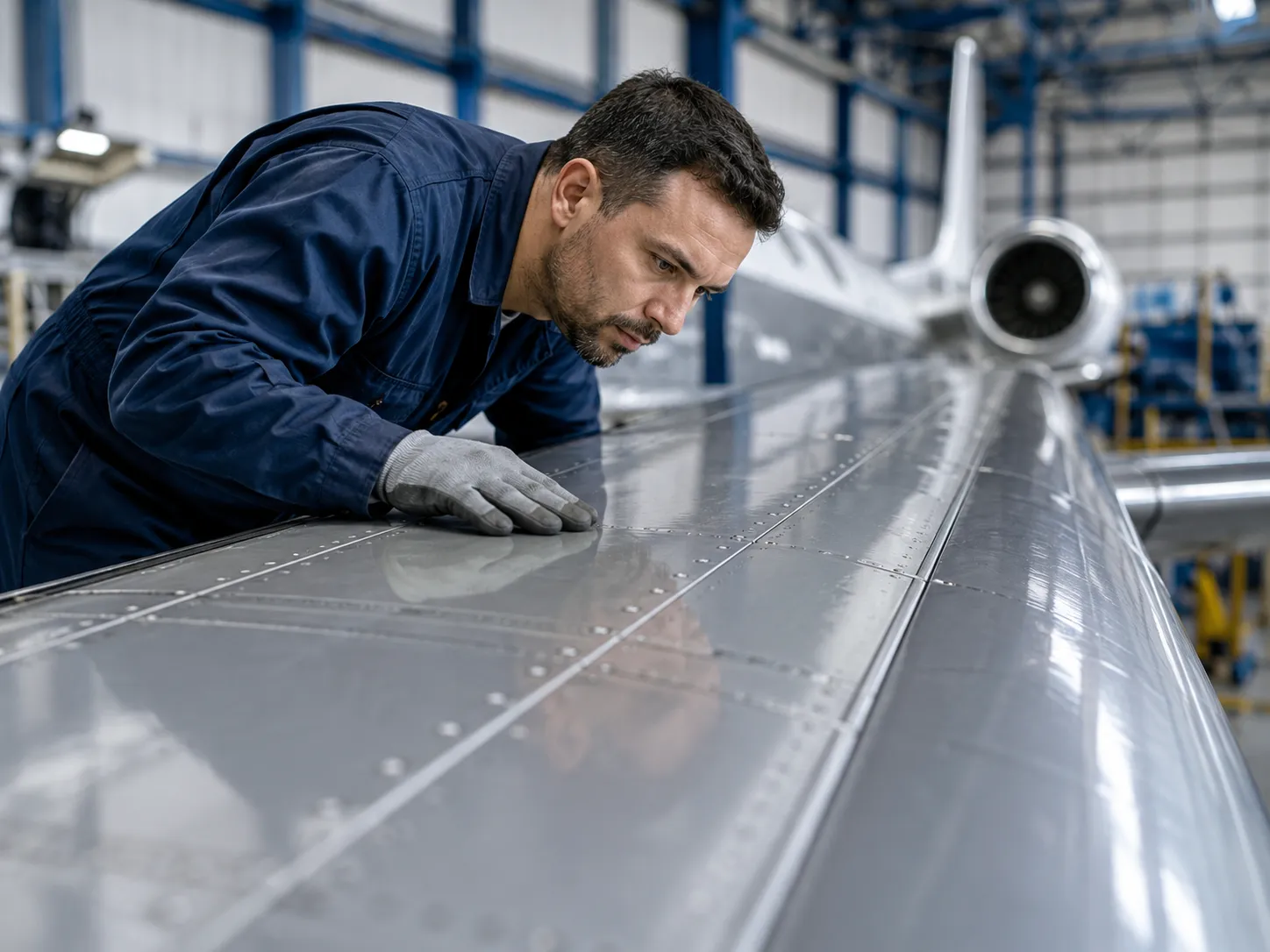
For the aircraft maintenance technician, this concept is fundamental. Wings and aerodynamic surfaces must maintain their correct shape. Dents, waviness, ice, dirt, uneven paint, improper gaps, or poorly performed repairs can alter airflow and reduce aerodynamic efficiency.
That is why the visual and structural inspection of the aircraft’s external surfaces is not merely an aesthetic concern. It is a step directly related to flight safety.
Aerodynamics explains how air interacts with the aircraft and how this interaction produces the fundamental forces required for flight.
For anyone working in aircraft maintenance, understanding these principles helps with a better interpretation of aircraft design, the operation of control surfaces, and the importance of keeping wings, fuselage, stabilizers, propellers, and other components in proper condition.
Pressure, density, humidity, relative wind, Bernoulli’s principle, Newton’s laws, lift, drag, thrust, and weight are not just theoretical concepts. They appear in daily aviation practice and directly influence aircraft safety, performance, and reliability.