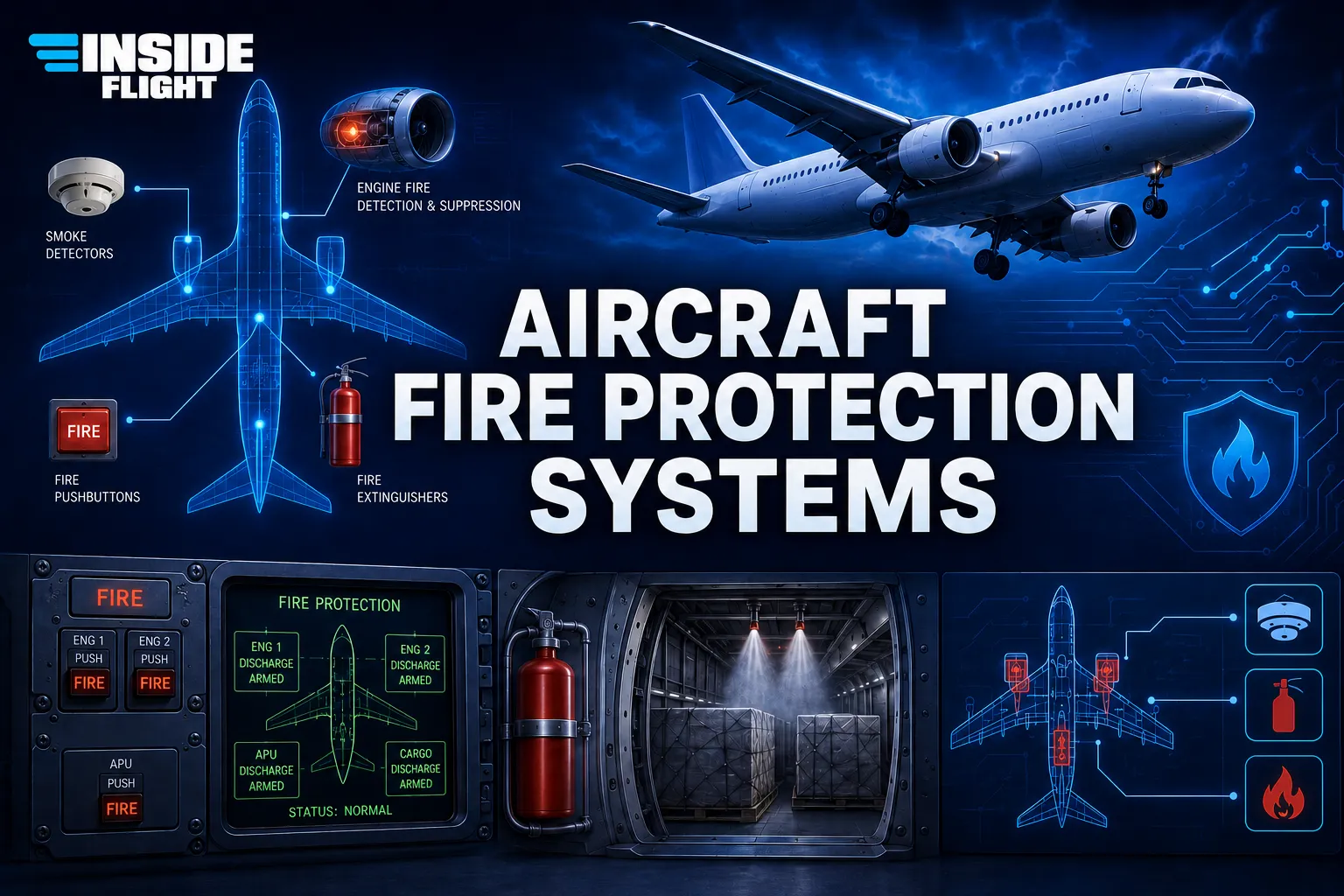
To explain the fire protection system, we will use the Boeing 737 MAX 8, also known as the Boeing 737-8, as a didactic reference. The goal is not to turn this content into a technical aircraft manual, but to use this model as a basis for understanding, in a clear and realistic way, how a modern commercial aircraft detects, alerts, isolates, and responds to fire, smoke, or overheat conditions.
The fire protection system is one of the most important systems for operational safety. In an aircraft, fire can develop in areas that are difficult to access, such as engines, technical compartments, the APU, cargo compartments, or areas near hot ducts. For this reason, the aircraft needs ways to quickly identify a hazardous condition and provide the crew with the resources needed to respond in an organized manner.
Some details may vary depending on the aircraft configuration, the airline, the equipment installed, the applicable technical documentation, and approved procedures. Even so, the general principles are similar in many modern commercial aircraft: detect, alert, isolate, and, when applicable, extinguish or suppress the fire.
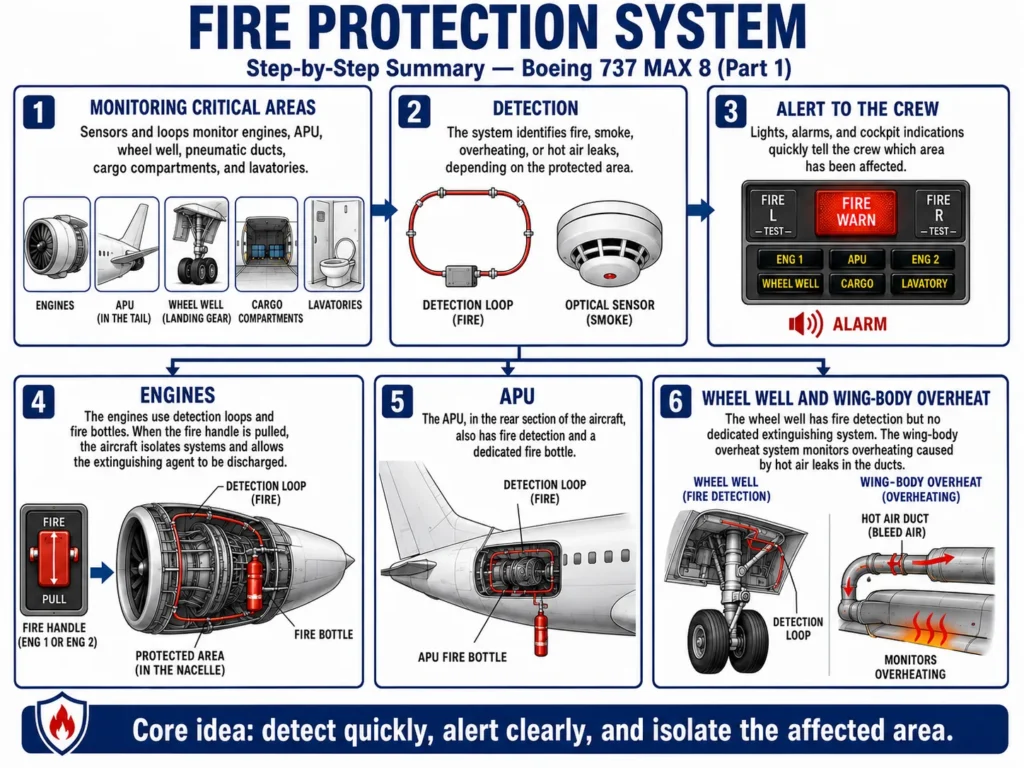
The fire protection system is a set of devices responsible for monitoring critical areas of the aircraft. It can detect fire, smoke, overheat conditions, or hot air leaks, depending on the protected area and the type of sensor installed.
This system is not made up of just one piece of equipment. It includes sensors, detection loops, smoke detectors, electronic units, control panels, warning lights, aural alerts, fire extinguishing bottles, squibs, tubing, discharge nozzles, isolation valves, and test circuits.
In simple terms, it works like a monitoring and response network. First, it monitors sensitive areas. Then, if an abnormal condition is detected, it alerts the crew. After that, depending on the affected area, it allows related systems to be isolated and an extinguishing or suppressing agent to be discharged.
The operation of the system can be understood in four main stages: detection, alerting, isolation, and extinguishing or suppression.
Detection occurs when sensors or detectors identify fire, smoke, excessive heat, or an abnormal thermal condition. Each area of the aircraft has different risks, which is why the detection devices also vary.
Alerting is how the information reaches the crew. This can happen through cockpit warning lights, aural alerts, panel indications, or messages related to the affected system.
Isolation is the action of cutting off or separating sources that could feed the fire. In the case of an engine fire, for example, it may be necessary to shut off fuel, isolate pneumatic air, disconnect the associated electrical generation, close valves, and disable related systems.
Extinguishing or suppression occurs when an extinguishing agent is released into a protected area. In engines and the APU, the goal is to fight the fire directly inside the affected compartment. In cargo compartments, the goal is often to suppress the fire, preventing it from spreading until the aircraft can land safely.
In a commercial aircraft such as the Boeing 737 MAX 8, the fire protection system can involve several critical areas. These include the engines, the APU, cargo compartments, lavatories, the main landing gear wheel well, wing-body overheat zones, and technical areas related to equipment cooling.
Each area has its own logic. Engines and the APU operate with fuel, oil, hot air, and high-temperature metal parts. Cargo compartments are enclosed areas that are inaccessible during flight. Lavatories have risks associated with smoke and the waste bin. The main landing gear wheel well can be affected by abnormal heat from brakes or landing gear components. Wing-body overheat zones monitor possible hot air leaks in areas near the wing and fuselage.
For this reason, there is no single solution for the entire aircraft. The system is divided into zones, and each zone receives the type of protection best suited to the existing risk.
Engines are critical areas because they bring together fuel, oil, hot components, compressed air, mechanical accessories, and support systems. An oil or fuel leak coming into contact with a hot surface can create a dangerous situation.
To monitor these areas, engines use fire and overheat detection systems. On aircraft in the Boeing 737 family, this detection is performed by loops installed in specific regions of the engine. Although the internal system may have several segments and sensors, this architecture is presented to the flight crew in a simplified way in the cockpit, usually as loop A and loop B.
These loops work as distributed sensors. Instead of monitoring only one point, they cover a larger area of the engine compartment. If excessive heat or a fire-compatible condition occurs, the system sends a signal to the detection unit, which processes the information and generates the corresponding alert.
This architecture helps reduce false alerts and increases reliability. Under normal conditions, the logic may require proper confirmation from the loops before issuing a fire warning. If one loop fails, the system may change its detection logic according to the system architecture and the applicable procedures.
The detection loop is one of the most important elements of the system. It can be understood as an elongated sensor installed around critical areas. Depending on the area, this element may operate through gas expansion, changes in electrical resistance, or another thermal detection principle.
In engines and in the APU, certain systems use gas-filled sensing tubes. When the temperature rises above the established limit, the gas expands and activates pressure switches at the ends of the loop. The system interprets this change as an overheat or fire condition.
In other areas, such as the main landing gear wheel well, the logic may use a temperature-sensitive element with specific electrical behavior. When the temperature reaches a certain value, the resistance changes and allows the circuit to indicate a fire or extreme heat condition.
The main point is that the loop can cover a larger area than a single-point sensor. This is important in areas such as engines, the APU, pneumatic ducts, and the wheel well, where a dangerous condition may appear at different points within the compartment.
The signals sent by the loops and sensors need to be processed by an electronic unit. This unit interprets whether the condition is normal, whether there is a circuit fault, whether an overheat condition exists, or whether the situation corresponds to a fire.
On the Boeing 737, these units are located in technical areas of the aircraft, such as the electrical and electronic compartment, known as the E&E Bay. For pilots, the system presents information in a simplified way in the cockpit. For maintenance, the unit can provide more detailed information, helping identify which loop, area, or circuit has failed.
This difference is important. The flight crew needs quick and clear information in order to act. Maintenance personnel need more precise data for troubleshooting, inspection, and correction of the problem.
In the cockpit, the flight crew has specific controls to respond to engine and APU fires. In many commercial aircraft, these controls are called fire handles or fire switches.
These controls are not used only to discharge the extinguishing agent. Before that, they help isolate the affected area. When an engine fire control is activated, the aircraft may close fuel valves, isolate bleed air, disconnect the associated electrical generation, cut hydraulic supply related to the engine, and prepare the extinguishing bottle for discharge.
This logic is essential. If there is a fire, it is not enough to simply release an extinguishing agent into the area. It is necessary to reduce or eliminate the sources that could feed the fire. Fuel, oil, hot air, electrical power, and hydraulic fluid can make the situation worse if they are not isolated correctly.
Once the area is isolated, the flight crew can command the discharge of the extinguishing agent according to the required procedure.
Fire extinguishing bottles are pressurized containers that store the extinguishing agent. They are installed in technical areas of the aircraft and are connected by tubing to the protected zones.
In the case of the engines, the bottles are usually located in a structural area near the wheel well, but they do not protect the wheel well itself. They are directed to the engines through the appropriate lines and valves.
The bottle contains the extinguishing agent and a pressurizing gas, such as nitrogen, which is responsible for pushing the agent through the tubing when discharge is commanded. Bottle pressure is monitored, and the flight crew may receive an indication when the bottle has been discharged.
These bottles are part of the aircraft’s fixed fire extinguishing system. During flight, no one physically accesses the engine to fight a fire. The flight crew commands the discharge from the cockpit, and the agent automatically flows to the selected area.
One essential component in bottle discharge is the squib. The squib is an activation device that ruptures the bottle seal when it receives the proper electrical command. After this rupture, the internal pressure forces the extinguishing agent out of the bottle and through the tubing to the protected zone.
In simple terms, the squib works as the mechanism that “opens” the bottle at the right moment. Without it, the agent would remain trapped inside the cylinder.
In systems that allow one bottle to be directed to more than one area, there may be different squibs or discharge paths. This allows the flight crew to select the affected side or compartment.
For many years, Halon 1301 was widely used in fixed aircraft fire extinguishing systems. It is effective against fire, does not conduct electricity, and does not leave residue like dry chemical powder, which is important in areas with sensitive components.
At the same time, Halon has an environmental impact, especially related to the ozone layer. For this reason, the aviation industry has been studying and adopting alternatives in new projects and certified applications. Even so, many aircraft in operation still use certified Halon systems in accordance with applicable requirements.
The extinguishing agent has a difficult job: it must fight the fire without causing unnecessary damage to equipment, without conducting electricity, and without creating greater additional risks to the aircraft.
The APU, or Auxiliary Power Unit, is a small auxiliary turbine installed in the rear section of the aircraft. It provides electrical power and pneumatic air, mainly on the ground, before the main engines are started or during certain operating conditions.
Because the APU operates with fuel, ignition, air, and hot parts, it also needs fire protection. The system monitors the APU area through detectors or loops, sends an alert to the cockpit in case of fire, and allows the extinguishing agent to be discharged.
The APU has its own fire extinguishing bottle. Even if the cockpit control can be rotated in more than one direction, the didactic logic is simple: the APU has a dedicated bottle, and the discharge is directed to the APU compartment.
On the ground, APU fire protection is especially important because the unit may be running while the aircraft is parked, during boarding, maintenance, or flight preparation. Some configurations may include external warning indications and controls in the wheel well, allowing ground or maintenance crews to respond.
The wheel well is the compartment where the main landing gear is housed when it is retracted. This area can be exposed to abnormal heat, especially after heavy braking, brake problems, leaks, or conditions associated with the landing gear.
On the Boeing 737, the wheel well has fire detection, but it does not have a dedicated fire extinguishing system. This is a very important distinction. There are fire extinguishing bottles located in the wheel well area, but they serve the engine fire extinguishing system, not the wheel well itself.
If a fire warning occurs in the wheel well, the flight crew follows the required operating procedure. In simple terms, the logic may involve reducing speed, extending the landing gear, and landing as soon as possible. When the landing gear is extended, the area is no longer enclosed inside the compartment and begins to receive outside airflow, which can help reduce the temperature and remove the heat source.
This example shows that fire protection does not always mean “detect and extinguish.” In some areas, the system detects and alerts, while the response depends on operational procedures.
The wing-body overheat system monitors areas near the wing and fuselage, especially regions where pneumatic ducts carrying hot air are routed. This system is related to overheat detection, not necessarily direct fire detection.
Pneumatic air, known as bleed air, is hot compressed air taken from the engines or the APU. It can be used for air conditioning, pressurization, anti-ice, and other systems. If this air leaks from a duct, it can heat the structure, insulation, wiring, and nearby components.
For this reason, sensors or detection elements monitor areas around the pneumatic ducts. If abnormal heat is detected, the system sends an alert to the flight crew. The goal is to identify the leak before it causes structural damage, component damage, or a greater fire risk.
In simple terms, wing-body overheat works as protection against heat in the wrong place. Not every alert of this type means there is a fire, but every overheat condition must be treated seriously.
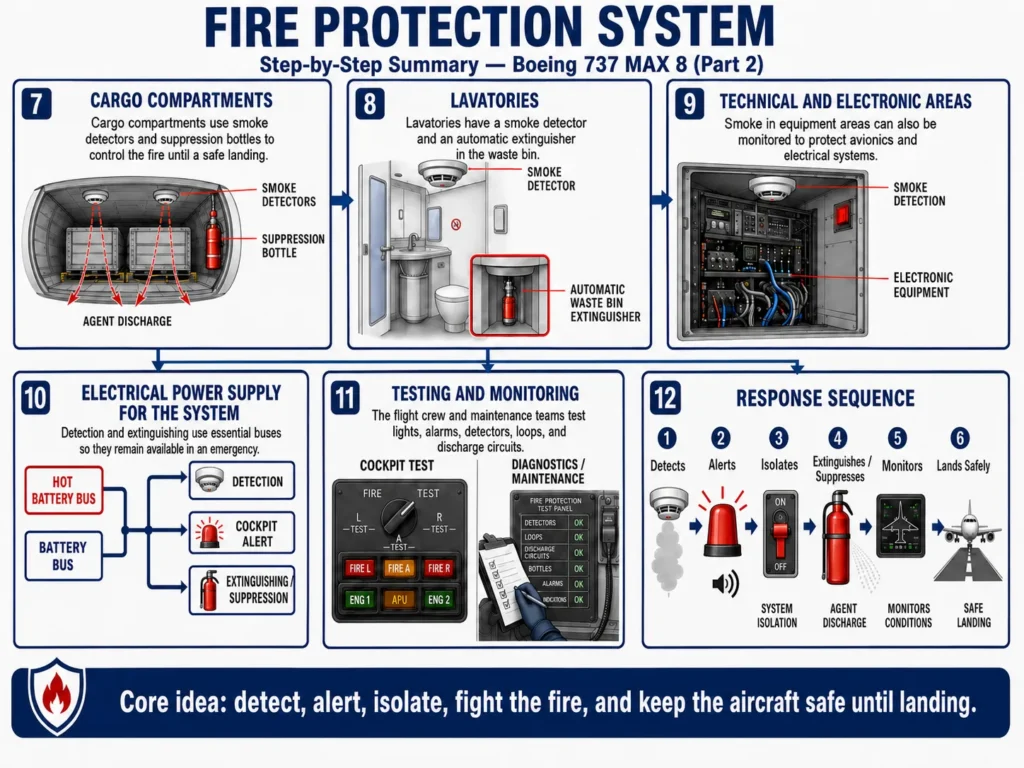
Cargo compartments are critical areas because they are outside the crew’s reach during flight. If smoke or fire occurs in a cargo hold, the pilots cannot physically access the area.
For this reason, these compartments use smoke detectors and fire suppression systems. The detectors may use photoelectric technology, identifying smoke particles in the air. In some architectures, the detectors use dual-loop logic, increasing detection reliability.
When smoke is detected in a cargo compartment, the flight crew receives an indication in the cockpit and follows the appropriate procedure. This procedure may include arming the system, discharging a suppression agent, and changing ventilation or pressurization settings to reduce the chance of smoke entering the cabin.
In cargo compartments, the more accurate term is often suppression, rather than simply extinguishing. This is because the system needs to control the fire long enough for the aircraft to land safely. In some configurations, there may be an initial discharge and, later, a second discharge to maintain the concentration of the suppression agent for a longer period.
Cargo suppression bottles may be installed in technical areas of the aircraft, such as areas near the air conditioning distribution system and the wheel well. They are connected by tubing to the forward and aft cargo compartments.
Depending on the aircraft configuration, there may be one or two bottles for the cargo compartments. The main difference is the protection time. A configuration with two bottles can maintain suppression for a longer period, which is important on certain routes.
The logic is to keep the situation under control until landing. The system reduces the fire’s ability to develop and helps prevent it from spreading. After landing, emergency and maintenance crews can access the compartment and handle the situation directly.
Lavatories have smoke detectors because they are enclosed areas where there may be a risk of smoke or fire, especially near the waste bin. A small heat source in a waste bin can develop into smoke and, in extreme cases, into fire.
The lavatory smoke detector monitors the air inside the compartment. If it detects smoke, it alerts the cabin crew and, depending on the configuration, may generate an additional indication. This allows for a quick response before the situation becomes more serious.
In addition to the detector, the lavatory waste bin may have a small automatic fire extinguisher activated by heat. This extinguisher is local and independent. It does not depend on a cockpit command. If the temperature inside the waste bin reaches a certain limit, the device operates automatically and discharges extinguishing agent directly into the waste bin.
This protection is important because the lavatory may be occupied or closed, and the cabin crew may not immediately notice an initial source of smoke without the detector.
In aircraft, smoke detectors can use different technologies. Older models could use ionization detection. In more modern configurations, photoelectric detectors have become common.
Photoelectric detectors identify smoke particles through a light beam or optical principle. When particles enter the detector chamber, they change the behavior of the light, and the system interprets this as smoke.
This type of detector is sensitive, reliable, and suitable for areas such as cargo compartments and lavatories. The choice of detector depends on the application, the environment, and certification requirements.
Modern commercial aircraft depend on many electronic and avionics components. This equipment needs ventilation and cooling. If smoke is present in technical areas, it may indicate an electrical fault, overheating, a short circuit, or a problem with a piece of equipment.
For this reason, some aircraft have smoke detection associated with the equipment cooling system. This protection is not directly related to an engine or to fuel, but rather to the integrity of the electronic systems and the aircraft’s technical environment.
This point is important for readers to understand that fire protection is not limited to visible flames. Often, the first sign of a problem is smoke, odor, excessive heat, or an overheat alert.
A fire protection system must be testable. The flight crew and maintenance personnel need to verify that lights, alerts, detectors, loops, and discharge circuits are working correctly.
In the cockpit, there are selectors or test buttons that simulate conditions to verify that the indications appear. This makes it possible to confirm that the system responds correctly before operation.
Maintenance personnel can also use diagnostic resources to identify faults in loops, sensors, or detection units. This capability is important because a fire protection system must be available when needed. It is not enough for the equipment to be installed; it must be functioning and monitored.
Fire protection must remain available even in abnormal situations. For this reason, certain components are powered by essential electrical buses, such as the battery bus or the hot battery bus, depending on their function.
The logic is to ensure that critical resources, such as detection and extinguishing, remain available even if part of the main electrical system is degraded. The ability to command the discharge of a fire extinguishing bottle, for example, must be preserved in emergency conditions.
Some devices, such as the automatic fire extinguisher in the lavatory waste bin, do not require electrical power. They are activated by heat and operate automatically.
It is essential to understand the difference between detection, extinguishing, and suppression.
Detection identifies the abnormal condition. It may involve fire, smoke, overheating, or a hot air leak.
Extinguishing is the discharge of an agent to fight the fire directly in a protected area, such as the engines or the APU.
Suppression is the control of combustion to prevent the fire from developing or spreading. This concept is widely used in cargo compartments, where the goal is to keep the fire under control until landing.
Not every area has all three functions. The wheel well, for example, has detection but no dedicated extinguishing system. The lavatory has smoke detection and automatic local extinguishing protection in the waste bin. Engines and the APU have detection and extinguishing. Cargo compartments have detection and suppression.
The fire protection system does not operate in isolation. It is connected to several other aircraft systems.
In the case of an engine fire, the fuel system, hydraulic system, pneumatic system, electrical system, thrust reverser, and cockpit indications may be affected.
In the case of smoke in a cargo compartment, the system may involve pressurization, air conditioning, recirculation, ventilation, communication with air traffic control, and diversion planning.
In the case of wing-body overheat, the problem may be related to the pneumatic system, bleed air ducts, anti-ice, or components near the wing and fuselage structure.
For this reason, the response to a fire or overheat alert always depends on specific procedures. The flight crew does not improvise; they follow approved checklists.
On the ground, fire protection remains essential. Engines, the APU, electrical equipment, and maintenance procedures can create specific risks.
The APU, for example, may be running during boarding or flight preparation. If an APU fire occurs on the ground, the system must provide an alert and allow a rapid response. In some configurations, there may be external controls or automatic discharge under specific conditions.
During maintenance, technical crews can also access compartments, check bottles, indicators, sensors, loops, and system connections.
In flight, the priority is to detect the condition quickly, alert the crew, and allow a safe response. If the alert is related to an engine, the crew follows the engine fire procedure. If it is smoke in a cargo compartment, they follow the cargo fire procedure. If it is wing-body overheat, they apply the corresponding procedure.
The response may involve system isolation, discharge of an extinguishing or suppression agent, communication with air traffic control, declaration of an emergency, diversion, and landing at the nearest suitable airport.
The goal is not only to eliminate the fire. The goal is to keep the aircraft controllable, protect passengers and crew, prevent the situation from spreading, and reach the ground safely.
Fire is one of the most critical situations in aviation. In an aircraft in flight, many areas are not easily accessible, and response time is essential. For this reason, the system must be reliable, fast, and clear.
For passengers, this system is usually invisible. But it is present in fundamental areas of the aircraft, monitoring engines, the APU, cargo compartments, lavatories, the wheel well, ducts, and technical areas.
It helps the crew identify the problem, isolate the affected area, discharge extinguishing agent when available, and make operational decisions based on defined procedures.
In a commercial aircraft such as the Boeing 737 MAX 8, the fire protection system combines sensors, detection loops, smoke detectors, electronic units, cockpit alerts, isolation controls, fire extinguishing bottles, squibs, tubing, discharge nozzles, and operating procedures.
It does not work the same way in every area of the aircraft. Engines and the APU have detection and extinguishing. Cargo compartments have detection and suppression. Lavatories have smoke detection and automatic local protection in the waste bin. The wheel well has detection but no dedicated extinguishing system. Wing-body overheat zones monitor overheating caused by possible hot air leaks.
The system’s main function is to detect quickly, alert clearly, allow the affected area to be isolated, and provide the means to control the situation until the aircraft is safe.
Note: this content is educational and introductory. It does not replace official manuals, Boeing technical documentation, FAA publications, certified training, airline procedures, or guidance from qualified professionals.