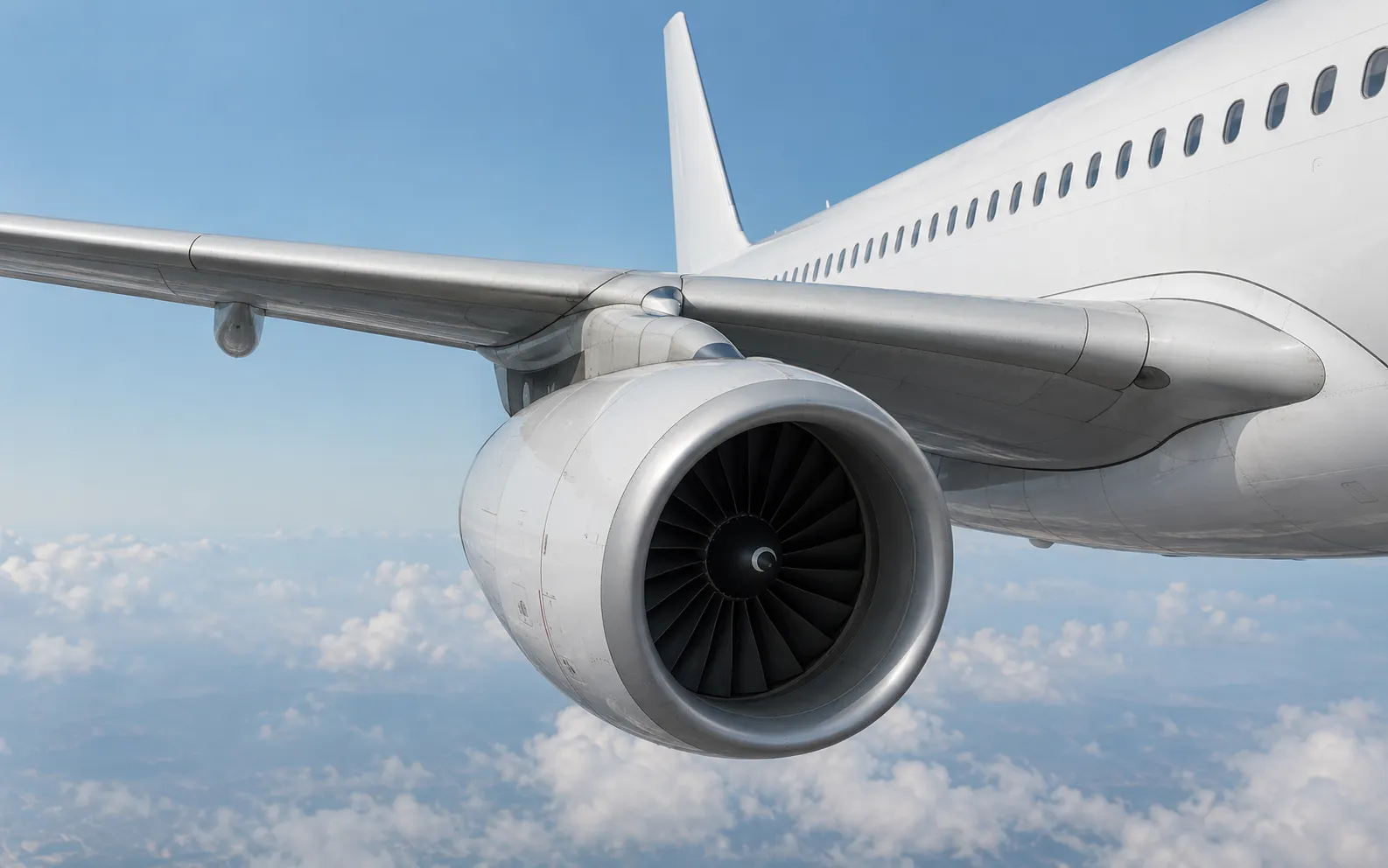
The idea of an engine failing in flight can sound frightening. When people look at a twin-engine commercial aircraft, it is natural to assume that both engines are what keep the airplane in the air. Technically, however, that is not how flight works. Engines are essential because they produce thrust, but the wings are what generate lift.
In flight, an aircraft is affected by four basic forces: lift, weight, thrust, and drag. Lift is produced mainly by the wings; weight acts downward; thrust is produced by the engines; and drag opposes the aircraft’s motion through the air. In stabilized flight, these forces are balanced according to the flight condition. An airplane is not “hanging” from its engines. It remains airborne because its wings are moving through the air and generating lift.
This is why the failure of one engine does not automatically make the aircraft fall out of the sky. What changes is the amount and distribution of available thrust. In a twin-engine aircraft, the remaining engine can continue producing thrust, allowing the airplane to keep moving forward. The situation still requires control, performance assessment, and proper crew procedures, but it does not mean an immediate loss of flight.
When only one engine is producing thrust, the aircraft experiences asymmetric thrust. In simple terms, one side of the airplane is still being pushed by the operating engine, while the other side is not receiving the same thrust. This creates a yawing tendency, meaning the nose of the airplane tends to turn toward one side. That is not the same as the airplane falling; it is a directional control issue that must be corrected.
The primary control used to correct this yaw is the rudder, the movable surface on the vertical stabilizer at the tail. The rudder helps keep the aircraft aligned and under directional control. Depending on the aircraft, the phase of flight, and the specific procedure, other flight control inputs and configuration changes may also be used.
In airline operations, flight crews are trained to identify the failure, stabilize the aircraft, confirm the situation, apply the appropriate procedure, and proceed toward the most suitable airport.
A key point is that commercial transport-category airplanes are certified with engine-failure scenarios in mind. Certification rules include performance and controllability requirements with the critical engine inoperative. For example, U.S. transport-category aircraft certification standards under 14 CFR Part 25 include one-engine-inoperative climb requirements and minimum control speed requirements when the critical engine fails.
This does not mean that every aircraft, under every condition, can always climb indefinitely on one engine. It means the aircraft must demonstrate required performance and controllability within the conditions and operating limits used for certification.
In short: an engine failure is a serious event, but in modern commercial aviation it is also a condition considered in aircraft design, certification, and crew training.
Whether the airplane can climb, maintain altitude, or needs to descend depends on several factors: aircraft weight, altitude, temperature, configuration, phase of flight, available performance, weather conditions, and operational procedures.
In some cases, the airplane may continue climbing; in others, it may maintain altitude; and in certain situations, it may need to descend to an altitude where single-engine performance is adequate. The crew’s decision is based on aircraft performance data and the applicable operating procedures.
It is also important to understand that an “engine failure” does not always mean an explosion, fire, or complete loss of the aircraft. It may involve a loss of power, abnormal indications, vibration, internal damage, or a precautionary engine shutdown. In any case, the crew’s first priority is to maintain aircraft control, then analyze the situation, and then choose the safest course of action.
So, why doesn’t an airplane fall when one engine fails? Because the wings continue to generate lift, the remaining engine can still provide thrust, the aircraft is designed and certified for engine-out scenarios within defined limits, and the flight crew is trained to manage asymmetric thrust and follow specific procedures.
Is it a serious situation? Yes. Does it require training, technical discipline, and careful decision-making? Absolutely. But it does not mean the aircraft will immediately fall from the sky. In modern commercial aviation, the failure of one engine is treated as a major abnormal or emergency condition, but it is also a condition considered in aircraft design, certification, and crew training.
Watch the short video: